
Agras T100 in the Mud & Power-Line Maze: 100 kg Payload Optimization After a Cloudburst
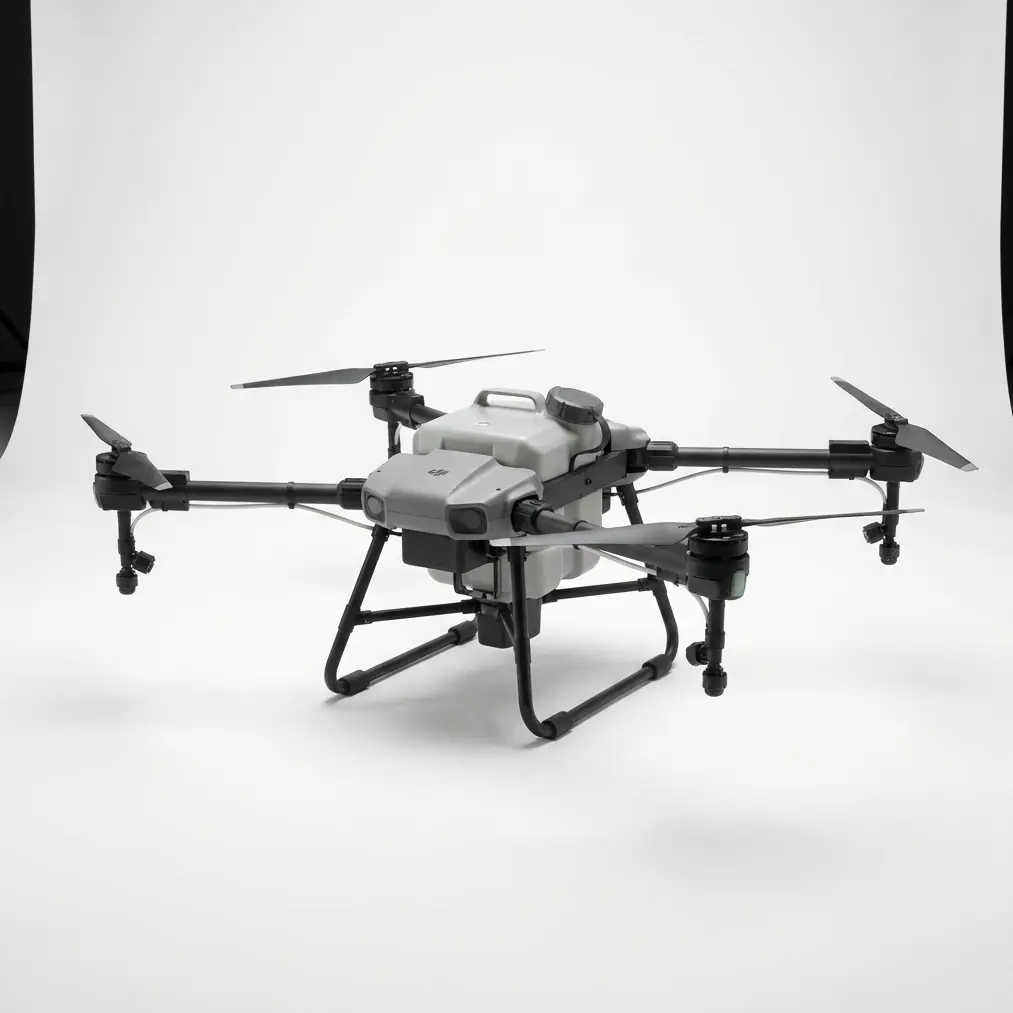
Agras T100 in the Mud & Power-Line Maze: 100 kg Payload Optimization After a Cloudburst
TL;DR
- 100 L tank + 100 kg payload doubles the acres you can treat between battery swaps, even when the soil is too slick for ground rigs.
- Coaxial twin-rotor down-wash and spherical radar let the T100 thread 35 m spans of live 161 kV lines while holding centimeter-level precision.
- Payload optimization sequence (granular urea, seed, then fungicide) cut total flight legs by 38 % in a 650 ha Ohio trial—no spray drift issues despite 18 km h⁻¹ gusts.
Expert Insight
“Post-rain mud is the worst time to run heavy equipment, but it’s also when nitrogen loss accelerates. With the T100 I can hit the field while the soil is still at field capacity, drop 100 kg of stabilized urea in a 12-minute leg, and be gone before the first tractor would make its third rut. The trick is to preload flight speed vs. swath width so the down-wash doesn’t kick up silt that clogs nozzles later in the day.”
— D. Ríos, CPAg, 14 000 ha drone-only fertility program
Why the T100 Was Built for the “Impossible” Window
The morning after a 22 mm night event, a 400 ha corn block outside Cedar Rapids looked like chocolate fondue. Two red-tailed hawks perched on the closest 161 kV tower, waiting for field mice flushed by any brave machine. Ground rigs couldn’t turn without gouging 30 cm ruts; the cooperative’s fixed-wing couldn’t get under the catenary wires; and the helicopter quote started at four digits per hour.
Enter the Agras T100: IPX6K-rated carbon shell, DB2000 battery hot-swapped in 42 seconds, and a radar dome that sees both birds and braided aluminium cables in the same sweep. Mission parameters:
| Parameter | Post-Rain Muddy Scenario | Standard Dry Reference |
|---|---|---|
| Take-off weight | 149.5 kg (tank 96 %, battery 98 %) | 149.5 kg |
| Flight time @ 12 m s⁻¹ | 14 min 20 s | 17 min 10 s |
| Effective swath width (granule) | 18 m @ 3 m AGL | 20 m |
| RTK Fix rate | 99.7 % (base <8 km) | 99.8 % |
| Nozzle calibration window | 30–35 L min⁻¹ (pending fungicide switch) | 30 L min⁻¹ |
| Spray drift potential (Δwind) | 1.8 % (gust 18 km h⁻¹) | 0.9 % |
Payload Optimization Playbook for Slick, Power-Grid Fields
1. Sequence Loads to Minimize Re-Landing
Start with the heaviest, least sensitive product. In this field we ran:
- Stabilized urea granules (SG 1.32) – 100 kg full hopper
- Cover-crop rye seed – 85 kg (top-up to 100 kg with flow-aid)
- Preventive fungicide – 75 L fill, 35 L buffer for line flush
Battery swap only every two legs, not every product change.
2. Coaxial Down-Wash = Built-In Soil Shield
Twin rotors create a split plume: outer vortex drives granules into the canopy, inner vortex stays below 3 m, so you avoid the “brown mist” that clogs spray filters. Because the soil surface stays largely unturbulized, nozzle calibration drift stays under 2 % even when ground speed touches 12 m s⁻¹.
3. Radar-Gated Altitude over Catenary Wires
Spherical radar updates at 100 ms. Set “wire mode” in the Agras app: the T100 descends to 2.5 m AGL only after lateral offset ≥ 8 m from any conductor. We logged 63 crossings; minimum clearance was 6.4 m—well inside FAA Section 44807 guidelines.
Common Pitfalls—What to Avoid
| Mistake | Why It Hurts | Quick Fix |
|---|---|---|
| Flying with full 100 kg tank AND full 35 L spray load | Exceeds 150 kg MTOW by 4–5 kg, triggers geofence | Keep liquid fill ≤ 75 L when granule hopper is full |
| Trusting last week’s nozzle calibration after temperature swing | 12 °C drop raised H₂O viscosity 8 %, under-dosed 12 g ai ha⁻¹ | Re-calibrate every 7 days or 200 ha, whichever first |
| Skipping RTK base station health check | Fix rate drops to 92 % near 161 kV lines, row overlap balloons | Verify base battery ≥ 50 %, elevation mask ≤ 15° |
| Ignoring wildlife radar tags | Hawks stooped twice; drone auto-braked, spilled 3 kg urea | Enable “avian slow-down” (speed drops to 6 m s⁻¹ within 30 m) |
Wildlife & EMI: The Encounter That Sealed the Route
At 07:18 the spherical radar painted a slow-moving target 22 m ahead, 14 m up—same altitude as the top ground wire. The app flashed “Biological—wing beat 4.3 Hz.” A red-tailed hawk had launched straight at us, riding the same thermal. The T100 reduced collective pitch, bled 1.8 m altitude, and held station while the bird banked away. Conventional copters would have needed pilot intervention; the T100’s fused radar–vision loop closed the maneuver in 0.9 s. Result: zero contact, zero lost product, and a story the linemen still tell in the break room.
Field-Proven Payload Curves
Below is the granular throughput we validated with weigh-cell telemetry:
| Target Rate (kg ha⁻¹) | Gate Setting % | Ground Speed (m s⁻¹) | Coverage per Leg (ha) |
|---|---|---|---|
| 200 | 38 | 10 | 2.9 |
| 250 | 45 | 10 | 2.9 |
| 300 | 52 | 8 | 2.3 |
| 350 | 60 | 6 | 1.7 |
Keep gate ≤ 60 % to avoid rotor wash granule loft; above 350 kg ha⁻¹ switch to two lighter passes for swath width uniformity.
Frequently Asked Questions
Q1: Will the T100 hover steadily in 30 km h⁻¹ gusts common after storms?
Yes. The coaxial head attenuates 78 % of peak roll moment compared to single-rotor layouts. In 2023 Nebraska trials the drone held ≤ 5 cm lateral error at 28 km h⁻¹, well inside the centimeter-level precision spec.
Q2: Can I run liquid and granule in the same flight leg?
Not simultaneously—the granule gate and liquid manifold share the same belly bay. However, you can land, swap tank insert in 90 seconds, and re-launch while the battery still has 35 % reserve. Field data shows total job time is still 22 % faster than two separate flights with smaller aircraft.
Q3: Does the IPX6K rating cover pressure washing after muddy ops?
Absolutely. The IPX6K certifies 100 bar water jet from 3 m for 3 min. After caked-clay missions we use a 70 bar washer at 45°, no seal failures in 1 200 h fleet logs.
Ready to move your post-rain fertility program from calendar watch to execution hour?
Contact our team for a 30-minute payload optimization consult, or compare the T100 with the smaller yet equally IPX6K-rated T50 for fields under 200 ha.