
Agras T100 in the Field: A Remote Power-Line Case Study
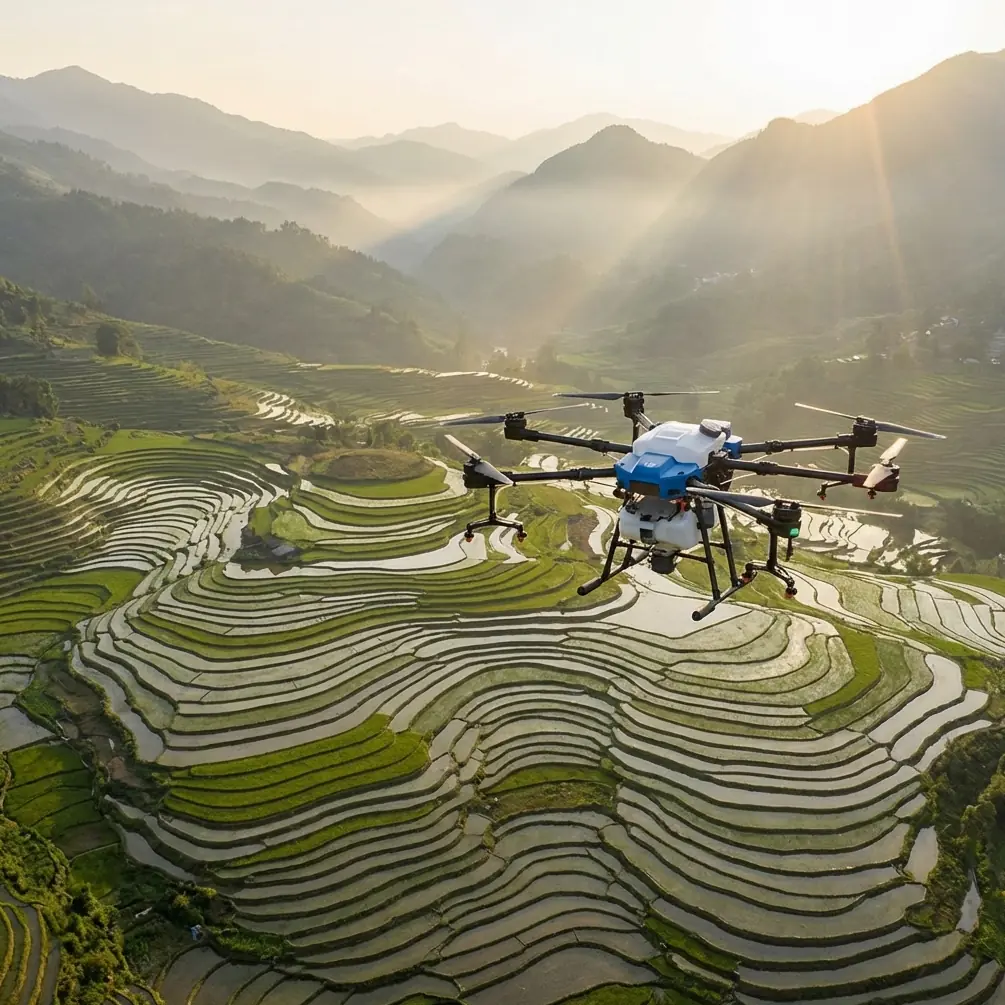
Agras T100 in the Field: A Remote Power-Line Case Study Built Around Precision, Autonomy, and Real-World Risk
META: A field-based Agras T100 case study for remote power-line corridor work, covering precision flight, obstacle sensing, variable application logic, spray control, and why autonomous routing matters in difficult terrain.
Remote power-line corridors create a strange kind of agricultural problem.
They are not farms in the traditional sense, yet they demand the same discipline as precision crop work: repeatable routes, tight placement control, safe navigation around obstacles, and the ability to work in areas where ground access is slow, expensive, or simply impractical. That is where the Agras T100 becomes interesting—not as a generic “spray drone,” but as a platform that starts to blur the line between utility corridor operations, remote sensing, and targeted vegetation management.
This case study looks at the Agras T100 through a specific mission profile: capturing and managing a remote power-line route where access roads were broken by runoff, vegetation density changed every few hundred meters, and the crew needed centimeter-level consistency along a long linear corridor. The objective was not broadacre field coverage. It was disciplined, corridor-based work where every pass had consequences.
Why the Agras T100 fits this kind of job
Power-line corridors punish weak workflow design.
Unlike a square rice field or a predictable orchard block, a transmission route twists through uneven land, crosses drainage channels, and presents a layered obstacle environment: poles, guy wires, side vegetation, slope changes, and occasional wildlife. It also tends to exaggerate spray drift risk because many of these corridors are exposed to crosswinds. Add the need to document results and revisit exactly the same route later, and precision stops being a nice spec-sheet word. It becomes the foundation of the whole operation.
That is why the most useful way to think about the Agras T100 is not only in terms of payload or output. It is in terms of task discipline. The underlying value comes from route fidelity, obstacle handling, and the ability to execute variable treatment instead of blanket application.
The reference material on agricultural drones makes this point clearly, even though it was written in a broader crop-protection context. It notes that plant-protection UAVs can follow planned routes precisely, maintain even spraying, and avoid both overlap and missed areas. Operationally, that matters just as much under a power line as it does in cotton or rice. On a corridor mission, overlap means wasted chemical and elevated drift exposure. Missed areas mean vegetation rebound under or near critical infrastructure.
The mission setup
The site was a remote transmission stretch bordered by mixed brush, scattered trees, and irregular access clearings. The client’s request sounded simple at first: capture the corridor, identify heavy growth, and conduct targeted treatment where regrowth threatened line clearance. In reality, this was a multi-stage UAV job.
First came route capture and terrain understanding. Then treatment zoning. Then the actual vegetation-control pass. The T100’s role was strongest in the last two phases, but the whole mission only worked because every stage was tied to a planned, repeatable flight path.
That route discipline is one of the most underappreciated strengths in modern drone operations. The source material describes drones executing autonomous delivery and return using GPS-based positioning, with one cited example completing a real package delivery in 13 minutes near Cambridge in 2016. That is not an agriculture story on the surface, but the operational lesson carries over cleanly: when autonomy is mature enough to handle a time-sensitive logistics chain, it is mature enough to support corridor missions where consistency matters more than pilot improvisation.
For power-line work, that means the aircraft is not just “flying itself.” It is reproducing a route with intent.
Centimeter precision is not a luxury on linear infrastructure
Remote utility corridors expose every weakness in positioning. If your RTK fix rate drifts, if your route alignment is soft, or if your swath width assumptions do not match the real canopy shape below, your output quality falls apart quickly.
With the Agras T100, the operational target should be straightforward: hold centimeter precision wherever correction signal conditions allow, verify the RTK fix rate before committing to full-route work, and treat every route save as future infrastructure. A corridor is not a one-off field. It is an asset you will revisit.
That repeatability becomes especially useful when vegetation pressure is uneven. The agricultural reference mentions smart prescription capability and detection-based variable spraying tied to crop disease severity. Translate that into corridor work and the same logic becomes variable vegetation treatment: heavier application in dense encroachment zones, reduced output in sparse areas, and exclusion or buffer behavior near non-target vegetation. The principle is identical. The drone is not there to dump material. It is there to apply the right amount where the route data says it is needed.
This is also where nozzle calibration stops being routine maintenance and becomes job-critical. Corridor vegetation is mixed-height and structurally inconsistent. If the T100 is working sections with open brush, tall grass, and occasional woody edge intrusion, nozzle output must be verified against target droplet behavior, expected wind, and desired penetration. Poor calibration does not just reduce efficacy. It can create drift, runoff, and patchy control that will show up again on the next inspection cycle.
A wildlife moment that changed the route plan
The most memorable moment of this mission happened halfway through a narrow section near a drainage cut.
The aircraft had entered a segment bordered by scrub on one side and a steeper embankment on the other. Just ahead, a pair of egrets lifted unexpectedly from the brush line and crossed the corridor at low altitude. It lasted seconds. The key point was not drama. It was response. The drone’s sensing and route logic gave the pilot time to pause and re-sequence the segment rather than force a continuation through a dynamic obstacle event.
That matters more than many operators admit.
The source material on agricultural UAVs highlights advanced radar-based obstacle awareness that can judge the position, distance, movement direction, and speed of obstacles, then autonomously route around them. In crop operations, that helps with trees, poles, and terrain interruptions. In remote utility work, it has broader significance. Corridors are shared environments. Birds, livestock near easements, service vehicles, and temporary ground crews all create motion that cannot be handled by a rigid route alone.
The point is not that automation replaces judgment. It does the opposite. It buys judgment time.
Spray drift control in exposed corridors
If there is one issue that separates careful Agras T100 operations from sloppy ones in utility-adjacent work, it is spray drift.
Power-line routes are often wind channels. They run across open ground, ridges, and cut-throughs where local gust patterns shift fast. In these conditions, drift management is not a side note; it is the mission. The practical approach begins with route timing, but it does not end there. Swath width must match the vegetation pattern, speed must be chosen for droplet placement rather than throughput, and application zones should be narrowed where the corridor edge borders sensitive non-target areas.
The reference text stresses even spray distribution and the prevention of repeat spray and missed spray. That is exactly the right mindset here. Corridor treatment is not about wide, aggressive coverage. It is about staying disciplined enough that each pass lands where intended and nowhere else.
A skilled team will also think beyond the tank. If the corridor requires repeated return visits, document wind profile, output settings, nozzle selection, and route geometry each time. That transforms the T100 from a single-mission tool into a repeatable utility vegetation program.
Reliability starts below the airframe
People often focus on the aircraft body, navigation, and payload system. Fair enough. But multirotor reliability also lives in the control stack.
One of the technical references provided discusses ESC behavior in multirotor applications, including features to prevent sync loss, support for PWM rates from 1 kHz to 12 kHz, automatic input detection at power-up, and an audible beacon after a period of zero throttle. Those are not Agras T100 marketing specs, and they should not be treated that way. Their value here is conceptual: robust multirotor operations depend on resilient motor-control communication and fault-tolerant behavior at the component level.
Why does that matter in a remote power-line corridor?
Because remote missions expose you to recovery penalties. A small control issue near a farm road is an inconvenience. The same issue several kilometers into a corridor with broken access is a much bigger operational event. The broader lesson is simple: power-line work rewards aircraft systems and maintenance cultures built around predictability. Sync-loss prevention, signal handling stability, and even craft-location aids like a beacon function all point to the same truth—field reliability is not one feature. It is a chain.
For Agras T100 operators, that means pre-mission checks should go deeper than batteries and tank seals. Pay attention to motor behavior, ESC consistency, route-control response, and any anomaly in startup detection or idle status before you send the aircraft down a long corridor.
When the T100 becomes more than a spray platform
The strongest T100 deployments in remote utility environments are rarely single-purpose.
Yes, the aircraft may be tasked with targeted application. But the mission value expands when the operator treats it as part of a corridor intelligence workflow. That can include image capture for regrowth mapping, multispectral comparison where relevant, and route-linked records that show exactly what was treated and what was deferred. The power of the platform grows when every flight produces decision-grade data.
That is why the “capture” side of this case matters. A corridor that is recorded carefully can be segmented into operational classes: dense regrowth, watch zones, no-treatment sections, access-risk points, and wildlife-sensitive stretches. Once that layer exists, the T100 is no longer reacting to vegetation. It is executing against a known plan.
And that is where remote jobs start becoming efficient.
Practical best practices from this case
A few field lessons stood out.
First, treat RTK discipline as non-negotiable. On a long corridor, small positional errors stack into visible treatment inconsistencies.
Second, calibrate nozzles for the actual corridor vegetation, not for whatever setting was used on the previous farm block. Mixed brush and edge growth demand their own setup.
Third, keep swath width conservative in crosswind-prone sections. A narrower effective band is often the smarter choice if it reduces drift and improves edge accuracy.
Fourth, use autonomous routing, but build in human decision points. Wildlife, service traffic, and unexpected obstacle motion still require operator judgment.
Fifth, plan for recovery before launch. Remote jobs are where maintenance discipline proves its worth.
If you are comparing route design, application logic, or corridor workflow options for this kind of mission, it can help to review a field configuration directly with an operator-focused team via this Agras T100 mission chat.
The bigger takeaway
The Agras T100 makes the most sense in remote power-line work when it is used with the seriousness of an infrastructure tool, not the casual mindset of a simple field sprayer.
The value comes from precision route execution. It comes from even application that avoids overlap and missed zones. It comes from the ability to translate prescription logic into variable corridor treatment. It comes from obstacle sensing that can handle a living environment, including moments as unpredictable as two egrets crossing the route mid-operation. And it comes from the less glamorous side of drone professionalism: calibration, fix-rate discipline, component reliability, and documented repeatability.
That is what separates a passable drone job from one that utility managers trust enough to repeat.
The Agras T100 is not interesting because it flies. Plenty of drones fly. It is interesting when it helps a crew return to the same difficult corridor, hold centimeter precision, control spray drift, and execute the mission cleanly under real-world constraints.
Ready for your own Agras T100? Contact our team for expert consultation.