
Agras T100 for Vineyards in Low Light: What Actually
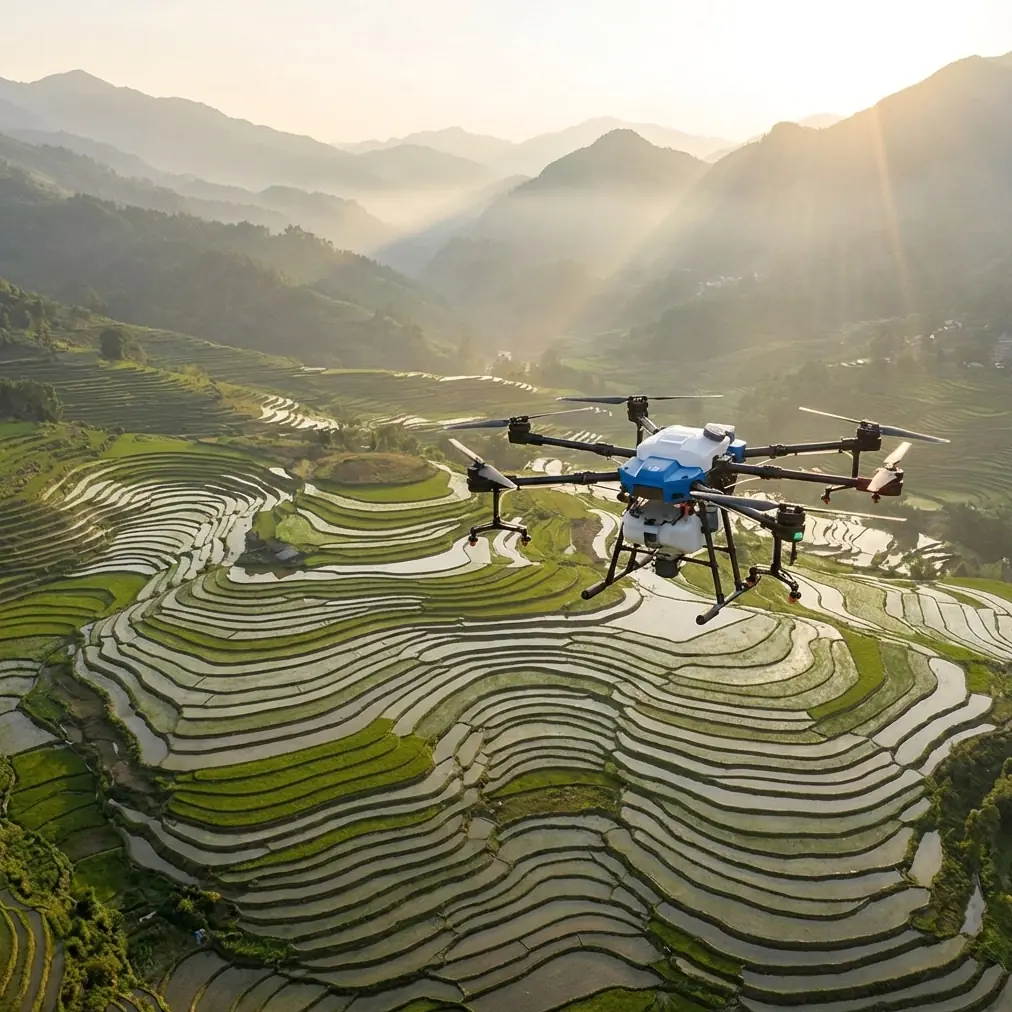
Agras T100 for Vineyards in Low Light: What Actually Matters in the Field
META: Expert analysis of how the Agras T100 can support low-light vineyard operations, with practical guidance on spray drift, nozzle calibration, RTK fix rate, swath width, IPX6K durability, and centimeter-precision flying.
Low-light work in vineyards is where spec sheets stop being useful.
Anyone can read payload figures or marketing claims. The harder question is whether a platform like the Agras T100 can deliver stable, precise, repeatable performance when the rows are tight, the terrain is uneven, the canopy is inconsistent, and the operation starts before sunrise or stretches into late dusk. That is the real test. In vineyards, especially during narrow spray windows, low-light conditions often create the exact combination that exposes weak navigation, poor calibration discipline, and sloppy mission planning.
The Agras T100 sits in an interesting position for that job. It is built as a high-output agricultural aircraft, but vineyards are not broadacre fields. They punish excess. A platform that performs well over open acreage can still struggle badly around trellis wires, changing slopes, irregular headlands, and patchy GNSS visibility near trees or valley walls. So the right way to evaluate the T100 for vineyard use is not to ask whether it is powerful. It is. The better question is whether that power can be controlled with enough finesse to protect crop, operator, and surrounding habitat when visibility drops.
That is where three issues decide outcomes: spray drift, navigation reliability, and sensing discipline.
The vineyard problem after sunset and before dawn
Low-light spraying is often attractive for sound agronomic reasons. Temperatures are lower. Wind can settle. Evaporation losses may be reduced. In some vineyards, operators also prefer these hours because daytime activity around workers, vehicles, and visitors is lower. But the same period introduces a different set of risks.
Visual cues become weaker. Row edges flatten into shadow. Terrain undulations are harder to judge from the ground. Even a skilled operator can lose confidence in obstacle distance when dark foliage blends into background hills. If the aircraft relies on poor route setup or inconsistent positioning, small errors grow fast. A few tens of centimeters off line may not matter in a cereal field. In a vineyard, that can mean clipping a post line, overspraying border vegetation, or leaving disease pressure untreated inside a dense canopy pocket.
This is where centimeter precision and RTK behavior stop being technical jargon and become operational necessities.
If the T100 is deployed with a strong RTK fix rate, row tracking consistency improves in a way vineyard managers immediately notice. Pass-to-pass alignment becomes more predictable. Boundary behavior tightens. Spot treatment becomes more defensible. In steep or segmented blocks, that matters because the aircraft is constantly translating digital intent into physical path corrections. A weak fix rate forces more interpolation, more uncertainty, and ultimately more reliance on operator judgment in conditions where the human eye already has less to work with.
A vineyard at dusk also tends to be full of false confidence. The air can feel calm at ground level while microcurrents still move above the canopy. That is why spray drift management is not optional when flying a powerful agricultural drone. The T100’s utility in vineyards depends heavily on how well nozzle calibration, droplet strategy, and swath width are matched to the block rather than copied from a broadacre template.
Why nozzle calibration is the real performance lever
Many operators obsess over aircraft size and tank capacity. In vineyards, nozzle calibration is usually the more consequential variable.
A badly calibrated setup can turn a capable drone into a very expensive way to waste chemistry. Too fine a droplet profile increases drift risk, especially when cool air begins draining downslope in the evening. Too coarse, and canopy penetration may suffer where bunch zones are shielded by dense foliage. The T100’s effectiveness is shaped less by raw delivery potential than by whether the spray system is tuned to vine architecture, travel speed, and desired coverage.
Swath width is part of that same equation. In open crops, pushing a wider swath can improve efficiency without major penalty. In vineyards, the practical swath often has to narrow to preserve deposition quality and avoid pushing material beyond the intended row. This is one of the most common mistakes I see in mission planning: operators inherit an efficient-looking coverage pattern that becomes agronomically inefficient because it assumes uniform crop geometry that vineyards simply do not have.
The T100 can be a strong platform here if the operator treats swath width as a biological setting, not just a productivity setting. The correct width is the one that gives repeatable coverage at the canopy target while keeping drift exposure low along row ends, access tracks, waterways, and habitat margins.
That distinction becomes even more important in low light because visibility cannot compensate for bad assumptions. If nozzle output and path spacing are wrong, the aircraft may complete the mission perfectly and still produce a poor agronomic result.
A wildlife moment that explains the sensing challenge
One evening case study stays with me. During a twilight mission near a vineyard edge bordered by scrub, a wallaby broke cover and crossed between rows as the aircraft approached a turn point. The drone’s sensing suite responded quickly enough to avoid the animal and hold control continuity rather than forcing a chaotic manual correction. That incident was brief. Operationally, it was significant.
Why? Because low-light agricultural missions do not happen in sterile environments. Vineyards sit beside shelterbelts, drainage lines, and semi-wild margins. Birds rise suddenly. Deer can move through blocks. Domestic animals may appear near service roads. A drone used in these settings needs sensor performance that remains useful when contrast is weak and the operator’s eyes are doing less of the work.
The lesson is not that automation replaces field awareness. It does not. The lesson is that sensor-assisted navigation becomes materially more valuable in low light because response time matters more and visual redundancy matters less. On the T100, that kind of sensing support should be viewed as part of risk control, not merely convenience.
Weather resistance matters more than brochures admit
Low-light vineyard work often overlaps with damp conditions. Early morning dew, residual moisture on leaves, and occasional mist are common. That is why an agricultural drone’s environmental protection rating deserves attention. An IPX6K-class design signals that the machine is built for aggressive washdown and resistance to demanding wet-field conditions, and that matters for two reasons.
First, vineyards are chemically unforgiving environments. Spray residue accumulates. If the airframe is awkward to clean or vulnerable to repeated wash cycles, long-term reliability suffers. Second, missions often do not happen in perfectly dry, laboratory-like windows. A drone that tolerates moisture exposure better gives operators more confidence to work when the agronomic timing is right rather than waiting for ideal optics and perfect dryness that may never arrive during disease pressure periods.
For the T100, an IPX6K-level durability profile is not just a box-tick. It supports the practical routine that vineyard operations require: spray, clean thoroughly, inspect, redeploy. Over a season, that translates into less hesitation about using the aircraft in real field conditions and more confidence in maintenance hygiene.
The role of multispectral thinking, even when the mission is spraying
The T100 is usually discussed as an application platform, but vineyard managers should think beyond the spray event itself. Multispectral intelligence, whether gathered by another platform or integrated into broader farm workflows, can sharpen how the T100 is deployed. Low-light conditions are not ideal for every type of imaging, but the strategic value lies in combining precise application capability with better zone identification.
This is especially relevant in vineyards where vigor variability can shift quickly across slope, soil depth, drainage, and clone differences. A block may look uniform from the access road and perform very differently row to row. Multispectral maps can identify stress signatures, canopy inconsistencies, or developing disease pressure zones that then inform where the T100 is used for targeted treatment rather than blanket application.
Operationally, that matters because a high-capacity aircraft becomes more useful when it is not asked to treat every square meter equally. Precision begins before takeoff. The more accurately a manager defines the treatment area, the more effectively the T100’s pathing, swath design, and nozzle setup can be tuned to the biological problem rather than the convenience of a full-block mission.
What good T100 vineyard practice looks like in low light
When the T100 is used well in vineyards, the workflow is disciplined.
The operator confirms RTK health before treating centimeter precision as real rather than theoretical. That means watching fix stability, not merely assuming that the presence of RTK hardware guarantees row-level confidence. If signal quality is compromised by terrain or obstructions, the plan changes. That is professionalism, not caution for its own sake.
Next comes nozzle calibration specific to the block. Not last week’s orchard setting. Not a generalized profile from a neighboring property. The actual block. Row spacing, canopy density, target zone, temperature trend, and expected airflow all influence whether the chosen droplets and output are defensible.
Then swath width is set conservatively enough to preserve deposit quality. In vineyards, overstretching width often looks efficient on paper and underperforms in tissue coverage. I would rather see an operator accept a slightly longer mission than introduce drift and inconsistency that requires retreatment later.
Finally, low-light safety means assuming the environment is more dynamic than it appears. That includes wildlife, workers arriving early, utility vehicles, irrigation equipment, and terrain illusions caused by shadow. Good teams brief these factors before launch instead of improvising around them in the air.
If you are trying to build that kind of vineyard-specific workflow, this is the sort of field conversation worth having directly: message the operations team here.
Where the T100 genuinely fits and where it does not
The Agras T100 makes the most sense for vineyards that need repeatable, high-precision application under tight timing windows and are prepared to manage the aircraft as part of an agronomic system rather than as a standalone gadget. It is well suited to operations where centimeter precision, careful drift control, and robust cleaning matter every week, not just during a demo.
It is less well suited to operators who want to shortcut setup discipline. A drone with serious application capability magnifies both competence and error. If RTK performance is ignored, if nozzle calibration is treated casually, or if low-light sensing is overtrusted without site awareness, the machine’s strengths become irrelevant. Vineyards are too unforgiving for lazy deployment.
That is the core judgment. The T100 is not especially interesting because it is large or advanced. It is interesting because, in a vineyard, it can combine power with enough precision to make low-light operations viable when many ground and aerial alternatives become awkward or inconsistent. But that only happens when the operator respects the agronomic details: drift behavior, swath discipline, row geometry, fix reliability, and environmental uncertainty.
The expert takeaway
For vineyard managers weighing the Agras T100, the smartest question is not “Can it fly this block?” The smarter question is “Can it hold line, protect boundaries, and place spray accurately enough in low light to justify its use?”
If the answer includes a reliable RTK fix rate, true centimeter precision in row-following, block-specific nozzle calibration, restrained swath width, and a maintenance routine that takes advantage of IPX6K-grade washdown resilience, then the T100 becomes a serious vineyard tool rather than an oversized field drone adapted by hope.
And in low light, hope is never a strategy. Systems are.
Ready for your own Agras T100? Contact our team for expert consultation.