
Agras T100 for Coastline Work: What Actually Matters
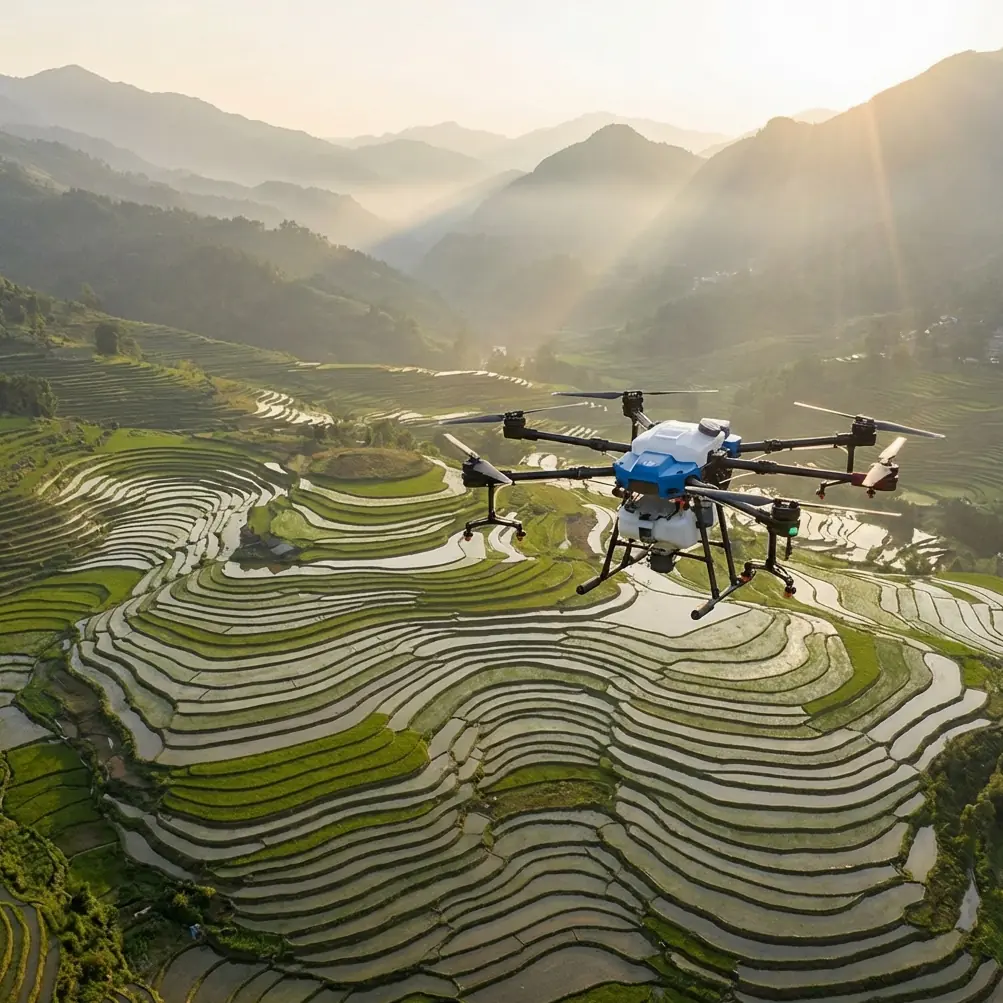
Agras T100 for Coastline Work: What Actually Matters in Complex Terrain
META: A field-focused look at how Agras T100 operations near coastlines benefit from photogrammetry discipline, clean pre-flight routines, and data workflows built around DEM, DOM, and DLG outputs.
Coastal work looks simple from a distance. It rarely is.
A shoreline can shift from open flats to steep embankments in minutes. Wind comes across water differently than it does across inland fields. Salt hangs in the air, moisture lingers on equipment, and terrain breaks the assumptions that work well on uniform farmland. When operators talk about using an Agras T100 in these environments, the real question is not just whether the aircraft can fly the mission. The question is whether the workflow around it is disciplined enough to produce repeatable results.
That is where older UAV photogrammetry practice becomes surprisingly relevant.
A 2015 technical paper on UAV aerial photogrammetry described a maturing phase in China’s low-altitude survey ecosystem. One detail stands out: from 2009 onward, national and provincial mapping agencies were deploying UAV systems such as the UAVRS-10B, carrying a 5 kg payload with about 1.5 hours of endurance, often paired with a Canon 5D Mark II for large-scale base mapping. Those numbers matter because they remind us how much early survey success depended on careful mission planning, not brute force. Even with modest payloads by current standards, teams were already building reliable mapping outputs by respecting process.
That lesson transfers directly to the Agras T100 when the job involves coastlines in complex terrain.
The real problem with coastal delivery and treatment routes
Operators tend to focus on wind first, and they should. Spray drift is a serious concern near water, especially where crosswinds accelerate along ridgelines or seawalls. But drift is only one layer of the problem.
The harder issue is that coastal terrain disrupts consistency. Swath width can change in practical terms when height above target varies across a broken surface. RTK fix rate becomes more than a nice specification because centimeter precision starts affecting how cleanly you can hold route geometry around irregular edges. If you are moving along a coastline with abrupt elevation changes, marsh transitions, utility corridors, or terraced access paths, the aircraft is not just following a line. It is constantly negotiating a three-dimensional margin for error.
That margin grows if your pre-flight routine is casual.
Salt residue, fine sand, and damp film on sensors or surfaces can quietly degrade performance long before a mission fails outright. On aircraft used around coastlines, a pre-flight cleaning step is not housekeeping. It is a safety procedure. Before power-up, I want operators checking and cleaning vision-related surfaces, exposed connectors, landing gear contact areas, and spray-system-adjacent components if the aircraft has been working in corrosive air. If the airframe or critical exterior surfaces carry an IPX6K-type protection rating, that helps with harsh-environment resilience, but it does not eliminate the need for cleaning. Protection ratings are a buffer, not permission to ignore contamination.
The same logic applies to nozzle calibration. In a controlled inland block, a slightly imperfect setup may still produce acceptable visual results. Near a coastline, where gust behavior changes fast and buffer zones matter, poor calibration amplifies drift risk and coverage inconsistency. If you are asking an Agras T100 to deliver repeatable output in this setting, calibration is part of navigation quality, not a separate maintenance chore.
Why an old photogrammetry workflow still matters to T100 users
The most useful insight from the reference material is not tied to one specific aircraft model. It is the data logic behind UAV operations.
The paper outlines a production chain for DEM, DLG, and DOM outputs, then describes using field-measured data to test the accuracy of DLG and DOM results. Operationally, that is a big deal.
- DEM gives you terrain shape.
- DOM gives you corrected image context.
- DLG gives you structured vectorized features.
For coastline missions, these are not abstract mapping terms. They are how you convert a difficult environment into a manageable plan.
A DEM is what lets you stop thinking of the route as flat. In complex terrain, that means more reliable altitude management and better consistency when maintaining target-relative flight behavior. A DOM gives the team a current visual base layer that reveals shoreline breaks, vegetation lines, service tracks, drainage cuts, and access obstacles. DLG adds structure by extracting meaningful boundaries and features that can be referenced in route planning and reporting.
If you are running an Agras T100 near coastal infrastructure, reclamation edges, aquaculture zones, embankments, or fragmented agricultural strips near the sea, a terrain-aware pre-plan is often the difference between a smooth mission and a series of reactive corrections.
This is where the article’s software details are also telling. The workflow referenced full-digital photogrammetry processing in PixelGrid, then stereoscopic model restoration in Virtuozo to interpret imagery and collect terrain and feature elements according to mapping standards. Even if today’s teams use different software stacks, the principle remains unchanged: raw flight data becomes operationally useful only after structured processing and interpretation.
That matters for T100 operators because a lot of mission mistakes start before takeoff. They happen when people assume visual familiarity is enough. On coastlines, it usually is not.
A practical coastline workflow for the Agras T100
If I were advising a team preparing an Agras T100 for repeated coastal work, I would build the process around five control points.
1. Clean first, then inspect
This should happen before route review.
Remove salt film, fine dust, and moisture residue from the airframe exterior, sensing surfaces, and any exposed areas relevant to obstacle awareness or system integrity. Pay close attention after previous operations in sea air. Safety features cannot perform at their best if the surfaces they rely on are dirty or partially obscured. This is the unglamorous step that prevents small environmental effects from becoming flight issues.
2. Confirm RTK behavior before you trust route precision
A coastline with broken terrain punishes vague positioning. If your RTK fix rate is unstable, route fidelity degrades right where precision matters most: edges, turns, setback zones, and transitions in elevation. For operators who expect centimeter precision, the benchmark is not what the system can do on paper. It is what the aircraft is actually holding on that site, that day, under those atmospheric and terrain conditions.
3. Build the mission from terrain data, not from memory
This is where the DEM-DOM-DLG mindset shines.
A DEM-informed plan helps maintain more consistent geometry over slopes and embankments. A DOM provides a corrected current visual reference. A DLG-style layer gives crisp feature boundaries for route shaping. The article’s emphasis on testing DLG and DOM accuracy with field-measured data is especially useful here. If a coastline is changing, or if there are man-made alterations such as drainage work or access road cuts, validate what matters on the ground rather than assuming the image base is enough.
4. Calibrate spray hardware with local wind behavior in mind
Nozzle calibration is not a box-tick. It directly affects droplet behavior, coverage pattern, and the probability of drift. On coastlines, where gusts can shift sharply along water edges and terrain breaks, operators need tighter discipline. Practical swath width may need to be treated conservatively, especially in corridors where drift into water or non-target areas is unacceptable.
5. Keep the payload mission secondary to the site logic
This sounds obvious, but it is often ignored. Teams fall in love with throughput metrics and forget that the site determines the safe operating envelope. The reference paper was built around engineering application, data processing, and output verification. That sequence is worth copying. First understand the site. Then define the data. Then execute the mission.
What the historical numbers reveal about modern expectations
That older UAVRS-10B reference is worth revisiting. A 5 kg payload and 1.5-hour endurance do not sound exceptional today. Yet those systems were already being used to support large-scale mapping tasks because operators matched aircraft capability to disciplined workflow.
For Agras T100 users, the takeaway is sharp: advanced hardware alone does not solve coastline complexity. Better sensors, stronger automation, improved environmental sealing, and smarter route control all help. But the operational edge still comes from process quality.
This also frames the role of multispectral data in a sensible way. It can add value for vegetation differentiation, stress detection, and zone-specific planning near coastal agriculture or managed greenbelts. But it should not be treated as a shortcut. If the base terrain model is weak, if field validation is skipped, or if route geometry is built on stale assumptions, extra spectral layers will not fix the foundation.
The coastline problem-solution in plain terms
The problem is not simply that coastal terrain is difficult. The problem is that it creates stacked uncertainty:
- wind behaves unpredictably
- target elevation changes quickly
- moisture and salt affect equipment condition
- route edges often matter more than route center
- environmental sensitivity raises the cost of drift or misplacement
The solution is to operate the Agras T100 less like a generic field machine and more like a precision platform inside a survey-grade workflow.
That means using terrain products intelligently. It means checking the real-world accuracy of your planning layers. It means treating cleaning and calibration as mission-critical. And it means validating that your positioning stack is delivering the RTK performance required by the site, not the performance you hope it is delivering.
Where many teams lose efficiency
Most inefficiency in these missions does not come from the aircraft spending extra minutes in the air. It comes from rework.
A poorly built route creates gaps. Weak cleaning discipline leads to degraded sensor confidence or avoidable maintenance interruptions. Inadequate calibration forces conservative operation later. Lack of current DOM or terrain understanding pushes the pilot into manual judgment calls that should have been solved in planning.
The photogrammetry reference is useful because it emphasizes a full chain: collect, process, model, verify, apply. That is exactly how coastal T100 work should be approached if the goal is reliable output rather than one-off improvisation.
If your team is trying to refine that workflow for shoreline projects, site-specific route planning, or coastal treatment operations, you can share your use case directly here: message Marcus Rodriguez on WhatsApp.
The bottom line for Agras T100 coastline operations
Agras T100 deployment in complex coastal terrain is not won by raw specs. It is won by operational discipline.
The old survey literature proves an enduring point. Back in the period when Chinese UAV mapping programs were expanding, teams were already producing usable outputs through structured processing pipelines for DEM, DOM, and DLG, backed by field accuracy checks. That mindset still solves modern problems. On a coast, where terrain and environment constantly work against consistency, it may be more valuable than ever.
So if you are planning T100 missions along shoreline corridors, embankments, coastal agriculture, or uneven marine-adjacent terrain, start with the workflow. Clean the aircraft before every mission as if safety features depend on it, because they do. Verify your RTK conditions instead of assuming them. Use terrain-informed planning. Calibrate for real wind, not average wind. Validate outputs against the ground.
That is how you make a capable aircraft perform like a dependable one.
Ready for your own Agras T100? Contact our team for expert consultation.