
Agras T100 Best Practices for Complex-Site Deliveries
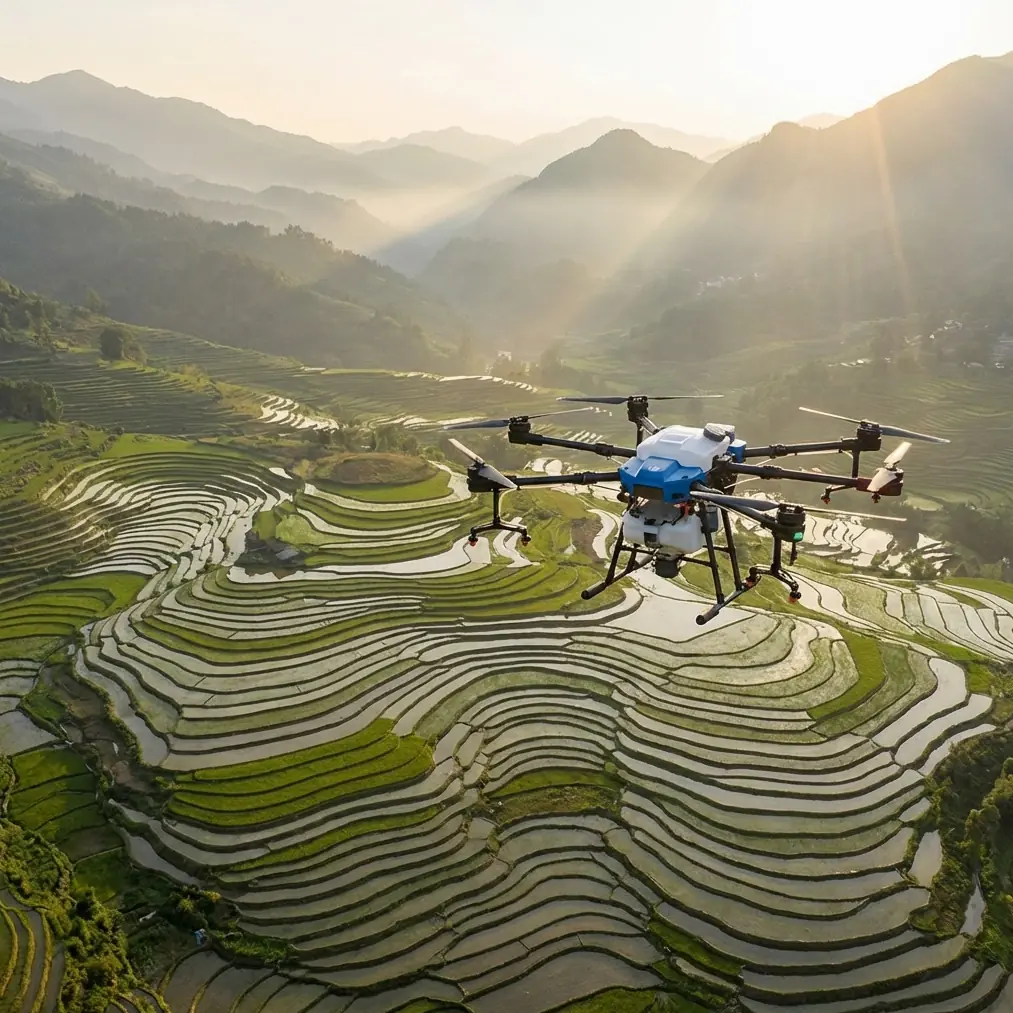
Agras T100 Best Practices for Complex-Site Deliveries: Flight Logic, Pre-Flight Cleaning, and Control Discipline
META: A practical Agras T100 guide for complex terrain operations, covering pre-flight cleaning, control-input behavior, circular and spiral flight logic, and safer delivery workflows.
Construction-site delivery looks simple on paper: load, launch, fly, drop, return. On real terrain, it rarely behaves that cleanly. Elevation changes, partial obstructions, tight staging areas, dust, and unpredictable approach angles all punish sloppy setup. That is why the most useful way to think about the Agras T100 is not as a generic drone platform, but as a precision aircraft whose behavior is shaped by what the operator asks it to do through control inputs, flight programming, and pre-flight discipline.
The most overlooked starting point is not the route. It is cleaning.
A careful pre-flight cleaning step matters because the aircraft’s safety features only work as intended when sensors, moving parts, and external surfaces are not compromised by site debris. On construction sites, dust cakes onto landing gear joints, fine particulate settles around exposed surfaces, and splash contamination can reduce confidence during takeoff and landing checks. If your T100 is expected to hold stable in a constrained zone, maintain predictable response, and support repeatable delivery cycles, then pre-flight cleaning is not cosmetic. It is operational risk control.
Wipe down the aircraft before power-up. Clear residue from the landing interface, payload contact areas, and any surfaces that can affect inspection visibility. If you are working in muddy or dusty conditions, pay extra attention to areas where grime can hide small cracks, looseness, or interference. This is especially relevant when a workflow depends on reliable positioning and steady hover behavior in complex terrain. A dirty aircraft can conceal problems you should have caught on the ground.
That may sound basic. It is not. Good delivery performance starts before the motors spin.
Why flight-input logic matters more than most operators think
One of the most useful reference points for understanding T100 behavior comes from a training framework that breaks drone motion down into four control parameters: roll, pitch, throttle, and yaw. In the source material, changing only two of the first three parameters—roll, pitch, or throttle—while keeping the others at zero causes the aircraft to fly in a straight line. The examples given are specific: it can move toward the left-front in a straight path, or climb diagonally upward in a straight path.
That is not just a classroom exercise. It maps directly to construction-site delivery work.
If you need to send the aircraft from a staging zone to a partially elevated drop point along a clean approach corridor, straight-line behavior is your friend. It means that when your control mix is disciplined, the aircraft response becomes easier to predict and easier to repeat. On sites with scaffolding, sloped access roads, or stacked materials, repeatability beats improvisation every time.
The same reference also points out something operators should not ignore: if you change throttle and yaw together, the aircraft performs a vertical straight ascent or descent while rotating. Operationally, that is useful in very limited cases, such as reorienting the aircraft during a controlled vertical reposition. But on a busy site, it can also create unnecessary complexity if used carelessly near obstacles or visual distractions. Rotation during climb or descent changes the pilot’s visual relationship with the aircraft and can make the movement look less stable than it actually is.
Then comes the detail that matters most for terrain-constrained routing. When roll or pitch is combined with yaw, the aircraft traces a circular path in the air. That single point explains a lot of what pilots experience when the aircraft seems to “arc” instead of tracking directly to a target. It also tells you how circular motion can be used deliberately.
The hidden value of circular and spiral motion on difficult sites
Many delivery operators think only in straight segments. On open farmland, that is often enough. On a construction project built across uneven ground, a circular or spiral profile can be more practical.
The source material explicitly asks the learner to explore what determines the radius of a drone’s circular trajectory. That question has direct field value. If the aircraft enters circular motion because yaw is being mixed with roll or pitch, then the circle’s radius becomes a planning issue, not just a curiosity. A wide-radius turn may be harmless over an open laydown yard. The same turn becomes a hazard if it pushes the T100 over temporary structures, parked equipment, or an exposed edge.
This is where operator discipline pays off. If you know that certain input combinations produce a circular path, you stop treating off-track motion as “drone personality” and start treating it as controllable geometry.
The training reference goes one step further. It describes a program in which a keypress can trigger diagonal straight flight, another can trigger spiral ascent, the space bar commands landing, and another directional key initiates takeoff; when no key is pressed, the drone hovers. That matters because it frames flight behavior as a set of defined states rather than a stream of improvisation. For delivery work, that mindset is gold.
A T100 operating over complex terrain should be managed through clearly defined motion states:
- takeoff and stabilized hover
- straight translation
- controlled ascent or descent
- intentional turning behavior
- approach
- landing or release sequence
- hover fallback when no valid movement command is active
That final point deserves emphasis. Hover is not dead time. Hover is the default safety state. The training logic explicitly treats no-input as hover, and that is exactly how a careful delivery workflow should be built. When the route becomes uncertain, visibility degrades, or a landing area changes unexpectedly, the aircraft should transition into a stable pause rather than into half-committed motion.
How this applies to Agras T100 delivery planning
The Agras T100 conversation often gets pulled toward platform capability, but capability without motion discipline does not solve complex-site logistics. What does help is a route plan built around how the aircraft actually behaves.
Start with your approach corridor. If you want a clean, efficient run into a drop zone, design for straight-line translation whenever possible. The reference finding that two-parameter changes among roll, pitch, and throttle produce straight-line flight gives a simple operator lesson: simplify the command stack. Do not layer unnecessary turning inputs into an already constrained approach.
Next, identify where circular or spiral motion might be useful rather than problematic. Spiral ascent, for example, can help when climbing within a confined horizontal footprint while maintaining visual orientation around a terrain feature. But it requires enough clearance, because spiral profiles consume lateral space. On a cliff-adjacent road project or a stepped excavation, that lateral demand can be either helpful or dangerous depending on where you initiate it.
Then evaluate drop-point geometry. If the receiving zone sits above or below the launch point, diagonal straight-line movement may be more efficient than climbing vertically first and translating second. The training example of a drone flying diagonally upward in a straight line is a good reminder that altitude gain and horizontal progress do not always need to be separated into different phases.
This matters for battery efficiency, but even more for exposure time. The fewer unnecessary transitions you make over an obstacle-rich site, the fewer opportunities you create for confusion, drift, or reorientation errors.
Pre-flight cleaning as a safety workflow, not housekeeping
Let’s return to cleaning, because it deserves a place in every T100 delivery checklist.
On construction sites, debris accumulates fast. Dust can make visual inspections less reliable. Caked mud or residue can mask wear around structural connection points. Grit near moving interfaces can interfere with smooth operation or hide developing faults. If you are relying on high-precision routing, steady hover, and consistent landing behavior, the aircraft needs to be inspected in a clean state.
A practical pre-flight cleaning sequence looks like this:
Clean before inspection, not after.
If you inspect a dirty aircraft, you are inspecting dirt as much as hardware.Pay attention to landing and payload-contact areas.
These zones see repeated ground interaction and are the first to show contamination from site conditions.Clear surfaces that affect visibility during checks.
You want to see cracks, looseness, and residue patterns clearly before launch.Confirm no debris remains in areas that could influence movement or interfere with deployment steps.
A minor obstruction can become a major distraction during takeoff.Only then move into power-on checks, control checks, and route confirmation.
This is also the right moment to review environmental conditions linked to spray drift, nozzle calibration, RTK fix rate, multispectral payload logic, swath width, centimeter precision, and IPX6K-style durability expectations if your T100 fleet crosses between agricultural and site logistics work. Even when the mission is delivery rather than spraying, that broader systems mindset helps. The point is not to force farm terminology onto a construction site. The point is that disciplined operators think in terms of contamination control, precision reliability, and environment-specific readiness.
A simple control philosophy for difficult terrain
If I were writing an internal SOP for Agras T100 deliveries on rugged sites, I would reduce the control philosophy to five rules.
1. Straight beats clever
When the route is available, use straight-line segments. The reference clearly shows that controlled combinations of roll, pitch, and throttle can produce direct linear travel. That predictability lowers pilot workload.
2. Do not mix yaw casually
Yaw is not harmless decoration. Combined with throttle, it creates vertical motion with rotation. Combined with roll or pitch, it creates circular motion. Both can be useful. Both can also widen your risk footprint.
3. Hover is the safest pause state
The source program treats no keypress as hover. That is exactly how a delivery pilot should think under uncertainty. If the site changes, stop translating and stabilize.
4. Test circular radius before you need it
The training material asks what factors determine the radius of a circular trajectory. On a real site, you should not discover that answer near a crane, retaining wall, or scaffold edge. Practice and validate turning behavior in open space first.
5. Clean first, then trust your checks
A dirty aircraft produces dirty decision-making. Pre-flight cleaning supports better inspection quality and more reliable mission readiness.
When training logic becomes operational advantage
There is a tendency in the drone sector to separate “education” from “real work.” That is a mistake. Some of the most practical field knowledge starts in stripped-down control experiments. The reference material’s exercises—changing two parameters, then three, observing straight lines, circles, spiral climbs, and hover states—are not abstract. They teach the grammar of motion.
For Agras T100 operators handling deliveries in complex terrain, that grammar becomes operational advantage.
You understand why the aircraft arcs instead of tracking direct.
You understand when diagonal ascent is efficient.
You understand why an idle control state should mean hover, not confusion.
You understand that route design is really movement design.
And if your team needs a second set of eyes on route logic, cleaning workflow, or mission setup for difficult terrain, you can message a T100 operations consultant here.
The bigger takeaway for Agras T100 users
The smartest T100 delivery workflows are usually the least theatrical. They do not rely on constant correction. They reduce unnecessary inputs, respect how yaw changes the shape of the flight path, and treat cleaning as part of airworthiness, not presentation.
The source references gave us two very different kinds of insight. One came from a training document that explains how combinations of roll, pitch, throttle, and yaw produce straight, circular, and spiral motion. The other described aircraft design thinking from a different DJI platform family, including an 8-rotor configuration and details like retractable landing gear, vibration reduction, and structural design for professional aerial work. Even though that second material is not about the T100 itself, it reinforces a familiar lesson: serious aircraft operations depend on disciplined mechanical readiness and predictable flight behavior, not on improvisation.
That is the lens worth using for the Agras T100 on complex construction sites. Clean the aircraft. Simplify the motion. Use circular and spiral behavior intentionally, not accidentally. Build your route around what the controls actually produce in the air.
That is how deliveries become repeatable.
Ready for your own Agras T100? Contact our team for expert consultation.