
Agras T100 in Low-Light Field Delivery: What Calibration
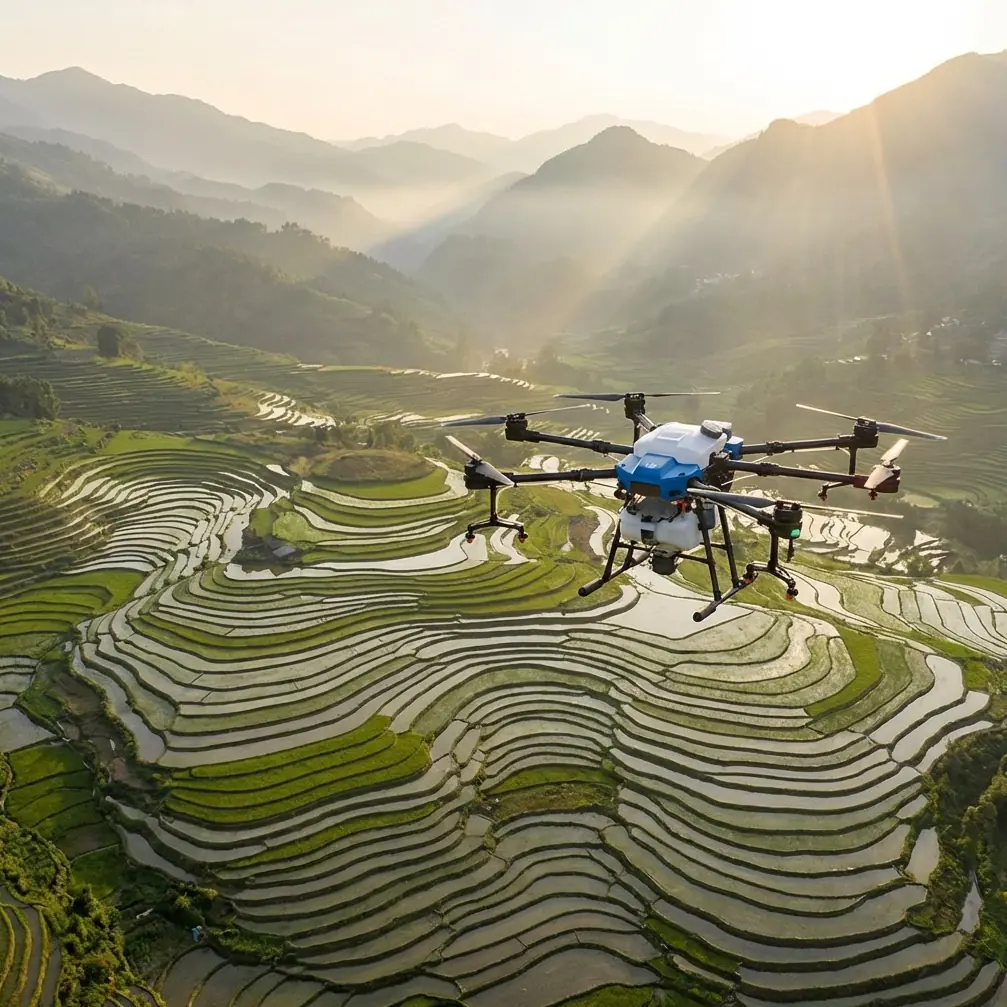
Agras T100 in Low-Light Field Delivery: What Calibration Discipline Really Changes
META: A technical review of Agras T100 low-light field delivery operations, with practical insight on altitude, compass interference thresholds, synchronized routing logic, and why setup discipline matters for accuracy and drift control.
Low-light operations expose every weakness in an agricultural drone workflow. Daytime can hide sloppy setup. Dusk does not. When the field edge fades, landmarks flatten, and visual cues start to disappear, the quality of the mission depends less on operator intuition and more on the machine’s positioning logic, calibration discipline, and flight profile.
That is exactly where an Agras T100 conversation becomes interesting.
Most commentary around large agricultural UAVs stays broad: payload, acreage per hour, automation, maybe RTK. Useful, but incomplete. For a reader focused on delivering fields in low light, the real question is narrower: what operational habits preserve placement accuracy and reduce avoidable risk when visibility drops? The reference materials point to two underappreciated answers. First, synchronized movement and waypoint discipline matter more than many operators realize. Second, magnetic and power-system calibration quality directly shapes stability in hover, return-to-home behavior, and autonomous path confidence.
Those are not abstract engineering details. They affect real field outcomes such as spray drift exposure, swath consistency, and whether a mission feels controlled or uneasy after sunset.
Why low light changes the T100 workflow
An Agras T100 working near dusk is not simply the same aircraft flying in a darker environment. The sensory burden shifts. Human sight becomes less reliable, so the operation leans harder on onboard positioning, route execution, and repeatability. That is why low-light delivery work should be treated as a system problem rather than a piloting problem.
In practical terms, three things become more sensitive:
- route precision at the start of each pass
- altitude consistency over crop and terrain
- heading stability during automated segments and return actions
Even small errors can stack. A slight heading deviation widens overlap on one swath, narrows it on the next, and increases the chance of uneven deposition. If the mission involves liquid application rather than pure transport, those deviations also influence spray drift and nozzle performance. If the mission is granular spreading or field delivery, they still affect placement, boundary compliance, and turnaround efficiency.
This is why I would not begin with speed. I would begin with positioning integrity.
The hidden lesson from synchronized dual-drone routing
One of the source documents is not about Agras at all. It describes a Tello educational environment, including synchronized commands, numbered aircraft, visual identification using LED or character display, and repeated “fly to challenge card” sequences with coordinate values and timed waits between actions. At first glance, it seems far removed from a professional farm platform.
It is not.
The operational significance is the idea of structured synchronization. In the excerpt, aircraft are assigned identifiers such as “Tello number 1” and “Tello number 2,” then sent to target points with explicit x, y, z coordinates and controlled waiting intervals between synchronized commands. That pattern captures something fundamental to real agricultural UAV work: if multiple motion events are not sequenced carefully, repeatability collapses.
For an Agras T100 operator in low light, this translates into a simple rule. Every mission segment should have deterministic structure:
- clear aircraft identity and configuration state before takeoff
- known detection or positioning mode before entering the field
- repeatable altitude and speed logic through each work lane
- deliberate pause or confirmation between critical transitions
The educational example repeatedly references altitude values like 120 cm in target movement logic and inserts synchronized wait times between command blocks. No one is suggesting a T100 should work a field at 120 cm. The value matters because it shows altitude is not incidental in programmed movement. It is a fixed parameter that must be chosen on purpose and held consistently.
That is the right mindset for the T100.
My preferred low-light altitude strategy for the Agras T100
For low-light field delivery, I favor an altitude strategy that is slightly more conservative than what some operators use in broad daylight. Not dramatically higher, just disciplined. The objective is to keep the aircraft comfortably clear of crop variation and unexpected micro-obstacles while preserving deposition control and lane confidence.
Why this balance matters:
- Too low, and the aircraft becomes more vulnerable to crop-top undulation, rotor wash interaction, and abrupt perception errors near uneven canopies.
- Too high, and the application footprint becomes harder to control, drift risk rises, and swath edges soften.
For spray work, that means your optimal flight altitude should be selected in direct relationship to nozzle calibration, droplet class, wind behavior near the canopy, and intended swath width. In low light, I generally advise treating altitude stability as a precision variable, not just a clearance setting. The T100’s value is not merely that it can automate passes, but that it can hold those passes with repeatability when your own visual depth judgment is less dependable.
If the field is uneven, I would rather see a carefully verified, slightly buffered height with tight route confidence than an aggressive low pass that looks efficient on paper and becomes unstable at dusk.
This is also where centimeter precision and RTK fix rate stop being brochure language. If your positioning solution is solid and your route holds tightly, you can maintain a consistent relation to the crop surface and preserve cleaner swath geometry. If it is not, you will compensate manually, and manual compensation is exactly what degrades first in poor light.
Compass calibration is not a ritual; it is a predictor
The second reference document is much more directly relevant to field reliability. It covers compass calibration in a PX/APM environment and includes a current-interference test. Several details stand out.
During the process, if the power module or current sensor is enabled, the system displays “measuring compass vs CURRENT.” The operator is instructed to listen for the ESC unlock tone, then slowly advance throttle to 50%–75% over 5–10 seconds, allow the props to spin, and quickly reduce to zero before pressing Finish. The purpose is not to make the aircraft fly. It is to measure how much magnetic interference increases when the power system is under load.
That matters enormously to an Agras T100-style workflow, even if the exact software stack differs.
Agricultural platforms draw significant electrical load. Pumps, motors, power wiring, and payload systems all create an electromagnetic environment that can distort compass readings if the installation or calibration quality is poor. In full daylight, a mild heading inconsistency may look like a nuisance. In low light, where pilots rely more heavily on autonomous stability and less on visual cross-checking, the same inconsistency can degrade track alignment, hover confidence, and return path predictability.
The source also gives one of the most useful thresholds in the entire dataset: an interference reading below 30% is considered acceptable, 31% to 60% is a gray zone, and above 60% calls for corrective action such as moving the controller away from interference sources or using an external compass solution. That is not just a workshop note. It is an operational decision boundary.
If I were preparing an Agras T100 for low-light work, I would treat those thresholds as a mindset template:
- under 30%: proceed with confidence after normal checks
- 31% to 60%: expect variability; validate autonomous behavior conservatively
- above 60%: do not trust the setup for precision field work until the interference source is addressed
This directly affects return-to-home behavior, autonomous lane holding, and any route segment where the aircraft must maintain heading while the operator’s visual cues are degraded.
Why this changes spray drift and swath quality
A lot of people separate navigation setup from application quality. In practice, they are connected.
If the drone’s heading oscillates because of magnetic interference, the aircraft can yaw slightly during passes or transitions. That may not sound serious, but it changes how the spray pattern or spread pattern presents to the field. On long rows, repeated micro-corrections alter overlap. On headlands, the turn geometry becomes less clean. Combined with low-light hesitation, the result can be inconsistent swath width and higher drift sensitivity.
This is why nozzle calibration and navigation integrity should be reviewed together. A perfectly calibrated nozzle set does not rescue an unstable route. Likewise, flawless positioning cannot compensate for poor droplet selection or uneven flow. The T100 performs best when those systems are treated as one application chain.
If your operation includes variable crop vigor mapping through multispectral data collected separately, the point becomes even more practical. Prescription intent only matters if the aircraft can place material where the map expects it to go. Poor heading discipline quietly erodes that promise.
The value of explicit setup states before dusk
The Tello reference also mentions setting serial identifiers and using visual indicators to distinguish aircraft. Again, this may seem like a teaching feature, but the deeper point is excellent: every aircraft in a workflow should have an unambiguous identity and a known state before launch.
For single-T100 operations, that means:
- verify the mission loaded is the correct field and treatment block
- confirm the positioning mode and RTK status
- validate nozzle or spreader setup against the actual task
- confirm obstacle and terrain assumptions match current field conditions
- check lighting, visibility, and expected return path before the first takeoff
For multi-aircraft teams, the principle becomes critical. In low light, confusion over which aircraft is assigned to which block or which machine completed which calibration check can create preventable errors. What looks like “administration” is actually flight safety and agronomic quality control.
Don’t ignore environmental durability, but don’t overrate it either
Readers often ask whether weather protection ratings such as IPX6K change the low-light equation. They help, especially when moisture, residue, or washdown discipline are part of routine agricultural use. But environmental durability does not solve the core precision problems discussed here. A rugged airframe is valuable. A rugged airframe with poor heading confidence at dusk is still a compromised platform.
The order of importance should be:
- positioning integrity
- calibration quality
- altitude discipline
- application hardware setup
- environmental resilience
That hierarchy tends to produce better field outcomes than focusing first on toughness or speed claims.
A practical pre-mission framework for Agras T100 low-light work
If I were briefing a professional operator preparing for evening field delivery, I would use a checklist logic rooted in the reference facts:
1) Verify route repeatability
The synchronized Tello examples repeatedly insert wait intervals between movement commands. That is a reminder to avoid rushed transitions. On the T100, confirm route segments, turn behavior, and completion logic before entering a narrow visibility window.
2) Set altitude deliberately
The educational material’s repeated use of explicit z values reinforces the point that altitude is a commanded variable, not a guess. For low light, choose a height that protects against canopy variation while preserving drift control and pattern quality.
3) Check current-related compass interference
The PX calibration procedure’s 5–10 second throttle ramp to 50%–75% under load is valuable because it reveals interference that static checks miss. If your platform or diagnostic process supports an equivalent test, use it before trusting automated flight near dusk.
4) Interpret interference thresholds realistically
The under-30% / 31–60% / above-60% logic is one of the clearest go/no-go frameworks available. Low-light field work is not the place to rationalize gray-zone data.
5) Link navigation quality to application quality
Spray drift, swath width, and nozzle calibration are not isolated topics. Route stability determines whether those settings produce the intended agronomic result.
Final thought for serious operators
The Agras T100 belongs in a conversation about field productivity, but low-light performance is not primarily about productivity. It is about whether the aircraft remains trustworthy when the human operator loses visual margin.
The most useful lesson from the source materials is surprisingly old-fashioned: precision comes from discipline. Explicit coordinates. Defined wait states. Known aircraft identity. Measured compass interference under load. A threshold that tells you when “acceptable” stops being acceptable.
That is the foundation I would trust at dusk.
If you are comparing field setups or want a second opinion on low-light mission planning, this direct Agras T100 discussion channel is a sensible place to continue the technical conversation.
Ready for your own Agras T100? Contact our team for expert consultation.