
Agras T100 Guide for Power-Line Delivery in Extreme
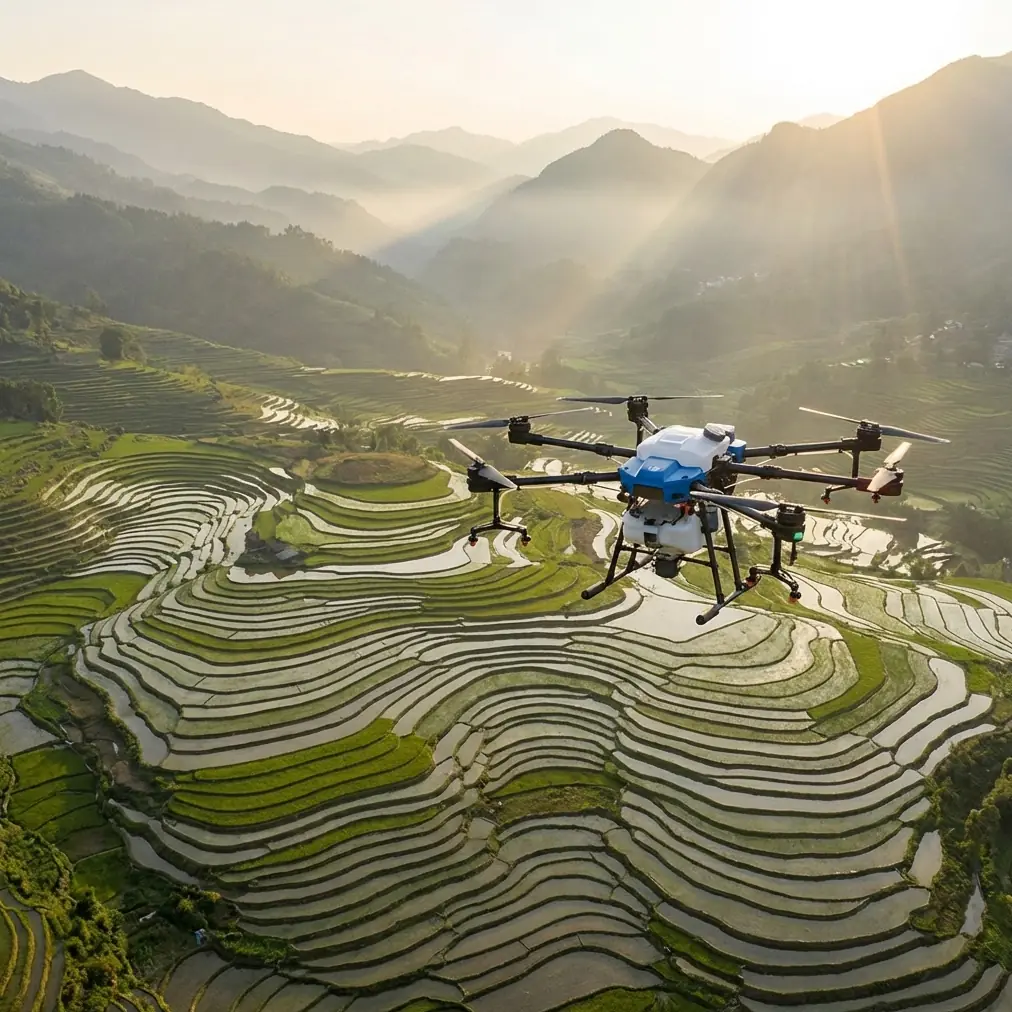
Agras T100 Guide for Power-Line Delivery in Extreme Temperatures: What Precision Training Really Looks Like
META: A practical expert tutorial on using the Agras T100 for power-line delivery in harsh temperatures, with lessons drawn from maze-based drone training, control discipline, RTK precision, nozzle calibration logic, and obstacle response.
When people hear Agras T100, they usually think of agricultural throughput: swath width, tank capacity, spray drift control, and field efficiency. That framing is too narrow for one of the more interesting civilian applications now taking shape: carrying lightweight line payloads for power-line stringing support in punishing weather, where positional discipline matters more than raw speed.
I approach this as both a training problem and an operations design problem. If a drone is expected to place or carry line accurately near infrastructure in heat, cold, wind shear, and cluttered terrain, the real question is not whether it can fly. The question is whether the crew can make it behave predictably when the margin for drift is small and the environment keeps changing.
That is why an unusual reference point matters here: a maze-training format from an educational DJI drone manual, and a classic aerobatic control principle from model aircraft instruction. Neither was written for utility logistics. Both are deeply relevant to the Agras T100 when the mission is controlled line delivery.
Why a maze exercise belongs in a power-line workflow
One source describes a competition maze built from 60 cm by 60 cm grid cells. The beginner course is 4 x 3 cells, with overall dimensions of 180 cm x 240 cm x 120 cm. The advanced course expands to 5 x 5 cells, or 300 cm x 300 cm x 120 cm. It includes a start point, hidden task points, wall no-fly zones, and an exit. The task is not just to move through the maze. The aircraft must first explore, identify hidden points, and then compute the shortest path out.
That sounds far removed from power-line work until you look at the operational logic.
A line-delivery mission near poles, conductors, insulators, vegetation edges, and temporary staging equipment is effectively a three-dimensional maze. The drone may have a nominal route, but the useful path often depends on what it detects in real time: crosswind, thermal uplift over rock, temporary obstructions, birds, or a crew shift in ground position. The “hidden task point” in a training maze is the civilian equivalent of an operational unknown. You do not train only for the route you planned. You train for the route you discover.
This is where the Agras T100’s value needs to be understood properly. The platform’s precision features are only half the story. The crew’s ability to work in constrained geometry is the other half. A pilot who has been trained to think in measured cells, exclusion zones, and shortest-path corrections will deliver better outcomes than a pilot who has only practiced broad open-area flight.
For power-line delivery, I recommend a T100 training progression modeled on that same logic:
Cell-based corridor drills
Build a short training lane marked in 60 cm increments. This creates a visual discipline similar to the maze reference. Even if the actual corridor in the field is larger, the fine-grained spacing forces the pilot and visual observer to think in precise tolerances rather than vague directional movement.Hidden waypoint scenarios
Insert an unannounced route adjustment mid-flight. That mimics the source material’s hidden task point and teaches the crew to re-plan cleanly instead of over-correcting.Wall no-go simulations
Define vertical exclusion surfaces around poles, mock hardware, or flagged boundaries. In utility-adjacent work, “do not enter” volumes are more useful than simple point markers.Shortest-safe-path decision making
Do not reward only successful arrival. Reward efficient, stable, low-correction navigation. This matters in extreme temperatures, where wasted motion translates into battery stress and less reserve.
The operational significance is direct: training in a 3 m by 3 m-style constrained space, as reflected by the advanced 300 cm x 300 cm maze concept, sharpens the pilot’s ability to maintain safe separation and clean transitions near utility structures.
Extreme temperatures expose every weakness in control technique
Harsh temperatures do not merely affect batteries. They magnify bad habits.
In heat, crews tend to rush. In cold, they tend to over-control after delayed perception of aircraft response. Both are dangerous around line payloads. One of the best insights from the second reference comes from a completely different flying discipline: aerobatic training. It describes how to establish a rough 45° descending line by simply holding input until the aircraft passes the apex, then pausing briefly before rolling. The lesson is not the maneuver itself. The lesson is sequencing.
The source emphasizes two specific ideas:
- to create the descending line, hold the control through the top until it goes past the apex, rather than trying to force perfect geometry too early;
- before the half-roll, pause briefly at neutral so the aircraft rotates around an already established flight path, instead of wandering off-axis.
For Agras T100 utility delivery, that is gold.
Pilots carrying line or positioning a messenger rope often spoil the final segment by stacking inputs: yaw, pitch, lateral correction, then another yaw correction. The result is a wandering approach, swinging load dynamics, and inconsistent release positioning. The aerobatic lesson argues for a cleaner method:
- establish the line of travel first;
- neutralize briefly;
- then execute the orientation change or final alignment.
That tiny pause matters. It creates a moment where the aircraft is flying with the path instead of fighting it. When operating near power infrastructure, especially in gusty cold air or heat-generated convection, that can be the difference between a stable final approach and a cascading correction cycle.
I teach T100 crews a simplified version of this principle: path first, attitude second. If the aircraft is not already on the intended line, changing its heading or trying to finesse the payload is usually premature.
RTK precision is useful, but pilot geometry still decides the mission
Many discussions around the Agras T100 lean heavily on centimeter precision and RTK fix rate, as they should. In line delivery, consistent RTK lock is a major asset because it supports repeatable route corridors, cleaner handoff points, and stronger confidence when crews are working in visually deceptive terrain. Snow glare, low winter sun, and shimmer over hot ground can all distort human judgment. Centimeter-scale positional stability helps anchor the operation.
But RTK does not replace geometric discipline.
The maze reference gives us a practical reminder. A route through a constrained grid is not solved by knowing where the drone is. It is solved by understanding where it should not go, what must be found on the way, and how to leave efficiently after completing the task. That is exactly the logic of infrastructure delivery. A high RTK fix rate improves your coordinate confidence. It does not make a poor approach pattern safe.
If your T100 workflow includes repeated delivery runs, use RTK logs to review:
- where lateral corrections begin,
- whether drift consistently appears at one segment,
- whether crews crowd exclusion boundaries near structures,
- and whether the same handoff point could be reached with fewer control events.
That review process often reveals something obvious in hindsight: the problem was not the aircraft’s precision. It was the crew’s route architecture.
What nozzle calibration and spray drift teach us about line placement
At first glance, nozzle calibration and spray drift belong to agriculture, not power-line logistics. Yet the underlying discipline carries over beautifully.
A well-run spray mission depends on controlling output consistency, motion, height, and environmental influence. If calibration is sloppy, the field result drifts off target. If environmental conditions are ignored, material ends up where it should not. Replace droplets with a suspended line or a lightweight delivery payload, and the same systems thinking applies.
For T100 crews, the agricultural mindset provides three useful habits:
Measure before trusting
In spraying, nozzle calibration verifies what the machine is actually doing. In line delivery, the equivalent is confirming payload behavior, attachment balance, and swing tendency before the field run.Respect environmental transport
Spray drift is a warning about lateral movement caused by air. A suspended line in crosswind behaves differently, but the lesson is identical: what leaves the aircraft does not remain where you imagined it in still air.Think in swath width, not just track lines
Agricultural operators understand that the aircraft’s effect zone extends beyond the centerline. For utility delivery, the “effect zone” includes payload swing, prop wash influence, and safe clearance margins around hardware and vegetation.
This is one reason I advise crews not to treat delivery runs as point-to-point errands. They are influence-field operations. The aircraft, payload, air movement, and terrain all interact. Good T100 work comes from planning around that interaction.
A field scenario: wildlife, sensors, and why restraint matters
On one mountain-adjacent route assessment, a crew encountered a hawk rising off a slope near the intended transit corridor. This was not dramatic. That is exactly why it deserves mention. The aircraft’s sensing stack detected the conflict envelope early enough for the pilot to hold position and re-route laterally instead of pushing through.
That kind of event tests whether the crew has internalized the maze mentality. A hidden task point is one thing. A live, moving obstacle is another. The right response is not heroics. It is structured adaptation: stop, reassess corridor geometry, maintain separation, resume only when the route is clean.
For civilian utility operations, this is more than compliance. It protects wildlife, avoids abrupt control inputs, and preserves payload stability. In extreme temperatures, where battery planning is already tight, a calm reroute is often safer than an aggressive acceleration meant to “clear the area quickly.”
Building a practical Agras T100 tutorial workflow for power-line delivery
Here is the framework I recommend for crews using the T100 in this role.
1. Pre-mission geometry check
Before launch, map the route in segments rather than as a single line. Mark exclusion volumes around structures and identify one or two contingency holds. If possible, create a corridor model inspired by the maze concept: entry, unknowns, no-go surfaces, exit.
2. Environmental assessment
Extreme heat and cold affect aircraft behavior differently, but both demand conservative assumptions. Evaluate gust structure, localized terrain effects, and any thermal plumes. In utility corridors, the route is rarely as uniform as it looks from the ground.
3. Payload behavior validation
Do a short hover and low-speed translation check. Watch for oscillation, yaw bias, or delayed settling. This is your “calibration” phase, conceptually similar to nozzle verification in a spray workflow.
4. RTK and positioning discipline
Do not just confirm that RTK is available. Confirm that the fix is stable where the route becomes constrained. Precision matters most where the tolerances shrink.
5. Path-first control execution
Borrowing from the aerobatic reference, establish the travel line, then neutralize briefly before the final alignment change. That short pause often cleans up the entire approach.
6. Hidden-point training after every mission
After routine operations, create one training replay question for the crew: where was the hidden task point today? A wind pocket? A visual illusion? A wildlife movement? A cluttered handoff zone? This keeps the team learning from real flights rather than from abstract theory.
Why this approach fits the Agras T100 specifically
The Agras T100 is often evaluated through feature lists. That is useful but incomplete. In demanding utility support work, the stronger measure is whether the platform can be integrated into a disciplined operating method that accounts for precision, environmental disturbance, route constraints, and sensor-led adaptation.
That is where the combination of these reference ideas becomes surprisingly powerful.
From the educational maze source, we take the discipline of cell-based navigation, hidden objectives, no-go walls, and shortest-path planning. The numbers are not trivial. A training environment built around 60 cm units develops the kind of close-quarters judgment that translates well to infrastructure-adjacent flying.
From the aerobatic instruction source, we take the discipline of sequencing controls cleanly, especially the value of the brief pause at neutral before the next action. That single habit reduces over-correction and helps the aircraft remain on-axis during critical transitions.
Put together, they form a serious tutorial philosophy for T100 crews handling power-line delivery in difficult temperatures: train small, fly clean, and let precision serve judgment rather than replace it.
If your team is designing procedures for this kind of mission and wants a practical discussion around route setup, payload behavior, or corridor training, you can continue the conversation here via direct operations chat.
The headline point is simple. Agras T100 performance in extreme utility environments is not only about hardware toughness, IP-rated survivability, or centimeter precision. It is about whether the crew can convert those strengths into deliberate movement inside a constrained, changing three-dimensional workspace. That is what separates a capable aircraft from a reliable operation.
Ready for your own Agras T100? Contact our team for expert consultation.