
Agras T100 for High-Altitude Venue Deliveries
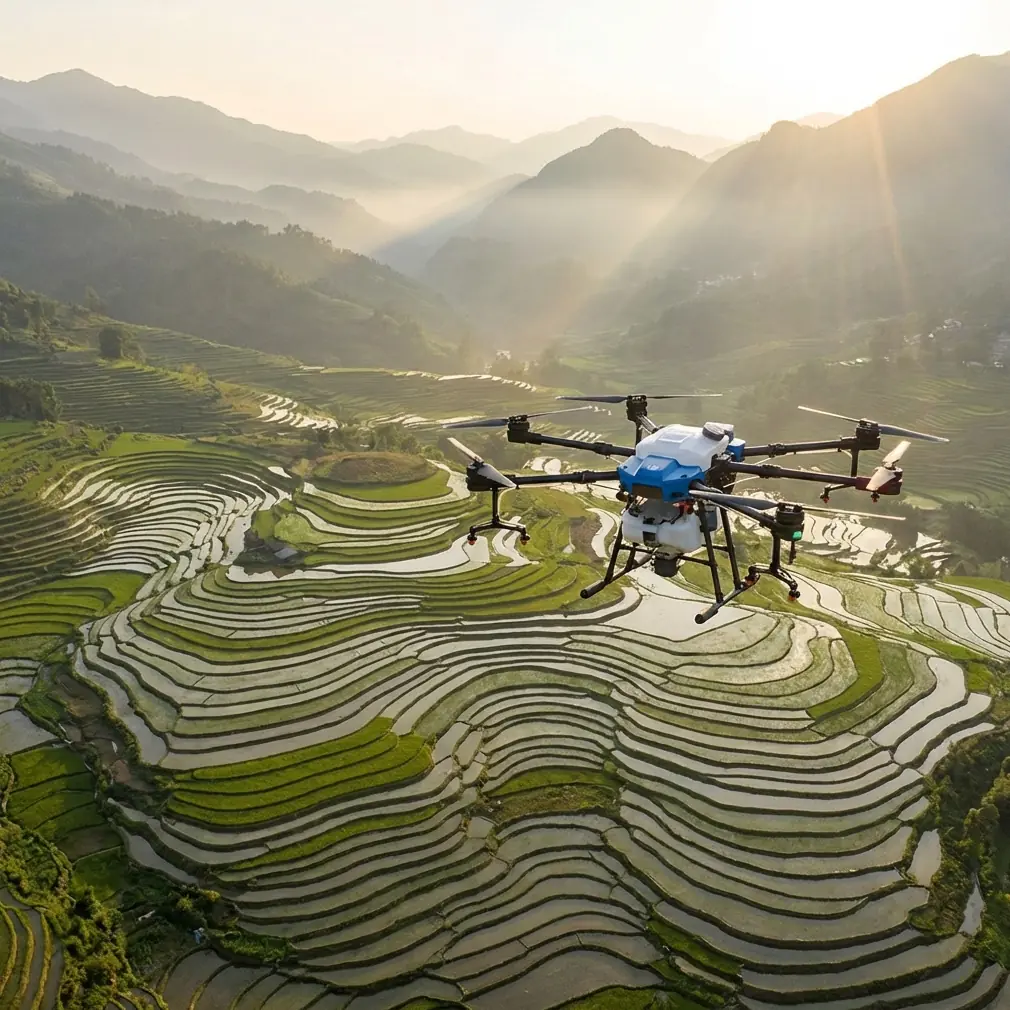
Agras T100 for High-Altitude Venue Deliveries: What Actually Matters
META: A practical expert look at using the Agras T100 in high-altitude delivery environments, with focus on RTK precision, weather resistance, route stability, and operational setup.
High-altitude delivery work exposes every weakness in an aircraft. Thin air cuts lift margins. Wind behaves badly around ridgelines and structures. GNSS quality can fluctuate near steep terrain. Payload stability stops being a comfort feature and becomes the difference between a clean drop and a wasted sortie.
That is why the Agras T100 deserves a more specific discussion than the usual brochure-level treatment.
Most people hear “Agras” and think agriculture first. Fair enough. The platform comes from a line associated with spraying and field work. But the details that make a serious agricultural aircraft reliable also happen to matter in high-altitude venue delivery: stable navigation, robust environmental sealing, repeatable route execution, and predictable performance when conditions are less forgiving than they look from the ground.
For operators supplying mountain event sites, hillside hospitality venues, remote work camps, or elevated recreation facilities, the T100 sits in an interesting position. It is not just another drone that can carry something from point A to point B. Its value comes from how it handles the operational friction that typically ruins delivery efficiency at altitude.
The real problem with high-altitude venue delivery
The challenge is rarely distance alone.
A venue on elevated terrain often has a workable road on paper and a terrible access profile in reality. Switchbacks slow vehicles. Narrow service roads limit timing. Last-minute requests create inefficiency. When weather shifts, ground delivery windows can collapse fast. A drone can solve that problem, but only if it maintains consistency where many aircraft start to feel nervous.
At altitude, minor navigation drift becomes a larger operational issue. A meter off track near an open field is usually manageable. A meter off track near terraces, retaining walls, tent structures, cable runs, or rooftop landing points is a different story. This is where centimeter precision is not marketing fluff. It directly shapes whether delivery routes can be repeated safely and whether landing or release zones remain usable during a busy operating day.
That is also why RTK fix rate matters more than many buyers realize. In a high-altitude environment with terrain shadowing and shifting line-of-sight, a platform that can hold a dependable RTK solution gives operators cleaner path repeatability. With the T100, that matters less as a checkbox and more as a workflow advantage. Routes can be refined, reused, and trusted. That reduces hesitation at launch and cuts the need for frequent manual corrections.
Why the T100 stands out in this scenario
The Agras T100 has one major advantage over lighter-duty delivery aircraft: it comes from a category where environmental punishment is normal. Dust, moisture, residue, repeated loading cycles, and outdoor exposure are baseline conditions, not edge cases.
That shows up in practical ways.
An IPX6K protection rating is not a glamorous spec, but in high-altitude venue operations it is highly relevant. Elevated sites often mean mist, sudden drizzle, road spray near staging areas, and dirty loading zones. Aircraft that need delicate treatment between flights slow the whole operation. A platform with this kind of environmental protection is better suited to repeated outdoor deployment, especially when the workday includes changing weather and quick turnaround requirements.
Compared with many competitor platforms that feel optimized for ideal demo conditions, the T100’s ruggedness is a real edge. Plenty of drones can perform one clean flight in calm weather. Fewer can do repeated missions from rough staging areas with moisture, dust, and rushed handling without becoming maintenance-intensive.
That toughness is only useful if the aircraft also flies precisely. Again, the T100’s appeal is the combination. It is not simply durable. It is durable in a way that supports route discipline.
Precision is what makes venue delivery scalable
One-off delivery flights are easy to romanticize. Repetitive logistics is where the value gets tested.
A high-altitude venue does not need a drone that can manage a single attention-heavy flight. It needs a system that can run the same route over and over with minimal drama. Supplies might include packaged consumables, event materials, medical support items, kitchen restocks, or lightweight maintenance tools. Each mission may be routine, but repetition magnifies every weakness in navigation and handling.
This is where RTK-backed centimeter precision changes the economics of operation. If approach paths are tight, if landing points are temporary, or if handoff zones sit close to guest-access spaces, repeatability is the entire business case. Operators need the aircraft to approach along the same corridor, stabilize consistently, and avoid creeping route errors as environmental conditions shift.
Against competitors that rely more heavily on standard GNSS performance alone, the T100 has a clear practical advantage when route fidelity matters. A stronger RTK workflow means fewer aborted approaches, less pilot stress, and better confidence when operating near terrain features that distort perspective. On a mountain venue, visual judgment is often poorer than it seems. Reliable positioning compensates for that.
Borrowing agricultural discipline for logistics work
One overlooked strength of the T100 is that its agricultural DNA encourages disciplined setup.
Take nozzle calibration and spray drift as examples. In a pure delivery conversation, those sound unrelated. They are not. In agriculture, nozzle calibration teaches operators to respect output consistency, droplet behavior, environmental influence, and equipment verification before launch. Spray drift awareness trains them to pay attention to crosswinds, terrain-induced gusting, and downwash interaction.
Those habits carry directly into high-altitude delivery operations.
An operator who understands spray drift is usually better at reading lateral wind behavior around slopes and venue structures. They are less likely to underestimate what a ridgeline gust can do during final approach. They are more likely to think about how airflow wraps around tents, grandstands, cliff-edge platforms, or service buildings. In other words, the agricultural mindset behind the T100 can produce better logistics operators because it rewards preflight discipline over improvisation.
That is a useful differentiator. Some competitor delivery systems are marketed as easy enough for anyone to pick up quickly. Ease matters, but in difficult terrain, oversimplification can create false confidence. The T100 is better suited to teams that value process, repeatability, and measured setup.
Swath width and multispectral: why they still matter in a delivery discussion
At first glance, swath width and multispectral tools seem irrelevant to a venue-delivery scenario. But they point to something deeper about platform maturity.
Swath width in agricultural operations is about predictable coverage per pass. The operator learns how to think in lanes, overlap, and efficiency. That same route-planning logic translates well to logistics corridors. Instead of optimizing spray coverage, the team optimizes safe air lanes between a base point and a high-altitude destination. A pilot experienced in coverage planning usually builds better repeatable delivery tracks.
Multispectral capability, where part of the broader workflow ecosystem is concerned, also has value around venue support operations. Not because the delivery aircraft needs to become a survey machine, but because elevated venues often operate inside larger managed properties: resorts, estates, vineyards, terraced farms, ecological parks, or event grounds. Teams already using multispectral analysis for land monitoring tend to appreciate geospatial accuracy and route consistency. The T100 fits naturally into that ecosystem because it supports a more professional operational mindset rather than a casual point-and-shoot one.
Wind, drift, and why the payload matters less than stability
Buyers often get fixated on carrying capacity. In high-altitude delivery, that is only part of the story.
A larger payload means little if the aircraft loses route stability on approach. Wind exposure at altitude can make even modest loads behave unpredictably, especially around built-up event spaces. The better question is not “how much can it carry?” but “how repeatably can it complete the mission under variable conditions?”
The T100’s advantage is that it is built for an outdoor workload where drift control, pattern consistency, and operational robustness are already part of the design philosophy. Even though spray drift is an agricultural concept, it highlights an engineering priority: keeping output and movement controlled in moving air. That is exactly what delivery operators need in exposed terrain.
This is where the T100 can outperform lighter competitors that look attractive on paper but become twitchy in real mountain conditions. A stable, rugged aircraft with disciplined navigation usually delivers more usable missions per day than a nominally simpler aircraft that spends too much time waiting for perfect conditions.
Weather resistance is not a luxury feature at altitude
If you deliver to elevated venues long enough, you stop asking whether weather will interfere. You ask when.
Moisture arrives quickly. So does dust. Temporary loading areas are rarely clean. Ground crews may be moving quickly between vehicles, shelters, and launch points. In those environments, IPX6K protection has operational significance because it reduces the fragility tax. The aircraft can be staged outdoors more confidently, cleaned more practically, and used in the kind of imperfect conditions that define real venue logistics.
That does not mean operators should treat weather casually. It means the platform is better aligned with commercial reality.
A lot of competing systems look polished but demand careful handling more typical of inspection flights than repeated logistics cycles. The T100 feels more at home in a working environment. For mountain hospitality support, event logistics, or elevated facility replenishment, that difference adds up over weeks of operations.
Building a practical workflow around the T100
A strong T100 operation for high-altitude delivery usually starts with route discipline, not aircraft heroics.
First, map the corridor with terrain in mind, not just straight-line distance. Ridge crossings, funneling valleys, and built structures can distort airflow in ways that are not obvious from a standard map view.
Second, treat RTK fix stability as a go/no-go quality metric for repeat mission work. If the fix is weak or inconsistent, the route may still be flyable, but it is no longer efficient in a commercial sense. Predictability matters more than improvising a successful single run.
Third, establish approach profiles with drift in mind. Borrow the agricultural mindset here: just as nozzle calibration ensures output consistency, delivery setup should verify release, landing, or handoff consistency before the route becomes routine. A small setup error repeated across dozens of flights becomes a significant operational problem.
Fourth, prepare for rapid weather change. The T100’s IPX6K durability helps, but the real win is maintaining turnaround without exposing the aircraft or team to unnecessary handling delays.
If you are planning this kind of deployment and want to compare route assumptions with someone who has worked through real operating constraints, you can message a specialist here.
Where the T100 fits best
The Agras T100 is not the answer to every delivery task. If the job is purely urban, highly regulated around dense pedestrian corridors, or designed around ultra-light handoff parcels in sheltered conditions, another category may fit better.
But for high-altitude venues where access is frustrating, weather is inconsistent, and route repeatability matters more than brochure simplicity, the T100 makes a strong case.
Its strength is not one isolated spec. It is the way several practical traits come together: RTK-based centimeter precision for route fidelity, an IPX6K-rated body for real outdoor use, and an operating philosophy shaped by agricultural discipline where drift, calibration, and repeatability are taken seriously. Those are not abstract features. They directly affect whether a delivery program can move from occasional convenience to dependable daily utility.
That is the difference between a drone that impresses on a test flight and one that keeps earning its place at a difficult venue.
Ready for your own Agras T100? Contact our team for expert consultation.