
Agras T100 Field Report: What It Takes to Serve Urban
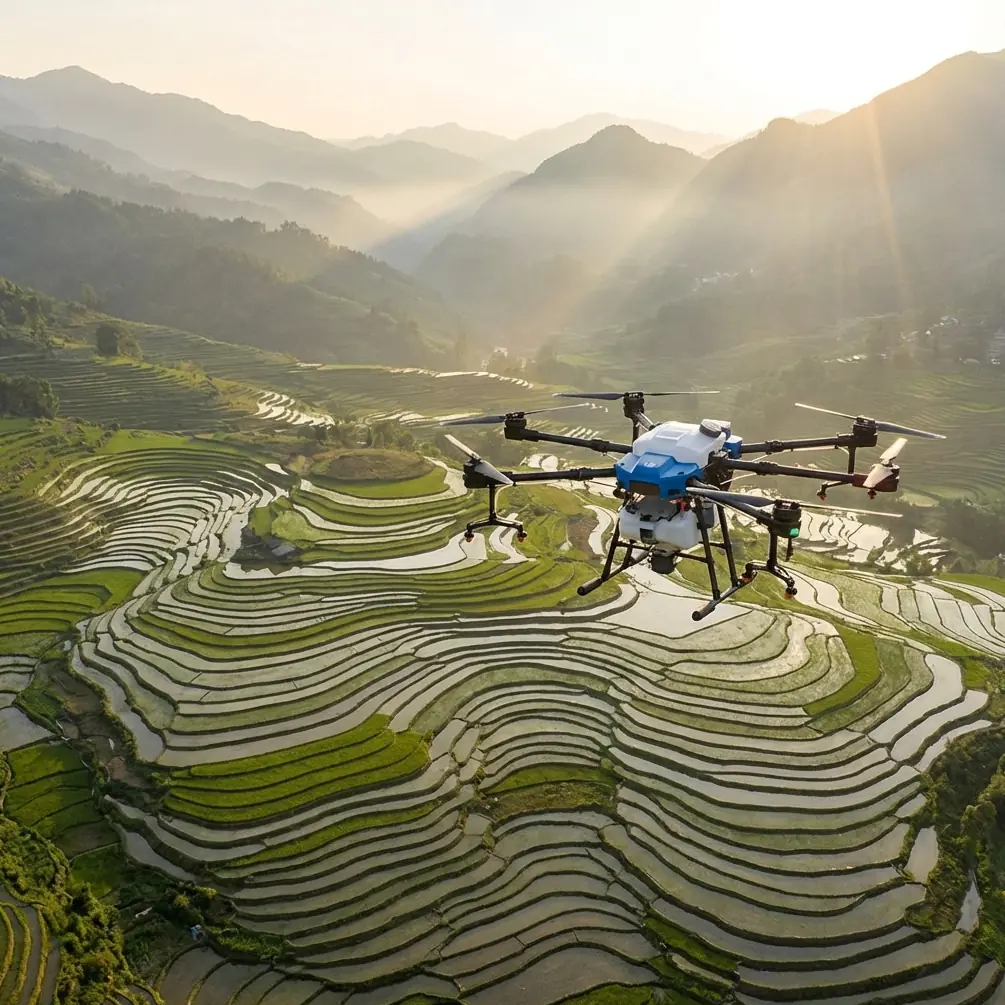
Agras T100 Field Report: What It Takes to Serve Urban-Edge Vineyards Well
META: Expert field report on using the Agras T100 for urban-edge vineyards, covering spray drift, nozzle calibration, RTK fix stability, swath strategy, IPX6K durability, and practical accessory upgrades.
Urban-edge vineyards are awkward places to run an ag drone. The blocks are often narrow, wind behaves badly near buildings and tree lines, and neighbors are much closer than they are in broad-acre farming. That changes the standard conversation around the DJI Agras T100. In this environment, raw output matters less than control, consistency, and how well the aircraft fits into a disciplined operating workflow.
I’ve spent enough time around mixed-use agricultural zones to know that vineyard work near urban boundaries exposes every weak point in a spray system. If your nozzle calibration is off, you see it quickly. If your RTK fix rate is inconsistent, your line spacing tells on you. If your drift management is casual, someone notices. The T100, when properly set up, gives operators a strong platform for this kind of work, but only if they treat it as a precision tool rather than a flying tank.
This field report looks at the Agras T100 specifically through that lens: delivering reliable vineyard operations where centimeter-level repeatability and drift discipline are not optional.
Why the Urban Vineyard Use Case Is Different
A vineyard near a city or dense residential edge has three operational constraints that reshape drone work.
First, the canopy is unforgiving. Grapevines do not reward sloppy droplet placement. You are working with row structure, variable leaf density, trellis hardware, and headlands that can be tighter than many field operators expect. Coverage has to be intentional.
Second, air movement is messy. Buildings, roads, retaining walls, and shelterbelts create turbulence that does not behave like open-field wind. A forecast that looks acceptable on paper can still produce local eddies that push a spray plume sideways at the edge of a block. That makes spray drift management one of the core decision points, not an afterthought.
Third, perception matters. In urban-adjacent agriculture, professionalism is visible. A crew that launches cleanly, follows consistent paths, and avoids overspray builds trust. A crew that improvises around corners and obstacles does the opposite.
This is where the Agras T100 starts to make sense. Not because it solves every problem by itself, but because its capabilities line up well with the demands of controlled, repeatable application.
The T100’s Real Advantage: Precision Under Constraint
Most pilots looking at the T100 focus on throughput first. That is understandable, but for vineyard delivery work the more interesting question is how stable the platform is when conditions are narrow and the margin for error is even narrower.
Centimeter precision is not a marketing flourish in vineyards. It directly affects swath overlap, missed strips, and how confidently an operator can return to a row set after a pause, refill, or battery change. A strong RTK fix rate matters here because vines amplify small navigation errors. A small lateral drift in broad-acre work might disappear inside a large canopy pattern. In a vineyard, it can show up as visible inconsistency along the row.
When the T100 holds a solid RTK solution, row-to-row tracking becomes more predictable, especially around irregular parcels or blocks broken up by access roads. That predictability has two benefits. The first is agronomic: more consistent application along the target zone. The second is operational: less pilot correction, less fatigue, and fewer “close enough” compromises.
For urban-edge work, that second benefit is often underestimated. Pilots under pressure make poor drift decisions. Systems that reduce mental load improve safety and outcomes at the same time.
Swath Width Is Not a Number to Max Out
One of the most common mistakes I see in vineyard spraying is treating swath width as a bragging-right metric. In reality, the right swath width is the one that matches canopy architecture, nozzle choice, droplet size, and wind behavior at the site.
With the T100, operators have enough application capability to be tempted into pushing coverage too aggressively. That usually backfires in vineyards near roads, homes, or fragmented land boundaries. A narrower, better-controlled swath often outperforms a wider pass pattern because it keeps deposition where it belongs and reduces the need for compensatory overlap.
This is where nozzle calibration becomes decisive. Calibration is not just about liters per hectare or flow matching. It is about confirming that the spray system is producing the droplet spectrum you actually want for that block on that day. In urban vineyard work, a poor calibration routine creates two immediate risks: fine droplets that drift beyond the target, or uneven output that leaves sections under-covered and forces repeat passes.
The T100 responds well when crews build calibration into the job rather than treating it as a pre-season checklist item. That means checking nozzle condition, verifying output uniformity, and adjusting settings for canopy stage rather than running a one-size-fits-all program. Vineyards change fast through the season. Your drone settings should too.
Spray Drift Is the Whole Story Near Urban Borders
If I had to name the single issue that separates competent urban-edge drone spraying from careless operations, it would be spray drift.
Drift is usually discussed as a weather problem. That is too simplistic. In practice, drift is the combined result of aircraft height, speed, nozzle setup, droplet size, route design, launch placement, and the operator’s willingness to stop when conditions no longer fit the mission.
The Agras T100 gives you a capable platform, but it does not repeal physics. Around vineyards bordered by houses, parking areas, pedestrian paths, or public roads, the aircraft must be operated as part of a drift-management system. That system starts with route planning that respects the most sensitive boundaries. It continues with conservative edge passes, careful altitude control, and realistic go/no-go thresholds.
This is also where third-party accessories can genuinely improve the mission. One of the most useful upgrades I’ve seen on T100 vineyard setups is a dedicated portable weather station mounted on a field tripod near the block edge. Not a generic pocket meter used once at launch, but a logging unit that tracks wind shifts where the work is actually happening. That accessory changes behavior because it gives crews live, localized data instead of assumptions. In an urban vineyard, where a light crosswind can curl unpredictably around structures, that is not a luxury. It is operational intelligence.
A second practical add-on is a high-visibility strobe kit for support equipment and landing zone demarcation, especially when working near service lanes or mixed-traffic farm entrances. It does not change spray quality directly, but it improves ground discipline in cramped sites where support crews, refill stations, and vehicle movement can get messy fast.
IPX6K Matters More Than People Think
The T100’s IPX6K protection rating deserves more respect than it usually gets. Operators often read durability specs as nice-to-have reassurance. For vineyard work, especially when the schedule includes repeated tank handling, rinsing, and work in damp conditions, that level of ingress protection has practical value.
An IPX6K-rated airframe is better suited to the reality of spray operations, where residue, washdown, and environmental grime are part of the day. That does not mean crews can be careless about maintenance. It means the aircraft is better aligned with actual agricultural use, where downtime often comes from contamination and wear rather than dramatic component failure.
In urban-edge vineyards, reliability has another dimension: time on site. The longer a crew spends troubleshooting in a visible location, the more friction the operation creates. A platform that tolerates harsh field handling better helps compress the workday and reduce the number of avoidable interruptions.
Multispectral Data Can Improve More Than Mapping
Multispectral tools are often discussed as a separate category from spray drones, but that split is increasingly artificial. In vineyard operations, even if the T100 itself is not the multispectral sensor platform in your workflow, the combination of localized crop imaging and T100 application planning can sharpen decision-making considerably.
The reason is simple. Vineyards are variable by nature. Vine vigor can shift row by row due to slope, irrigation inconsistency, soil depth, drainage, or disease pressure. Multispectral scouting helps identify where the canopy is denser, weaker, or more stressed, and that information changes how a T100 mission should be approached.
Maybe a block needs a more conservative pass pattern on one side because canopy density and wind exposure combine badly there. Maybe a stressed section should not be treated identically to the rest of the parcel. Maybe re-entry for a second pass is justified in one zone but not across the whole vineyard.
This is where the T100 earns its place in a mature operation. It can be more than a blunt application tool. Paired with good scouting, it becomes part of a targeted treatment system.
Building a Repeatable Delivery Workflow
If the reader scenario is “delivering vineyards in urban,” the word delivering deserves attention. The aircraft is only one part of the deliverable. What the client actually buys is confidence that the work will be done cleanly, on time, and without creating avoidable risk.
For T100 operators, that means building a workflow that looks professional from the first minute on site.
Start with a landing and refill area placed away from public sightlines where possible, but close enough to reduce deadhead time. Mark it clearly. Keep chemical handling disciplined. Log weather conditions before launch and during the mission. Verify RTK quality before committing to the block. Do not assume the fix is good because the system “usually” locks quickly. In urban-edge areas, interference and partial obstruction can degrade positional confidence in subtle ways.
Then work the edges with more caution than the center. That may slow the job slightly, but it reduces the chance of drift incidents where they matter most. Finally, document what you did. Even a simple mission record noting conditions, nozzle setup, and operational adjustments can be valuable later if a client asks why one block was treated differently from another.
If you are building or refining this kind of workflow, I’d suggest sending the field team a simple operations checklist through this WhatsApp planning link so launch-day decisions are not left to memory.
What Good Operators Do Differently With the T100
The best T100 vineyard crews I’ve seen share a few habits.
They do not chase maximum output on every block. They scale the mission to the site.
They respect nozzle wear. A nozzle that is only slightly off can quietly distort the entire job, especially over multiple vineyard rows where small inconsistencies accumulate.
They watch RTK stability like a real operational variable, not a technical footnote.
They use multispectral information, if available, to make application decisions smarter rather than merely more impressive in a report.
And they understand that a weather accessory, a cleaner refill layout, or a better edge protocol can produce more real-world value than squeezing a few extra minutes out of a flight sequence.
That is the right way to think about the Agras T100 in urban-adjacent viticulture. Not as a headline machine, but as a precision application platform whose value depends on disciplined setup.
The Bottom Line for Urban Vineyard Teams
The Agras T100 fits vineyard operations near urban boundaries when the team around it is just as precise as the aircraft. Its real strengths show up in controlled row tracking, disciplined swath planning, solid RTK-supported repeatability, and field durability backed by an IPX6K-rated design. Those are not abstract specs. They affect whether you can place material accurately, minimize drift, and complete the work without turning every mission into a risk management exercise.
For vineyard managers and drone service providers, the practical takeaway is straightforward: do not evaluate the T100 only by capacity or speed. Judge it by how well it supports tight-site operations where canopy variability, public proximity, and spray accountability define success.
In that setting, the operators who win are the ones who calibrate carefully, fly conservatively when needed, integrate localized weather data, and use precision as a daily habit rather than a slogan.
Ready for your own Agras T100? Contact our team for expert consultation.