
Agras T100 in Mountain Fields: A Practical Setup Guide
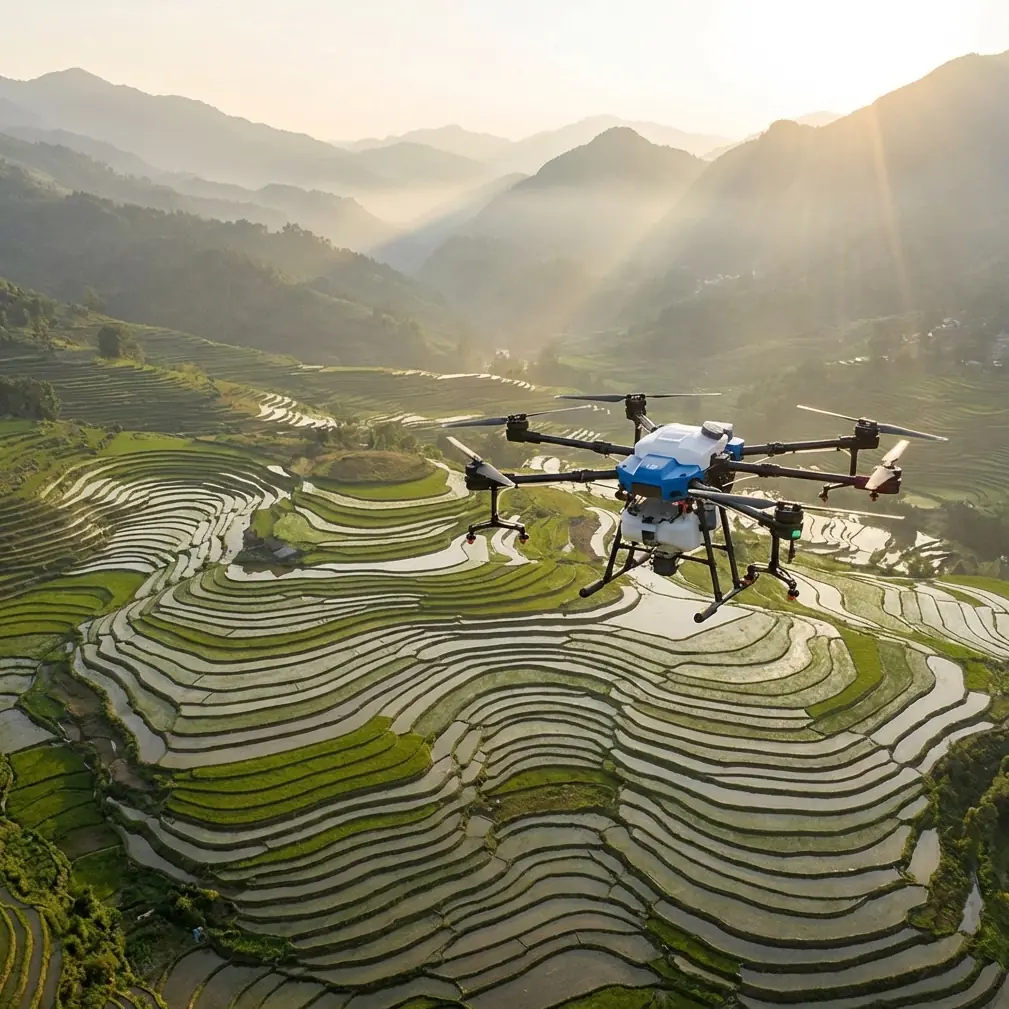
Agras T100 in Mountain Fields: A Practical Setup Guide for Safer, More Accurate Work
META: Expert how-to guide for using the Agras T100 in mountain fields, with practical advice on obstacle response, battery thinking, calibration discipline, RTK precision, and drift-aware spraying.
Mountain agriculture exposes every weakness in a drone operation. Wind shifts faster. Terrain changes break visual assumptions. Field edges are tighter, and stone walls, terraces, trees, and utility lines punish lazy setup. That is exactly why the Agras T100 deserves to be approached as a system, not just as a spray platform.
If you are planning to use the T100 for field documentation, application planning, or actual agricultural work in steep terrain, the smartest starting point is not speed. It is behavior. How the aircraft reacts near obstacles, how stable its power delivery remains through repeated sorties, and how carefully you calibrate the flight stack all matter more in mountain plots than they do in a broad, flat field.
I’ve seen operators obsess over swath width and forget the basics that preserve consistency on the third battery cycle of the morning. That’s the mistake this guide is meant to prevent.
Start with the terrain, not the mission menu
Mountain fields are visually deceptive from the ground. A terrace that looks broad can narrow sharply after takeoff. A wall bordering a crop lane may be low on one side and higher on the other because of grade change. For a T100 operator, this means route design and spray logic must be built around terrain-induced aircraft behavior.
In practical terms, that affects:
- spray drift exposure on ridgelines
- overlap consistency on sloped passes
- obstacle recovery margins near retaining walls
- battery reserve planning when climb segments stack up
- RTK fix stability when partial sky view is blocked by mountainsides
The T100 may be capable, but mountain work is where capability gets filtered through discipline.
A small flight-behavior detail that matters more than most people realize
One of the most useful reference points for understanding near-obstacle behavior comes from an educational DJI drone experiment involving a wall approach. In that exercise, when the aircraft backed toward a flat vertical wall at a control input of -30, its pitch angle stayed close to 0° during normal rearward flight. Once it actually reached the wall, the pitch angle rose noticeably to about 12°.
That sounds like a classroom detail. It isn’t.
Operationally, it tells you something important: aircraft attitude can reveal contact or contact-like interference before an operator fully interprets it visually. In mountain fields, especially around terrace walls or storage sheds beside a treatment zone, attitude changes are not just telemetry trivia. They can be a usable safety signal.
The same reference also describes a simple protective logic: when the drone’s pitch angle exceeds 6° during the wall-contact sequence, the program interprets that as collision and commands the aircraft to move forward for 0.5 seconds before hovering and landing. You are not going to copy an educational exercise directly into a production T100 workflow, but the principle is solid.
Why this matters on an Agras T100
On a larger agricultural aircraft, contact avoidance and recovery planning need to be thought through in advance. In mountain environments, there are moments when GNSS, terrain contour, and visual depth cues do not align perfectly in the operator’s head. If the aircraft’s attitude starts behaving differently than expected near a wall, berm, or terrace edge, that is an early warning to slow down, widen your margin, and reassess your path.
For filming fields in mountain terrain, this is even more relevant. Camera-focused flights often pull the operator’s attention toward composition and away from aircraft body language. A pilot who understands that a shift from near-level pitch to an abnormal attitude state can indicate contact pressure or obstruction interaction will catch problems earlier.
The lesson is simple: monitor attitude trends, not just position.
Build your T100 workflow around a calibration culture
Agricultural operators talk a lot about nozzle calibration, and they should. Uniform output is the foundation of responsible application. But mountain reliability starts one layer deeper: control fidelity.
A technical ESC reference in the source material outlines a throttle calibration sequence for PPM systems. During that process, the controller confirms stages with beep cues, and if the throttle remains above midstick for 3 seconds, max throttle is stored; below midstick for 3 seconds, min throttle is stored. It also notes that full throttle detected once indicates entry into programming mode.
Now, the T100 is not a hobby machine and you are not setting it up like an old DIY quad. Still, the field lesson carries over perfectly: calibration states matter, and misreading them creates downstream problems that operators often blame on wind, terrain, or firmware.
For T100 work, that means:
- confirm all control inputs are interpreted correctly before the first flight of the day
- verify stick response, mode behavior, and failsafe assumptions after transport
- treat any unusual motor response, throttle feel, or spool-up delay as a setup issue until proven otherwise
- never rush through preflight simply because the first few hectares look easy
The mountain environment amplifies tiny setup mistakes. A drift in control interpretation that seems tolerable on flat land becomes dangerous when your pass line runs beside a rock wall or drops into a ravine edge.
My field rule for battery management on sloped farmland
Here’s the tip I give every serious operator: in mountain work, battery planning should follow elevation change, not just acreage.
That may sound obvious, but many crews still calculate sortie expectations as if every field were flat. It doesn’t work. Climbing repeatedly over stepped terrain or lifting through variable wind bands drains packs unevenly and changes how the aircraft feels near the end of a run.
One industry reference in the supplied materials describes new pouch battery cells from Natrion with up to 80% higher energy density than standard lithium-ion batteries. Those cells are aimed at compliant supply-chain needs in uncrewed systems, not specifically the T100. Still, the operational takeaway is useful: energy density is becoming a bigger performance lever across drone categories, and operators should think more critically about what their battery system is really doing for endurance, reserve margin, and consistency under load.
For an Agras T100 operator today, the lesson is not to chase speculative battery upgrades. It is to manage the batteries you have with mountain-specific discipline:
My practical battery routine
Label packs by behavior, not just number.
If one pack sags earlier during uphill return legs, note it.Do not benchmark flight time on the easiest plot.
Use the most demanding field segment as your planning baseline.Keep extra reserve for the final climb out.
Descending across a terrace line can make the remaining capacity look more comfortable than it really is.Watch consistency across repeated hot turns.
In back-to-back sorties, the third launch often tells the truth about your thermal margin.Avoid pushing a “good enough” battery into a drift-sensitive mission.
When wind is shifting, predictable thrust response matters more than squeezing one more pass.
That last point affects image capture as much as spraying. If you are filming fields in mountain terrain to assess crop uniformity, irrigation flow, erosion patterns, or access routes, a battery with softer power delivery can subtly degrade path control and framing even before it becomes a safety issue.
RTK precision is only valuable if you respect its limits
People love the phrase centimeter precision, and yes, high-quality RTK performance can transform agricultural repeatability. On the T100, the value is obvious: cleaner pass alignment, more consistent overlap, better route repeatability, and improved confidence near narrow field boundaries.
But mountain plots complicate RTK behavior. Slopes block portions of the sky. Tree lines narrow satellite visibility. Structures can worsen multipath. That means your RTK fix rate deserves active attention, not passive trust.
A few habits help:
- wait for a stable fix before committing to precision-dependent work
- verify boundary geometry against visible ground truth
- be skeptical of perfect-looking path lines if the terrain is causing intermittent satellite masking
- recheck after moving between terraces or valleys
This matters especially when balancing swath width against drift control. On a mountain field, a theoretically efficient lane spacing can become sloppy if positional confidence drops at the exact moment crosswind increases. Precision is not just about line placement. It is about whether the aircraft can hold the treatment corridor you intended.
Drift control on mountain plots is really a timing problem
Spray drift is often discussed as a nozzle or droplet issue alone. That is incomplete. In mountain conditions, drift is as much about timing and terrain interaction as hardware.
Cooler air pooling in low sections, rising thermals on sunlit slopes, and lateral gusts over terraces can all change how material behaves within a single block. The T100’s application performance is strongest when the operator resists the urge to run every section with one setting and one schedule.
Think in micro-zones:
- upper slope
- mid-slope
- terrace edges
- sheltered corners
- open ridgeline exposure
Then match your operating choices to each section. That can include slower passes, adjusted route direction, narrower effective swath width, or delaying a segment until the air settles. Nozzle calibration is essential, but calibration without local timing judgment still produces mediocre outcomes.
IPX6K matters more in working agriculture than in marketing sheets
Agricultural drones live around dust, splash, residue, hose-down routines, and wet loading areas. For that reason, durability features such as IPX6K are operationally meaningful. Not glamorous. Meaningful.
In mountain farms, access roads are rough, staging zones are often improvised, and weather windows can close quickly. Equipment gets dirty. It gets carried, reloaded, and turned around fast. A platform built for harsh washdown and field contamination tolerance reduces friction in real operations.
That does not eliminate maintenance. It changes the maintenance conversation from “can this survive normal field abuse?” to “are we cleaning and inspecting it properly between jobs?”
For T100 crews, that means:
- inspect spray components after every mountain session
- clean around connectors and mounting points
- verify nozzle condition regularly
- look for residue accumulation that can distort flow or sensor confidence
- confirm moving parts are free of debris after hillside takeoff and landing cycles
If you are filming fields, don’t fly them like flatland agronomy blocks
Many readers looking at the T100 for mountain work are not just applying product. They are also documenting terrain, canopy consistency, access routes, and treatment results. If that’s your use case, your filming plan should borrow from agricultural logic without copying it blindly.
A few priorities stand out:
- fly with terrain in mind, not just a rectangular map box
- keep wider clearance near walls and structures
- watch aircraft attitude when backing near vertical surfaces
- reserve battery for retakes on uphill sections
- use precision positioning intelligently, but validate visually
- expect local wind changes to alter both image stability and application quality
If you want to compare setup ideas for steep plots or talk through route planning for your specific fields, you can message our team here: https://wa.me/85255379740
The real advantage is not raw capability
The Agras T100 will attract attention for payload, automation, and productivity. Fair enough. But in mountain agriculture, the edge does not come from the headline features alone. It comes from how well the operator integrates them.
A pitch change from near 0° to around 12° at wall contact is not just an interesting data point from a smaller drone exercise. It is a reminder that aircraft attitude can reveal environmental interaction before your eyes fully process it. A 6° threshold used in a protective routine is not just a teaching device. It is a prompt to think proactively about trigger conditions and recovery behavior. And a technical note about calibration timing at 3 seconds is not just old ESC trivia. It reinforces the larger truth that precise setup prevents vague field problems.
The same applies to battery thinking. News of cells promising up to 80% higher energy density shows where the industry is heading, but the operator’s immediate advantage still comes from conservative reserve management, pack tracking, and understanding how slope and wind change power demand on the T100 right now.
That is how experienced crews separate impressive flights from dependable operations.
Ready for your own Agras T100? Contact our team for expert consultation.