
Agras T100 Field Report: Practical Setup for Dusty Forest
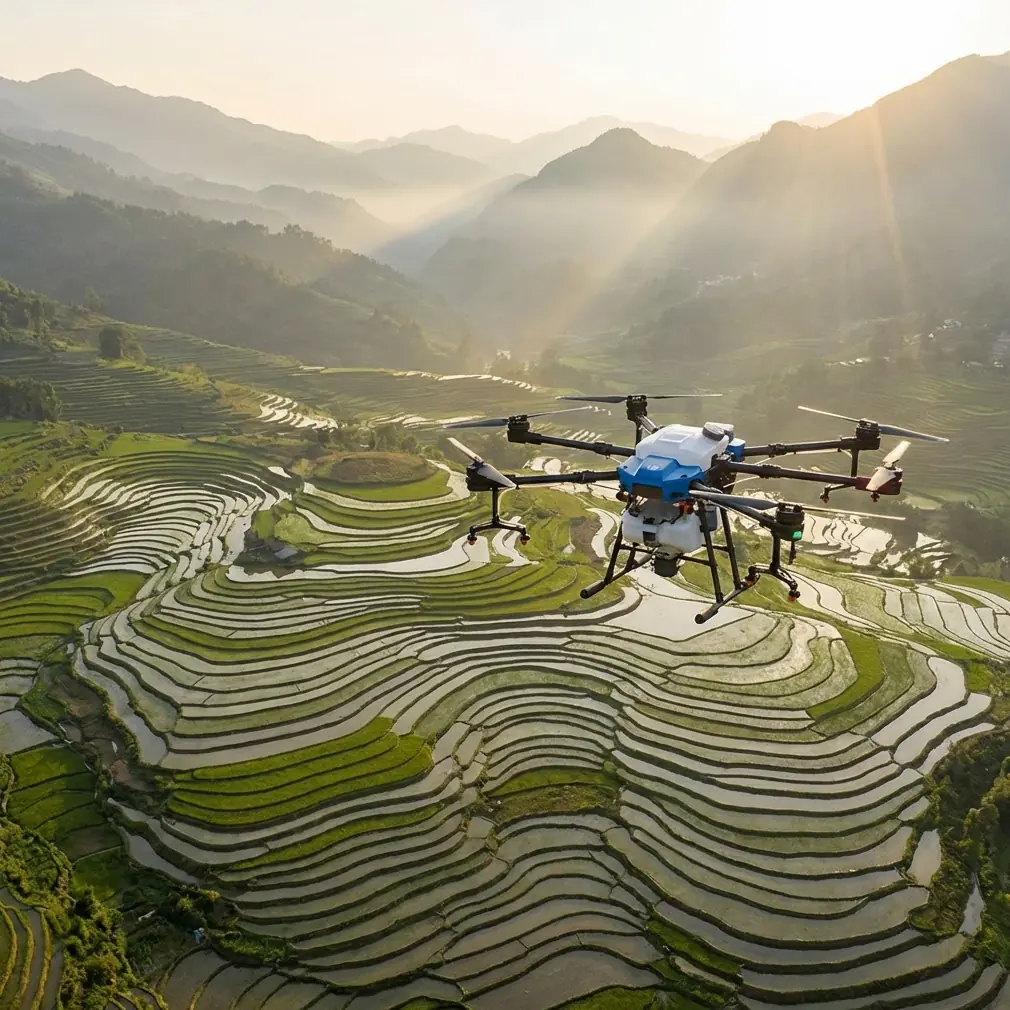
Agras T100 Field Report: Practical Setup for Dusty Forest Operations
META: Expert field report on Agras T100 setup for dusty forest work, covering spray drift, nozzle calibration, RTK fix stability, battery handling, and reliability tips.
Dust changes everything.
People often focus on payload, automation, or top-line efficiency when they talk about an agricultural drone like the Agras T100. In the field, especially around forest edges, timber corridors, dry plantation blocks, or dusty service roads, the smaller details decide whether the aircraft works cleanly or becomes a maintenance problem. If your mission involves operating an Agras T100 in dusty forest conditions, the right question is not simply whether the platform is capable. It is how to keep performance consistent when fine particulates, uneven canopy edges, and unstable airflow start interfering with normal assumptions.
I have seen crews treat dusty woodland jobs as if they were just open-field spraying with more trees nearby. That usually leads to drift issues, poor atomization consistency, and a surprising amount of downtime. The Agras T100 is a serious tool, but it rewards disciplined setup. This is where field craft matters more than spec-sheet reading.
Why dusty forest work is different on the Agras T100
Forest-adjacent operations are awkward because the environment keeps changing every few meters. One pass may be bordered by open access tracks and dry soil, while the next is hemmed in by treelines that bend rotor wash and trap suspended dust. That combination affects two things immediately: visibility around the aircraft and the stability of your application pattern.
Spray drift becomes harder to predict in these areas because tree walls create turbulent pockets rather than simple crosswinds. A neat, repeatable swath width in a clean open field can become irregular when the air mass rolls off a canopy edge. If you are using the Agras T100 near rows of eucalyptus, pine, or mixed forestry shelterbelts, the issue is not just chemical placement. Dust lifted by takeoff and landing can contaminate your nozzles, change droplet behavior, and interfere with your confidence in what the aircraft is actually delivering.
This is where nozzle calibration stops being a routine checkbox and becomes an operational control point.
Nozzle calibration matters more than most pilots admit
A lot of experienced operators say they calibrate regularly. Fewer recalibrate when conditions shift. In dusty forest environments, that second habit is the one that protects your results.
Fine dust can partially obstruct nozzle flow without creating a dramatic failure. The dangerous part is that the aircraft may still appear to be spraying normally from the operator’s perspective. What changes is the uniformity. You start seeing uneven coverage across the swath width, especially at the outer edges where airflow is already more vulnerable to canopy turbulence.
On the Agras T100, I recommend treating nozzle checks as part of every environmental transition, not just every workday. If you move from a cleaner staging area into a dry forest block with exposed tracks and powdery soil, do another calibration check. If you have completed several landings in a visible dust cloud, inspect again. That sounds conservative until you compare it with the cost of a missed section or a retreatment pass.
Operationally, this is significant because a small deviation in nozzle output can stack with drift and route overlap error. The result is not one obvious problem. It is a coverage pattern that looks acceptable in the app and underperforms in reality.
RTK fix rate is not just about navigation
Pilots tend to discuss RTK in terms of path accuracy, which is fair. Centimeter precision is one of the main reasons larger UAV platforms can execute repeatable work at scale. But in forests and dusty clearings, RTK fix rate has a second role: it supports confidence when visual cues are degraded.
Dust at low altitude can make aircraft attitude and exact lateral position harder to judge, especially during transitions, turns, or when operating against visually busy backgrounds. A stable RTK fix gives the operator cleaner positional trust when the eye is working with partial information. That matters even more around irregular forest margins where route spacing mistakes can quietly reduce application quality.
If your fix rate starts fluctuating near tall timber or broken terrain, do not dismiss it as a minor technical annoyance. In practice, degraded positional consistency can alter overlap between passes, distort effective swath width, and make edge treatment less reliable. In these environments, centimeter precision is not a marketing phrase. It is what keeps route geometry intact when the terrain and atmosphere are both trying to introduce noise.
My rule is simple: if RTK behavior gets inconsistent, I do not keep pushing productivity. I slow the operation down, confirm antenna placement and local line-of-sight conditions, and only resume normal tempo when the fix is stable enough to trust the route.
The battery tip that saves more time than it costs
Here is the field habit I wish more crews adopted with the Agras T100: let dusty batteries rest covered, not exposed, between rotations.
That sounds almost too basic, but it solves a real problem. In dry forest operations, batteries are often swapped in a hurry on the tailgate of a truck or on a folding table near the launch zone. Warm packs get set down in air full of suspended dust. Fans, vehicle movement, and rotor wash keep those particles circulating. Over repeated swaps, dust finds its way onto contact areas, around housings, and across the surfaces crews touch all day.
My approach is to move each used pack immediately into a clean, shaded container or covered case, then brush and inspect the contact area before the next cycle. I also keep charging infrastructure a little farther from the launch point than most teams prefer. That extra walking distance is worth it. Heat and dust are a bad pairing, and rushed handling usually creates both.
The operational significance is straightforward. Battery reliability is not only about cell health. It is also about keeping the whole power workflow clean enough that you are not troubleshooting avoidable connection issues or contaminating sensitive areas during a long day. In dusty work, discipline at the battery table supports flight continuity just as much as smart charging practice.
IPX6K helps, but it is not permission to be careless
A platform with IPX6K-grade protection is built for demanding environments, and that matters. Dusty forest work is exactly the kind of scenario where environmental sealing earns its keep. But crews sometimes misunderstand what a robust rating means in practice.
It means the aircraft is built to tolerate harsh field exposure better than less protected systems. It does not mean you should normalize bad launch discipline, dirty storage, or delayed cleaning. If anything, a sealed and durable aircraft should be paired with tighter procedures so the protection is preserved over time.
On the Agras T100, that translates into three habits: keep takeoff and landing areas as dust-controlled as possible, wipe down critical surfaces at sensible intervals during the day, and inspect spray system components before contamination accumulates into a performance issue. Ruggedness extends your margin. It should not become an excuse to consume that margin unnecessarily.
Swath width in forests is a planning decision, not a default number
A common mistake is carrying over swath width assumptions from open agricultural blocks into mixed forest-edge work. The problem is not only wind. It is how rotor downwash interacts with trees, shrubs, embankments, and cut tracks that channel airflow unpredictably.
When you are working the Agras T100 in these conditions, the smartest move is often to reduce your effective swath width and treat that as a precision adjustment rather than a productivity loss. Narrowing the pass spacing slightly can help preserve application consistency where canopy edges disrupt the outer portion of the spray pattern.
This is one of those decisions that separates clean operators from rushed ones. On paper, a wider swath looks efficient. In practice, if the outside edge of the pattern is drifting, curling, or thinning, your real-world coverage is already compromised. The more variable the forest boundary, the more conservative your route geometry should become.
That matters because dusty environments rarely stay static. As ground vehicles, support crews, and the aircraft itself keep moving through the site, local air conditions evolve. A swath width that looked acceptable during the first battery can become unreliable by the fourth.
Spray drift control starts on the ground
Most spray drift problems are blamed on in-flight conditions. Often the first mistake happened before launch.
In dusty forest operations, I want the launch area to do three things: minimize rotor-induced dust, preserve line of sight, and allow clean preflight checks. If you launch from loose powder every time, you are creating your own contamination source. A compacted mat, treated pad, or even a carefully selected firmer patch of ground can materially reduce how much dust gets recirculated into the aircraft and spray system.
This is not glamorous advice, but it works. Good launch discipline gives you cleaner sensors, cleaner battery handling, and more confidence that if application quality changes during the mission, the cause is environmental rather than self-inflicted.
If you are coordinating a team or want a second opinion on setup logic for a specific site, I often tell operators to send a field sketch and conditions summary through this Agras planning chat. It is much easier to solve drift and workflow issues before the first lift than after a half-day of inconsistent passes.
What about multispectral workflows?
The Agras T100 conversation usually centers on application work, but in forest environments it is worth thinking about how multispectral data may support mission planning around it, even if that sensing is handled by another platform in the workflow.
Why mention multispectral in a field report about dusty conditions? Because dusty forest jobs often involve variable plant stress, mixed canopy density, and uneven access. Multispectral mapping can help identify where treatment intensity or route priorities should change before the Agras T100 enters the block. That reduces guesswork and prevents the aircraft from being used as a blunt instrument over a biologically uneven area.
The operational advantage is not that the Agras T100 suddenly becomes a mapping aircraft. It is that a better-informed application plan reduces unnecessary passes and helps the drone spend its flight time where precise treatment actually matters. In rough, dusty terrain, every avoided pass is also one less cycle of landing dust, battery swapping, and wear exposure.
A field-ready operating pattern that actually holds up
If I were briefing a crew for an Agras T100 day in dusty forest conditions, the workflow would be simple and strict:
Start by verifying your RTK setup and confirming you are getting the fix stability needed for route confidence near trees and terrain breaks. Then set a conservative swath width based on actual airflow behavior at the site, not yesterday’s open-field numbers. Before every major segment, inspect and calibrate nozzles with the assumption that dust contamination is possible even if performance looks normal. Rotate batteries through a clean, shaded handling system rather than an exposed swap line. And treat the launch area as part of the spray system, because in these conditions it is.
None of that is complicated. What makes it effective is consistency.
The Agras T100 is best understood not as a miracle machine, but as a platform that rewards operators who respect environmental variables. Dusty forests are demanding because they layer several small risks together: drift, turbulence, contamination, visual interference, and repetitive handling stress. When crews address those risks systematically, the aircraft can remain precise, stable, and productive in places where less disciplined operations fall apart.
That is the real takeaway. Performance in this kind of work is rarely lost in one dramatic failure. It leaks away through small compromises: a lazy nozzle check, an overoptimistic swath width, a battery left sitting open in a dust plume, an RTK warning ignored because the mission is behind schedule. Fix those habits, and the Agras T100 starts showing what it is actually capable of.
Ready for your own Agras T100? Contact our team for expert consultation.