
Agras T100 for Mountain Solar-Farm Mapping
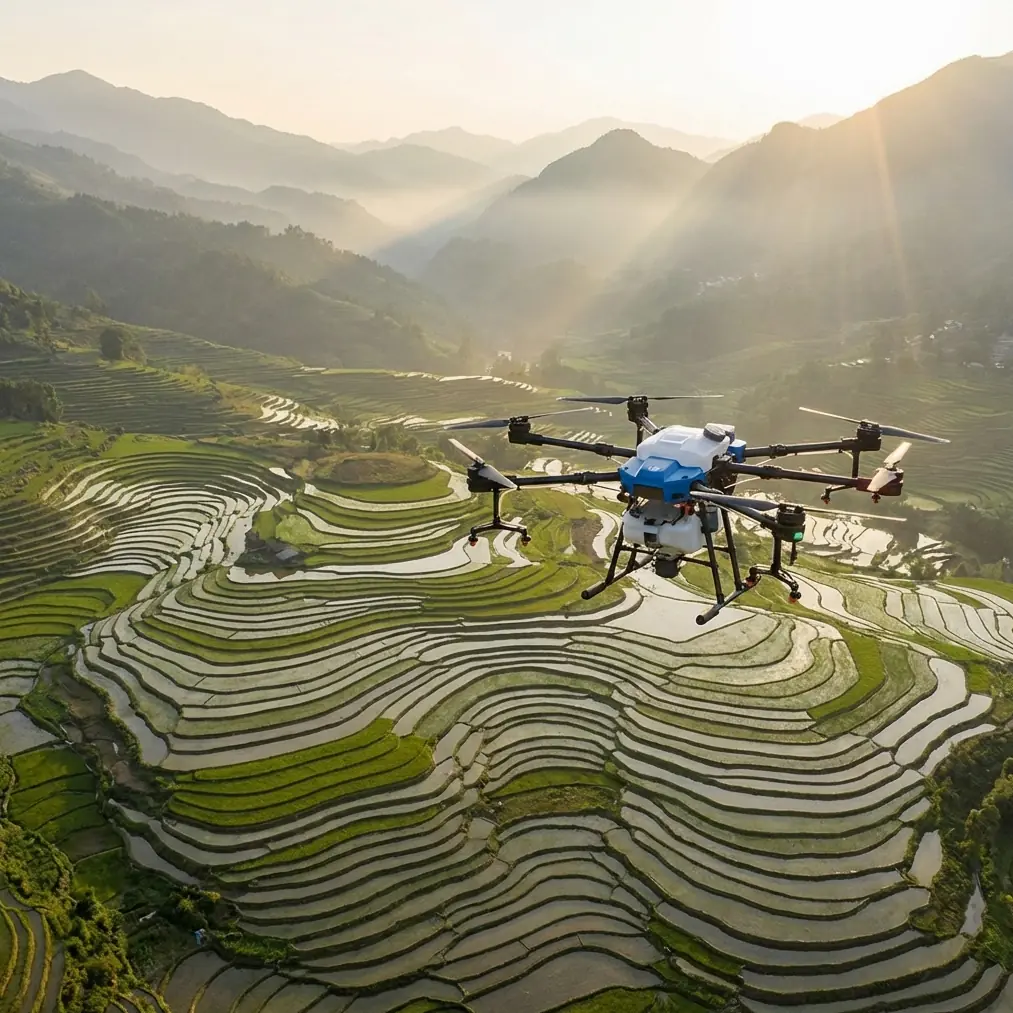
Agras T100 for Mountain Solar-Farm Mapping: What Actually Matters in the Field
META: A practical Agras T100 guide for mountain solar-farm mapping, covering battery planning, RTK precision, weather limits, workflow discipline, and why crop-sensing concepts like red and near-infrared still matter.
If you are evaluating the Agras T100 for mountain solar-farm mapping, the first mistake is to think only about airframe specs. In steep terrain, success is rarely decided by brochure numbers alone. It comes from workflow discipline: power planning, weather judgment, route inspection, data consistency, and how well the team handles terrain-driven interruptions.
That may sound less exciting than talking about payloads or automation. But this is where projects are won or delayed.
I’ve spent enough time around UAV operations to know that mountain sites expose weak habits quickly. Solar arrays spread across uneven slopes create line-of-sight issues, variable winds, awkward staging areas, and long walking distances between launch points. Even when the Agras T100 is being considered for a mapping-oriented workflow rather than plant protection, the operational lessons from agricultural drone teams are surprisingly relevant. In fact, some of the most useful field guidance comes from spray-service operations, because those teams have already learned how to manage batteries, weather windows, consumables, and next-day continuity under pressure.
Why the mountain environment changes the conversation
A flat solar site is one thing. A mountain installation is another.
On a hillside, route efficiency is fragile. You may have to reposition more often, verify obstacle clearance manually, and deal with localized gusts that do not show up in a simple forecast. This is why the pre-flight habits described in professional UAV field operations matter so much. One source on plant-protection team workflow emphasizes reaching the worksite early, becoming familiar with the terrain, checking the planned flight path for obstacles, and confirming takeoff and landing points before work begins. For mountain solar mapping, that is not optional housekeeping. It is the job.
Panel rows, maintenance roads, fencing, transformer pads, and terrain breaks can all distort what looked straightforward in planning software. If your launch area is poorly chosen, every battery cycle becomes less productive. If your path review is rushed, your “mapping mission” turns into repeated manual corrections.
The Agras T100 enters this conversation as a platform expected to work in real field conditions, not in a vacuum. That means the operator has to think like a site manager as much as a pilot.
Battery management is the quiet factor behind reliable output
Let’s get specific.
One reference on UAV operations notes that electric multirotor teams typically prepare 5 to 10 battery sets, along with chargers, and sometimes a generator if the worksite does not support convenient charging. That number matters more than many new operators realize. On a mountain solar-farm project, battery count is not just about endurance. It affects launch rhythm, data continuity, crew fatigue, and whether you can stay inside the day’s best weather window.
Here’s the field tip I give clients: don’t treat all charged batteries as equally useful. In mountain work, I prefer to divide them into three groups:
- Primary mission packs for the cleanest weather window
- Reserve packs for reflight of shadowed or incomplete sections
- Recovery packs held back in case terrain access or an unexpected route extension eats more power than planned
That sounds simple, but it prevents a common failure pattern: using your best energy early, then discovering after lunch that you need to re-fly a critical block when the wind is less cooperative.
I’ve seen crews carry enough batteries on paper and still lose half a day because they lacked a charging rotation plan. The practical lesson from agricultural service teams is clear: logistics must be built before the aircraft lifts off. If your mountain site lacks stable power near staging, bring charging support deliberately rather than improvising. A generator is not glamorous, but neither is hiking downhill with a paused project and dead packs.
For teams building their T100 workflow, I usually recommend recording not just flight count per battery, but also terrain-adjusted performance: ascent profile, average transit distance from launch point, and whether the pack was used during gustier afternoon conditions. That creates a much more honest endurance model than generic cycle logs.
RTK fix quality matters more in mountains than people admit
The phrase “centimeter precision” gets thrown around loosely. On mountain solar projects, it should be earned.
If you are using the Agras T100 in a mapping-support role, RTK fix rate has direct operational significance because panel fields are repetitive. Repetition is beautiful for power generation and annoying for positional ambiguity. Long rows of reflective structures can make visual interpretation harder, especially when shadows move across terraced ground. A stable RTK solution reduces the amount of second-guessing later when comparing flight tracks to asset rows, edge boundaries, and maintenance corridors.
The reason I stress fix rate instead of just “RTK capability” is simple: a specification is a checkbox, but a field fix is a condition. Mountain ridges, partial sky obstruction, and rapid repositioning between launch points can all affect consistency. If your workflow requires multiple short missions from changing elevations, you should monitor not only whether RTK is available but how often it remains clean throughout each segment.
This becomes even more relevant when a site owner expects repeatable documentation over time. One accurate map is useful. A sequence of aligned datasets is where operational value starts to compound.
Weather thresholds are not academic
A second field reference makes an observation that every mountain operator should memorize: when wind exceeds level 3, spray operations can experience major drift. While mapping is not spraying, the underlying lesson is still operationally valuable. Once light-to-moderate wind builds in uneven terrain, aircraft behavior and mission consistency begin to degrade faster than many planners expect.
And if your Agras T100 is also expected to support inspection or treatment tasks around vegetation growth near a solar site, then spray drift and nozzle calibration become more than side topics. They affect environmental control and project credibility.
The same source also advises stopping chemical application when temperatures rise above 35 degrees Celsius, because high heat can reduce treatment effectiveness. Again, even if you are focused on mapping, that threshold reinforces a broader rule: thermal stress changes field quality. High temperature affects battery behavior, operator stamina, and the timing of your best data capture window. On mountain sites, the smart pattern is usually to front-load high-precision flight segments into the calmer, cooler part of the day and reserve easier or less sensitive tasks for later.
This is where good teams separate themselves. They do not ask, “Can the drone fly?” They ask, “Will the output still be worth using?”
Why hyperspectral and multispectral thinking belongs in this discussion
At first glance, crop hyperspectral research may seem unrelated to solar-farm mapping. It is not.
One technical source on UAV hyperspectral imaging highlights a powerful principle: biomass shows a positive correlation in the near-infrared band from 740 to 1100 nm and a negative correlation in the red band from 620 to 700 nm. It also notes that nitrogen stress alters canopy reflectance by reducing leaf area index, biomass, chlorophyll, and protein content. For agriculture, that is about crop monitoring. For mountain solar sites, it points to something broader: spectral intelligence helps distinguish what the eye alone may oversimplify.
Why does that matter around solar farms?
Because many mountain installations sit inside active or recovering vegetation zones. Groundcover management, erosion control, drainage corridor monitoring, and vegetative encroachment around panel blocks all benefit from more than visual RGB imagery. A T100-centered workflow that can coordinate with multispectral or hyperspectral surveys becomes more useful over time, especially where site operators need to understand not only where vegetation exists, but how vigorous or stressed it is.
That distinction matters operationally. A patch of vegetation on a slope might look harmless in visible imagery but signal a drainage pattern, soil instability, or maintenance problem when spectral behavior changes. The same logic used in agriculture to read nitrogen stress and biomass can support infrastructure stewardship. You are no longer just mapping panels. You are reading the living surface around the asset.
One especially striking number from the hyperspectral literature is that a cotton-yield relationship with the atmospheric-resistant vegetation index VARI-700 reportedly reached a correlation of 0.96 in one study. The specific crop result should not be overextended, but it proves the broader point: when spectral parameters are chosen correctly, field relationships become much more measurable. That is exactly why multispectral thinking deserves a seat at the table in complex solar environments.
Workflow discipline beats improvisation
The best field teams operate with checklists that feel almost boring. That boredom is earned.
The agricultural operations reference describes end-of-day practices that should be standard for any serious T100 deployment: clean and maintain the aircraft, inspect the UAV system, check consumable usage, and record the day’s work area and flight count so the next day starts from a verified baseline. That routine is gold for mountain solar mapping.
Here is what I would adapt directly for an Agras T100 mountain project:
- Record completed sectors by battery, not just by day
- Log any segment where wind or terrain forced manual intervention
- Note launch-point elevation changes between flights
- Mark incomplete lines or doubtful coverage before leaving the site
- Inspect airframe contamination, especially dust and pollen accumulation near sensors and cooling paths
- Reconcile mission logs with planned coverage before darkness or fatigue ends the day
This sounds procedural because it is. But mountain work punishes memory-based operations. If you leave the site assuming you will “pick up where you left off,” there is a good chance the next morning you will spend the first hour rediscovering your own work.
If spraying is part of the site program, calibration cannot be an afterthought
Some solar-farm operators use UAVs not only for mapping but also for vegetation management in and around installations. If the Agras T100 is being evaluated for both roles, then spray drift and nozzle calibration move to center stage.
Wind sensitivity is already one issue. The other is consistency. Uneven application near panel infrastructure can create two problems at once: weak vegetation control in one zone and overspray risk in another. That is why the same source emphasizes checking spray flow before takeoff and monitoring whether operations are producing skips or overlap. For a mountain site, with terrain and wind interacting constantly, calibration should be checked with the same seriousness as route setup.
Nozzle calibration is not merely a maintenance task. It is the link between your digital plan and physical outcome.
Don’t ignore human coordination
The source material also mentions practical support tools such as radios for pilot-assistant communication and protective gear for field crews. That matters. On mountain solar sites, assistants often become your eyes on blind edges, access roads, livestock movement near fences, or maintenance personnel entering the work zone unexpectedly.
There is a tendency in drone marketing to make everything sound like a one-person operation. Real field performance says otherwise. Even highly automated flights benefit from active coordination, especially where terrain interrupts visibility and safe staging options are limited.
If your team is building a mountain-site workflow around the T100 and wants a practical benchmark for setup, flight rhythm, and battery rotation, I usually suggest starting with a written field sheet and refining from there. If you want a second set of eyes on that workflow, you can share your project brief here: send the site details on WhatsApp.
What the Agras T100 conversation should really be about
For mountain solar-farm mapping, the Agras T100 should not be judged only as a flying platform. It should be judged as part of a field system.
That system includes battery inventory, charging strategy, RTK stability, weather limits, route inspection, crew coordination, post-flight recordkeeping, and—when vegetation management is involved—spray drift control and nozzle calibration discipline. The reference material behind these points may come from agricultural operations and hyperspectral crop science, but the lessons transfer remarkably well to mountain infrastructure work.
Two details are especially worth carrying forward. First, the recommendation that electric multirotor teams prepare 5 to 10 battery sets is not a trivial logistics note; in mountain terrain, it is often the difference between a complete morning mission and a fragmented one. Second, the spectral behavior of vegetation—positive response in 740 to 1100 nm near-infrared and negative response in 620 to 700 nm red—shows why multispectral thinking can add real value around solar assets where vegetation condition, drainage, and slope stability all affect long-term operations.
The operators who get the most from the T100 will not be the ones chasing headline features. They will be the ones who build a repeatable field method around the aircraft and respect what the mountain is trying to tell them.
Ready for your own Agras T100? Contact our team for expert consultation.