
Agras T100 in Tight Vineyard Airspace: A Field Strategy
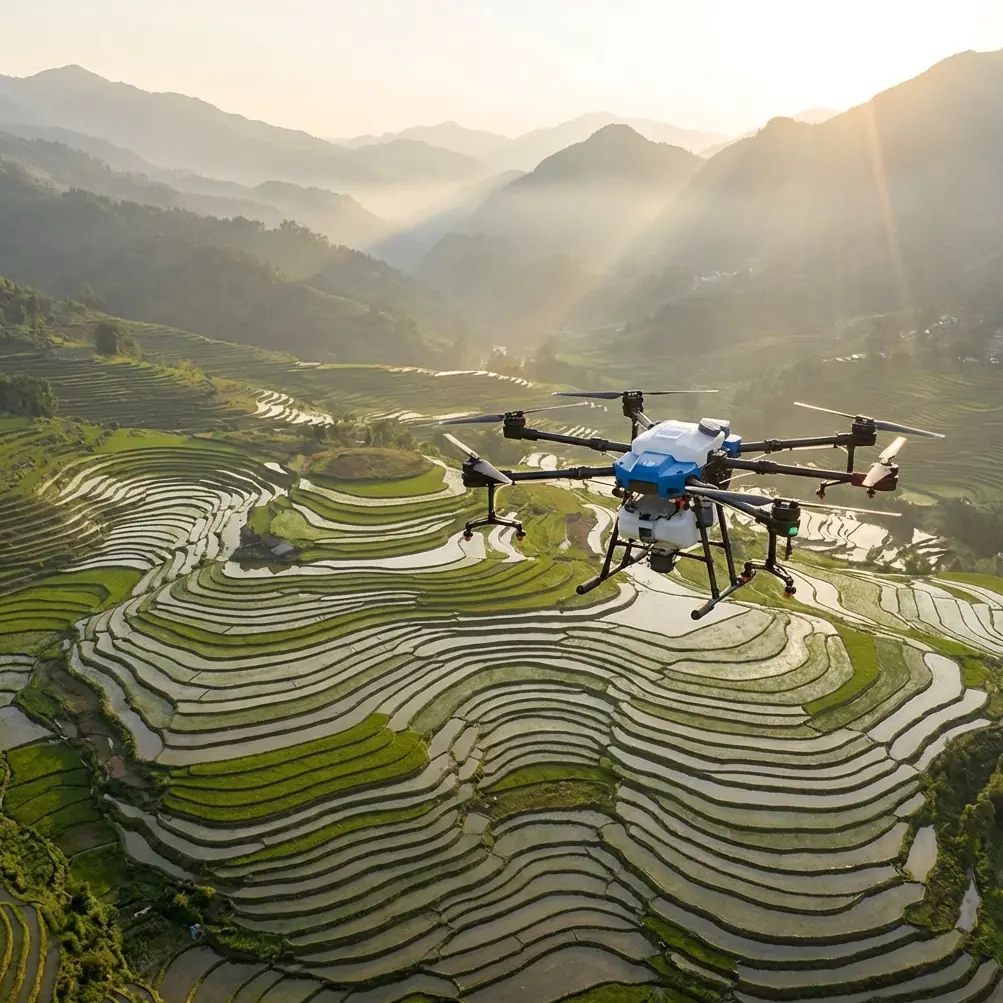
Agras T100 in Tight Vineyard Airspace: A Field Strategy for Urban Mapping and Precision Application
META: A practical case-study style look at how the Agras T100 can be deployed in urban vineyard environments, with training discipline, antenna positioning advice, RTK-focused workflow thinking, and precision setup insights.
Urban vineyards expose every weakness in a drone operation.
Not just the obvious ones, like signal blockage near buildings or awkward takeoff zones. The subtler weaknesses matter more: sloppy route planning, vague training habits, poor antenna orientation, and the assumption that maximum settings always deliver the best result. They don’t.
That last point is where many operators quietly lose accuracy.
When I advise teams evaluating the Agras T100 for vineyard work in built-up areas, I usually start with a principle that has nothing to do with brand loyalty and everything to do with operational maturity: the best result rarely comes from pushing one variable to its extreme. One of the reference examples here comes from phone photography, where aperture controls incoming light and background blur. Open it too far and the background does blur more, but the subject can soften as well, and the blur edge starts to look artificial. That idea translates surprisingly well to drone work. In a vineyard bordered by roads, walls, utility lines, and residential structures, “max everything” is often the fastest route to uneven outcomes.
With the Agras T100, success in urban vineyard mapping and precision treatment is not about running the widest possible swath, the longest conceivable link, or the most aggressive pass spacing. It is about tuning the machine and the workflow so the crop is measured clearly, treated consistently, and documented in a way the grower can trust.
Why the Urban Vineyard Is a Different Kind of Job
A vineyard in open rural terrain lets a pilot think in broad rectangles. An urban vineyard does not. Parcel shapes bend around roads, homes, service alleys, retaining walls, and tree lines. GNSS conditions can change from one edge of the block to another. Radio conditions can be clean above the canopy and noisy the moment the aircraft passes beside a masonry wall or metal-roofed structure.
That is exactly where a platform like the Agras T100 gets judged in real terms. Not on brochure abstractions, but on whether it can hold repeatable lines, maintain a stable RTK fix rate, and support data-driven work without turning each sortie into a hand-flown improvisation.
For vineyard managers, the stakes are practical. They need centimeter precision where row spacing is unforgiving. They need predictable swath width so coverage does not fluctuate between the center rows and the perimeter. They need controlled application behavior to reduce spray drift near roads, patios, and neighboring lots. And in many urban-edge vineyards, they need a machine that can tolerate water, dust, residue, and frequent washdown cycles. That is why details like IPX6K-style ruggedness matter operationally, even if they seem secondary at first glance. In commercial fieldwork, survivability is efficiency.
The Most Useful Lesson Isn’t From Agriculture
One of the strongest reference points behind this article comes from a training text on model aircraft aerobatics. Its message is simple and durable: don’t train randomly. Build purposeful sequences. Combine actions. Use a defined plan so you can tell whether you’re improving.
That mindset is exactly what separates a competent T100 operator from a merely active one.
In urban vineyard work, pilots who “just go fly” tend to produce inconsistent maps, irregular overlap, and variable application quality. Pilots who train in linked sequences build repeatability. They rehearse takeoff orientation, antenna alignment, RTK lock confirmation, row-entry geometry, pass transitions, obstacle checks, turn behavior, and return procedures as one integrated chain rather than isolated tasks.
This matters because a vineyard mission is not a single skill. It is a sequence. If one part breaks, the whole operation degrades.
The aerobatic training reference also makes another point worth stealing: if you only perform individual maneuvers one at a time, you may never know whether your overall control has actually improved. In drone terms, that means a pilot can be good at calibrating a system, or good at flying a straight line, or good at setting nozzle parameters, and still fail the actual mission because those skills were never practiced together under real constraints.
For an Agras T100 crew operating in urban vineyards, training should be built around full mission combinations:
- site arrival and launch-zone assessment
- base station or RTK setup
- antenna placement and controller orientation
- route confirmation against parcel edges
- nozzle calibration check
- low-altitude test pass
- verification of overlap and line holding
- obstacle transition behavior
- return, refill, battery swap, and relaunch timing
That is not glamorous. It is effective.
Antenna Positioning Advice That Actually Improves Range
The user brief asked for one specific operational spark: antenna positioning advice for maximum range. Here is the version I give in the field.
In urban vineyards, maximum range is rarely about raw transmitter capability. It is usually about preserving line-of-sight geometry and minimizing self-inflicted attenuation. Put simply, don’t let your own setup sabotage your link.
With the T100 controller, the antenna should be oriented so its broadside, not its tip, faces the aircraft’s working area. Operators often point antennas like arrows toward the drone, which feels intuitive but is commonly suboptimal. Keep the controller high enough to clear your torso, and avoid standing directly beside vehicles, metal sheds, or reinforced concrete corners that can reflect or partially block the signal. If the vineyard steps downhill between rows, don’t stand at the very crest if vines and trellis hardware will hide the aircraft during low passes. Shift laterally until the aircraft remains visible for the majority of the route.
That one adjustment can do more for practical link stability than chasing theoretical distance.
In urban sites, I also tell crews to choose the pilot position based on the midpoint of the working block, not the convenience of the parking spot. It saves time later because the aircraft spends less of the mission flying at poor geometry relative to the controller. Better geometry generally supports a steadier command link and helps maintain cleaner workflow when the RTK fix rate is critical.
If your team needs a second opinion on controller setup or site geometry, you can send a field layout through this direct WhatsApp line and get a practical read on antenna placement before deployment.
Precision Is More Than RTK
Centimeter precision is one of those phrases that gets repeated so often it starts sounding like decoration. In vineyards, it isn’t decoration. It determines whether your map aligns with actual row structure and whether repeat treatments stack correctly over time.
But precision is not produced by RTK alone.
The reference material on civilian drone power systems, though focused on helicopter development, highlights a core engineering truth: compact aircraft demand efficient power, long endurance, and low fuel or energy consumption while maintaining useful output. Translate that into modern commercial UAV operations and the lesson becomes clear. Endurance is not just about staying airborne longer. It is about preserving enough energy margin to finish a mission cleanly, without rushed turns, unstable ground speed, or compromised return planning.
For the Agras T100 in an urban vineyard, this matters because stop-start missions are common. Small parcels, segmented blocks, and repeated edge handling create more transitions than broadacre work. If the aircraft’s energy planning is casual, data quality suffers. Mapping lines drift. Application consistency changes near the end of a sortie. Re-entry after a battery swap becomes less tidy than the operator assumes.
That is why I treat RTK fix rate, battery discipline, and route segmentation as one discussion, not three. A high fix rate is only useful if the aircraft can complete each route segment with stable flight behavior and predictable timing. Precision is a systems outcome.
The “Maximum Setting” Trap in Vineyard Mapping
Let’s return to the phone aperture analogy because it is stronger than it first appears.
The reference says that opening the aperture to the maximum does not automatically create the best portrait effect. Push it too far and even the subject can lose clarity. The blur edge may look fake. The right setting is the one that keeps the subject sharp while softening the background naturally.
That is a strong mental model for configuring Agras T100 missions in urban vineyards.
Take swath width. Operators chasing maximum throughput may be tempted to stretch width aggressively, especially in visually uniform blocks. But vineyards in urban environments are full of variables that punish overextension: trellis shadows, irregular row edges, local wind curls, and abrupt terrain transitions. If the swath is pushed beyond what site conditions can support, coverage may look efficient on paper while becoming uneven in reality.
The same applies to spray drift management. Wider or more aggressive settings can look productive until wind channels between structures or across retaining walls begin carrying fine droplets outside the intended canopy zone. In these sites, nozzle calibration is not a box-ticking exercise. It is the difference between disciplined canopy placement and a preventable compliance problem.
A competent T100 workflow therefore avoids extremes. It finds the point where application density, flight speed, nozzle behavior, and row spacing are working together. The result may not be the most dramatic spec-sheet interpretation. It is usually the most defensible agronomic outcome.
A Practical Urban Vineyard Workflow for the T100
When I architect a T100 operation for a vineyard hemmed in by urban features, I usually structure it in five layers.
1. Build the mission around row reality, not parcel geometry
Start with the vine rows as the primary truth. Parcel boundaries matter, but they are secondary to crop orientation. Mapping, multispectral review, and application planning all improve when the route logic respects the row structure first.
2. Secure RTK conditions before the first productive pass
Do not treat the RTK fix rate as something to monitor after launch. Confirm it before committing to the route. If one edge of the vineyard suffers intermittent signal degradation due to nearby buildings, split the block into segments instead of pretending the whole site behaves the same way.
3. Tune swath width conservatively at the start
Use the first passes to verify actual coverage behavior against vine spacing and canopy architecture. This is where the aperture lesson applies: bigger is not automatically better. The best width is the one that remains accurate at the edges.
4. Calibrate nozzles like the boundary rows matter most
Because they do. Interior rows can hide small mistakes for a while. Boundary rows expose them immediately, especially where there is concern about spray drift toward public or residential spaces.
5. Rehearse mission sequences, not isolated actions
This is where the training reference earns its place. A crew improves faster when it practices entire operational combinations rather than disconnected tasks. That includes relaunch procedures, partial-block resumes, and handoff communication between pilot and observer.
What Multispectral Can Add to the T100 Discussion
Even when the immediate task is treatment rather than pure surveying, multispectral workflow thinking belongs in the conversation. Urban vineyards often show variability that standard visual inspection underestimates: heat stress near reflective surfaces, vigor differences along walls, and drainage-driven shifts between terraces or sub-blocks.
The Agras T100 becomes more valuable when it is used as part of a structured agronomy loop rather than a one-off flying tool. Map. Interpret. Adjust. Re-run. Compare. That sequence mirrors the training philosophy in the aerobatics document: planned combinations reveal progress; random repetition does not.
For growers, this means the drone operation starts producing management value rather than just air time. For consultants, it means recommendations become measurable. For operators, it creates a feedback system that improves every subsequent mission.
The Real Benchmark for an Agras T100 Crew
The benchmark is not whether the drone can fly the vineyard.
Almost any serious agricultural platform can do that under decent conditions.
The benchmark is whether the crew can produce repeatable outcomes in a constrained, noisy, uneven, urban-edge environment where every shortcut gets exposed. The references behind this article point to the same answer from different directions.
From the phone aperture example: avoid the naive belief that maximum settings create the best result. Precision often lives in the middle, where the subject stays clear and the effect remains natural.
From the UAV power discussion: compact flight systems succeed when efficiency and endurance are engineered into the mission, not assumed.
From the training manual: progress becomes visible when actions are combined into a deliberate sequence with a defined objective.
That, in my view, is the right way to think about the Agras T100 for urban vineyard mapping and precision work. Not as a machine that solves complexity by itself, but as a platform that rewards disciplined setup, better antenna positioning, conservative tuning, and sequence-based crew training.
In vineyards surrounded by infrastructure, those habits are what turn hardware into performance.
Ready for your own Agras T100? Contact our team for expert consultation.