
Agras T100 Monitoring Tips for Power Lines in Complex Terrai
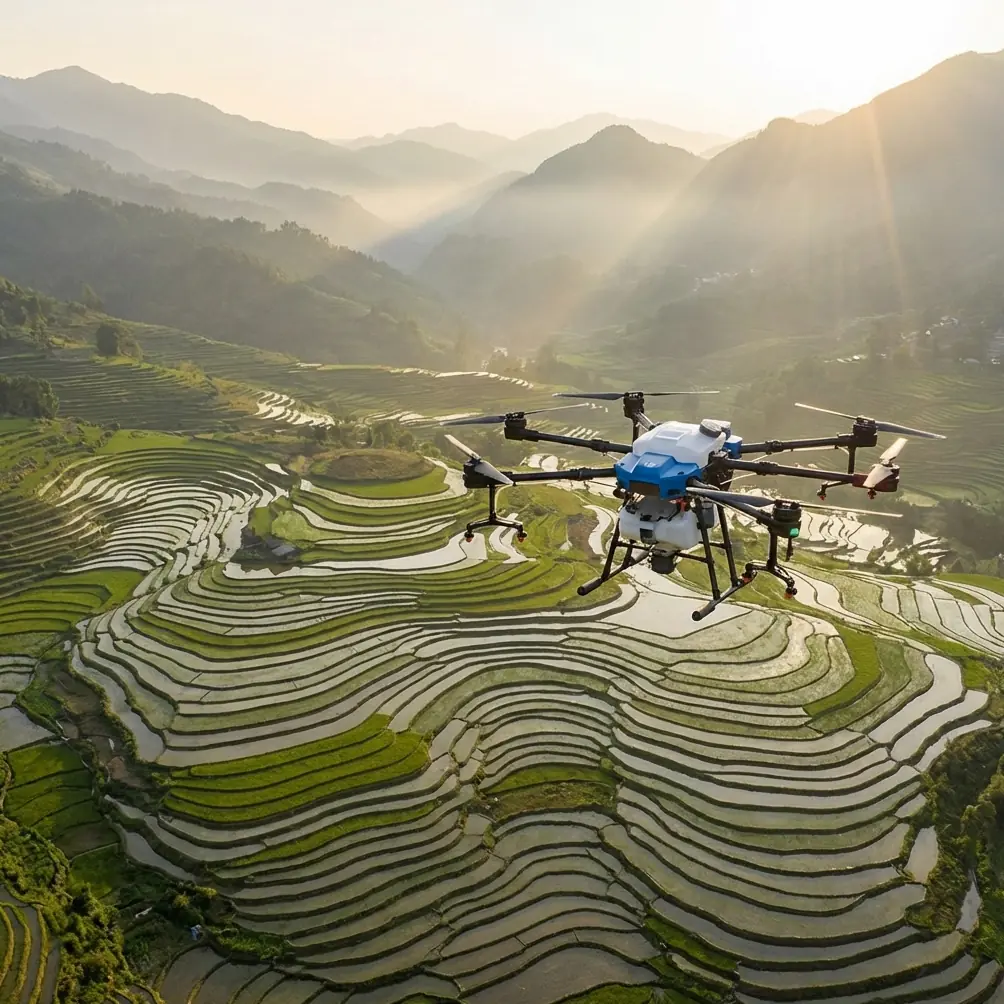
Agras T100 Monitoring Tips for Power Lines in Complex Terrain
META: Practical Agras T100 field tips for monitoring power lines in steep, obstacle-heavy terrain, with guidance on RTK fix stability, pre-flight cleaning, swath control, nozzle calibration, and weather-aware drift management.
Power-line inspection in broken terrain asks more of an aircraft than a flat-field spraying mission ever will. Elevation changes compress reaction time. Towers, conductors, trees, and crosswinds create a messy airspace. Even before payload strategy enters the discussion, the real question is whether the platform can maintain stable positioning, predictable path tracking, and safe standoff behavior when the environment stops being forgiving.
That is why the Agras T100 deserves a more technical conversation than the usual spec-sheet summary. For operators working around utility corridors, especially in hills, terraces, or narrow rights-of-way, the T100 is not just a high-capacity agricultural drone that can be repurposed. Its value comes from how precisely you prepare it, how carefully you manage sensing reliability, and how deliberately you adapt spray-system settings even when the day’s primary objective is monitoring rather than application.
This guide is written for crews using the Agras T100 near energized infrastructure, where centimeter-level positioning, sensor cleanliness, and flight-discipline matter more than raw throughput.
1. Start with a cleaning routine, not a battery check
Most crews begin their pre-flight sequence by thinking about charge state, tank condition, or route upload. Around power lines, that order should change. On the T100, the safest first move is a cleaning inspection focused on the aircraft’s sensing and exposure points.
If your aircraft has been operating in dusty farm environments, around dried chemical residues, or in wet roadside vegetation, contamination can quietly degrade safety features. A thin film of residue on vision-related surfaces, radar windows, lighting assemblies, landing gear contact areas, or connector seals may not trigger an obvious alert on the ground. In terrain with wires, slope, and clutter, that is exactly the kind of hidden problem that becomes operationally expensive.
A practical sequence looks like this:
- Wipe external sensing surfaces with a lint-free cloth before powering on.
- Inspect for dried deposits around arm joints and underbody housings.
- Check nozzle bodies and spray plumbing for residue, even if you are not planning a full application mission.
- Confirm connectors and protective covers are seated cleanly.
- Look for trapped mud or organic debris around landing gear and lower fuselage.
Why begin here? Because the T100’s safety envelope depends on clean, trustworthy inputs. A drone operating near conductors does not get many second chances. If obstacle awareness, altitude interpretation, or position holding are being influenced by grime, the aircraft may still fly, but the margin shrinks.
The mention of cleaning matters operationally in another way too: the T100 is associated with a high-ingress protection mindset, and equipment in this class is often expected to tolerate harsh field conditions. But robust environmental protection is not the same as “maintenance free.” Even with an IPX6K-grade weather-resistant design philosophy in mind, crews should treat water and dust resistance as resilience, not permission to skip surface care.
2. Treat RTK fix rate as a safety variable, not a convenience feature
For line monitoring in complex terrain, the T100’s ability to hold precise position is more than a mapping nicety. It directly influences corridor discipline.
When crews talk about “good RTK,” they often mean a binary state: fixed or not fixed. That is too simplistic for power-line work. What matters is RTK fix rate stability over time and along the specific route segment you intend to fly. A brief fixed solution on the launch pad is not enough. Valleys, ridgelines, tower structures, and vegetation can all affect satellite geometry and signal continuity.
Centimeter precision sounds abstract until you put it next to a conductor span on a side slope. Then it becomes very concrete. A small positional inconsistency can alter your lateral offset, your camera angle, your overlap pattern, and your confidence in repeat passes. If you are documenting vegetation encroachment or right-of-way conditions, repeatability is part of the job.
Before launching, verify three things:
- The RTK solution is stable at the takeoff point and remains stable during a short hover test.
- Your route does not pass through sections where terrain masking is likely to interrupt fix continuity.
- The aircraft transitions cleanly between manual positioning checks and planned path behavior.
For operators who are also collecting imagery for vegetation assessment, stable RTK behavior helps when comparing passes over time. If one mission is flown with strong fix continuity and the next is not, apparent changes on the ground may reflect flight inconsistency rather than corridor change.
This is also the point where many teams realize that a monitoring mission near power infrastructure is not purely a visual task. It is a geospatial discipline. The T100 becomes more useful when you think in terms of repeatable offset management, not just “fly close and look carefully.”
3. Keep spray hardware calibrated even on inspection-focused days
At first glance, nozzle calibration may seem irrelevant if the assignment is corridor monitoring. It is not. Many utility-adjacent teams use the same T100 fleet for both inspection and vegetation-control operations. If the spray system is fitted, neglected calibration can introduce two problems.
The first is weight and balance predictability. Uneven nozzle condition, trapped residue, partial blockage, or fluid asymmetry can affect aircraft behavior more than crews expect, especially when maneuvering on slopes or in gust-prone cuts.
The second is mission crossover risk. Inspection flights often become decision flights. You may inspect first, then plan selective treatment later. If your nozzle calibration history is poor, the operational handoff from observation to action becomes slower and less reliable.
A disciplined calibration routine should include:
- Checking nozzle output uniformity after cleaning
- Verifying there is no partial clogging from dried residue
- Confirming spray pattern consistency before any treatment planning
- Recording the current setup so the next crew understands aircraft state
This matters because swath width and droplet behavior are not just agronomy topics; they affect how precisely you can work near sensitive infrastructure and adjacent vegetation. A drone that is expected to fly utility corridors must be able to shift from observation to controlled application without guesswork.
4. Manage spray drift like an inspection hazard, not only an application hazard
Spray drift belongs in this discussion even when the main task is monitoring. Utility corridors often sit in the exact kinds of wind funnels operators dislike: ridges, cuts, open edges, and abrupt changes in canopy cover. Those same conditions that move droplets can also destabilize low-altitude flight and distort image consistency.
If your T100 mission includes any treatment planning or selective spot work near poles, substations, or vegetation beneath lines, drift control becomes a systems issue. It is not only about chemical placement. It is about staying honest with aircraft behavior in moving air.
Use local terrain reading, not just the headline wind number. A “safe” forecast can still produce lateral pulses near towers and saddles. In practice:
- Reduce assumptions about symmetrical coverage
- Reassess swath width when slope and crosswind interact
- Watch how airflow changes near conductors and tower bodies
- Avoid treating a nominal spray width as if it remains constant across uneven ground
That last point is often missed. Swath width on paper is only a planning baseline. In utility corridors, airflow deformation and terrain relief can narrow effective deposition in one section and push material wider in another. If you are using the T100 both to inspect and to support vegetation management, your monitoring data should inform those later drift decisions.
5. Use multispectral logic even if your payload plan is simple
The term “multispectral” is sometimes treated as a specialist add-on, but the underlying logic is broadly useful: do not rely on visible appearance alone when judging corridor condition.
Even if your current T100 mission setup is centered on standard visual assessment, the inspection method should borrow from multispectral thinking. Ask what the vegetation is doing physiologically, not just what it looks like from above. Stressed growth near conductors can blend into the background until it becomes structurally significant. Moisture differences, regrowth vigor, and patchy canopy recovery after maintenance are easier to interpret when crews think beyond color alone.
Operationally, this changes flight planning. You may choose:
- Slower passes in areas with mixed species growth
- More consistent altitude above terrain, not above canopy tops
- Repeat routes designed for comparison over time
- Better geotag discipline so suspect zones can be revisited accurately
The T100 is most effective in corridor work when it is treated as part of a monitoring workflow, not as an isolated aircraft event.
6. Build your route around terrain, not around the map line
Utility maps suggest order. Terrain creates reality.
A straight corridor on a screen can conceal sharp elevation transitions, side-hill turbulence, blind rises, and vegetation walls. The T100 should not be asked to “follow the line” in a simplistic sense when the terrain beneath it constantly changes the risk profile.
Instead, divide the corridor into behavior zones:
- Open segments where stable offsets are easy to maintain
- Tower approach zones where obstacle complexity increases
- Ridge or saddle transitions where airflow may shift abruptly
- Dense vegetation sections where visual interpretation needs slower speed
This zoning approach helps with pilot attention and route quality. It also supports more reliable RTK monitoring because you know where to expect satellite geometry issues or partial masking. If your team needs a field-ready checklist for corridor setup, it helps to keep one on a mobile device or briefing card; I often recommend crews build a shared version alongside their flight notes, and if you need a quick template, this corridor mission chat link is an easy way to keep the checklist circulating among field staff.
7. Respect weather sealing, but verify after every harsh mission
The T100 is the kind of aircraft operators expect to use in demanding conditions. That expectation is justified only when post-flight inspection is taken seriously.
An IPX6K-style protection level is meaningful in field operations because it points to resistance against heavy water exposure and contamination. For power-line monitoring, this matters after flights through mist, wet vegetation, roadside dust, or wash-down cleaning. But the operational significance is not just survivability. It is consistency. Seals, covers, and exterior condition influence whether tomorrow’s sensor readings and connector performance will be as dependable as today’s.
After difficult terrain missions, check:
- Moisture intrusion signs around service points
- Residue accumulation in lower-body recesses
- Fastener security after vibration-heavy segments
- Wiring and connector cleanliness before storage
This is where experienced crews separate durability from reliability. A drone can endure rough conditions and still become less trustworthy if the maintenance cycle is casual.
8. Create repeatable evidence, not just a successful flight
A successful inspection is not merely a safe landing and a folder full of images. It is a set of observations another crew can reproduce.
For the Agras T100 in power-line work, that means documenting the exact flight logic used in terrain-challenged sections: launch point, altitude strategy, offset assumptions, RTK behavior, wind anomalies, and any sensor-cleaning actions taken before the mission. If the aircraft needed additional nozzle cleaning, if drift risk forced a narrower effective corridor, or if a slope created temporary fix instability, those details belong in the record.
That traceability pays off later. It tells the next team whether a detected anomaly came from the corridor or from the flight environment. It also improves operational handoffs between monitoring and vegetation-control crews.
The reason this matters so much on the T100 is that it sits at the intersection of precision flight and field utility. Its strengths are not fully realized by pushing it harder. They are realized by making its behavior more repeatable.
Final field takeaway
For complex-terrain power-line monitoring, the Agras T100 performs best when crews think like systems managers, not just drone pilots. Clean the aircraft before evaluating readiness. Watch RTK fix rate over the route, not just at takeoff. Keep nozzle calibration current because inspection and treatment operations often overlap. Treat spray drift as a sign of unstable local airflow, not merely as an application concern. Use multispectral logic in how you interpret vegetation, even when the mission is visually led. And never confuse environmental protection with immunity from maintenance.
Those habits sound small. In the field, they decide whether centimeter precision remains real after takeoff.
Ready for your own Agras T100? Contact our team for expert consultation.