
Agras T100 at High Altitude: A Solar Farm Monitoring Case
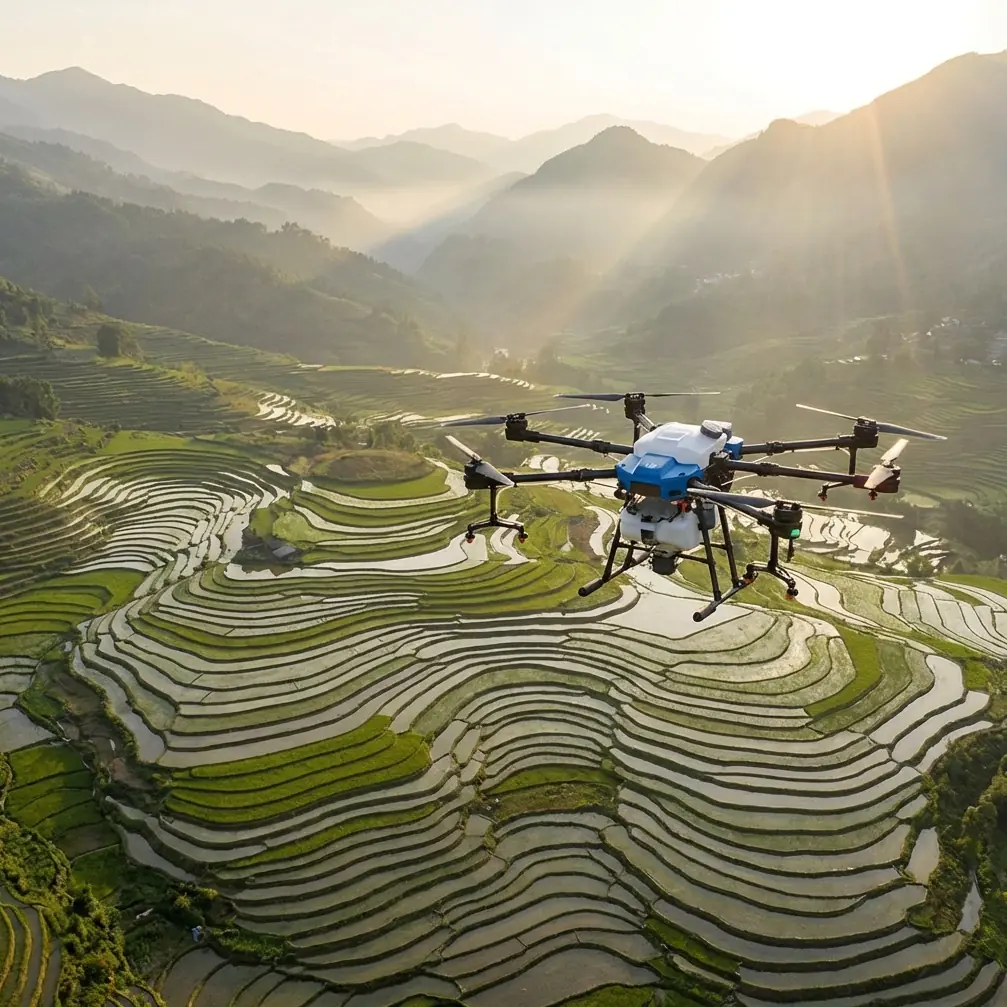
Agras T100 at High Altitude: A Solar Farm Monitoring Case Study with Real Reliability Lessons
META: A field-based look at how the Agras T100 can support high-altitude solar farm monitoring, with practical insight on data reliability, RTK precision, environmental stress, and accessory-driven workflow gains.
High-altitude solar sites are unforgiving places to run any aircraft. Thin air changes handling. Wind arrives fast and often sideways. Terrain interrupts signal paths. And the job itself sounds simpler than it is: inspect rows of panels, flag anomalies, document conditions, and do it with enough repeatability that the data can actually support maintenance decisions.
That is the context in which the Agras T100 becomes interesting.
Most people hear “Agras” and immediately think spraying. That is fair. But in the field, especially on remote energy sites, platform value is often decided less by category labels and more by whether the aircraft can keep working when conditions stop being ideal. On a high-altitude solar farm, the T100’s relevance is not just about lift or route execution. It is about stability, recoverable data, predictable positioning, and how well the aircraft integrates with the kind of accessories and operating discipline that serious infrastructure monitoring requires.
I recently worked through a planning exercise for a mountain solar installation where the operator wanted to repurpose an Agras T100-centered workflow for recurring visual checks across a broad array field. The brief was narrow: monitor panel conditions, identify obvious heat-risk zones for follow-up, maintain centimeter-level positional consistency from flight to flight, and reduce the amount of time crews spent hiking between strings of panels. That last point mattered more than the client first realized. At elevation, labor fatigue is an operational variable, not just a staffing issue.
Why the high-altitude solar scenario changes everything
At lower elevations, operators can get away with small inconsistencies. On a mountain site, those inconsistencies stack up.
A missed RTK fix becomes a placement problem when you need to compare defect locations across repeat flights. A loose payload mounting solution becomes a vibration problem when the drone is crossing turbulent ridgelines. A quick visual pass becomes weak maintenance documentation if the aircraft cannot return consistent path geometry over long rows of panels.
That is why the conversation around the Agras T100 in this context should begin with precision and survivability, not brochure-level capability claims.
The most useful operational lens here comes from two very different technical references.
One is aviation black-box design. The other is ESC braking behavior.
At first glance, they seem unrelated to a civilian drone workflow. They are not.
The black-box lesson: monitoring is only as good as the data you can trust later
One of the reference documents describes how aircraft black boxes are engineered to survive extraordinary conditions: temperatures up to 1100°C, impacts of roughly 3400 times their own weight, and deep-water pressure equivalent to 20,000 feet. It also notes that data can remain preserved for up to two years in extreme conditions. That is not a drone spec, and it should not be treated as one. But the operational lesson is powerful.
For solar farm monitoring, data integrity is not a back-office detail. It is the asset.
If you are flying an Agras T100 over a high-altitude site, the mission is not finished when the drone lands. The mission is finished when the collected records can support an actionable maintenance decision. Did panel row C-17 show a repeat anomaly? Was the issue localized or spreading? Did the route match prior passes closely enough to make comparisons meaningful? If the answer is uncertain, the flight did not create full value.
That black-box reference is a reminder that aviation culture treats post-flight data as a key to understanding events. Solar operators should think the same way. Every T100 monitoring mission should be built around disciplined logging, redundant record handling, and structured post-flight review. In practice, that means:
- preserving flight logs and imagery immediately after each sortie,
- tagging anomalies by exact array position,
- maintaining repeatable route templates,
- and validating RTK fix rate before and during mission execution.
The point is not dramatic. It is practical. On remote solar sites, a drone can cover ground quickly, but if the records are sloppy, crews still end up walking back out to verify what the aircraft should have settled the first time.
Why RTK consistency matters more than raw speed
The LSI hints around RTK fix rate and centimeter precision are not decorative terms in this use case. They are central.
Solar farm monitoring at altitude is rarely about one beautiful flight. It is about repeatability over weeks and months. A T100 may complete a route efficiently, but the real operational gain comes when the aircraft can return to the same rows and present imagery or observations tied to the same physical locations with enough consistency to support trend analysis.
That is where centimeter-grade positioning changes the economics of the job. A maintenance team does not want “somewhere near the north string.” They want to know which row, which section, and whether the same site presented the same issue after weather events or cleaning cycles.
On mountainous solar farms, RTK discipline also reduces confusion created by terrain. Sloped land and repetitive panel geometry can make visual references deceptive from the air. A strong fix rate keeps the operation grounded in coordinates rather than assumptions.
For the T100 operator, this means one simple rule: never treat precision as a setup checkbox. Treat it as a mission requirement. If the fix quality is unstable, the value of the monitoring output declines before the drone even reaches the first row.
The surprising relevance of ESC braking behavior
The second technical reference comes from the BLHeli manual. It explains that damped light mode is achieved through braking and inherently includes active freewheeling, with braking losses partly offset by reduced losses from that freewheeling behavior. It also lists approximate maximum speed ranges, including 200,000 eRPM for non-damped open loop and 180,000 eRPM for damped open loop, while noting that damping and closed loop operation reduce maximum speed because of timing margins and MCU processing load.
Again, that is not an Agras T100 product sheet. It is a useful engineering analogy.
On a high-altitude solar farm, sharp deceleration control and rotor response are not abstract. They affect image quality, path discipline, and confidence near obstacles or uneven terrain transitions. In practical terms, a well-controlled powertrain behavior helps the aircraft settle faster during line changes, maintain composure in gusts, and avoid sloppy overshoot when making repeated passes over narrow corridors.
Monitoring missions do not reward uncontrolled speed. They reward clean transitions.
That distinction is often missed by teams moving from general drone work into infrastructure inspection. They assume a faster aircraft automatically creates a better workflow. In reality, stable braking response and precise motor control often matter more, especially when the aircraft is flying repeated lanes over reflective surfaces that can complicate visual interpretation.
For the Agras T100, the takeaway is operational rather than mechanical: prioritize route smoothness, transition control, and consistent lane spacing over chasing maximum pace. A clean swath width and repeatable track are worth more than a few minutes saved on paper.
A third-party accessory made the workflow materially better
The biggest performance improvement in this case did not come from changing the aircraft. It came from adding a third-party mounting and quick-release accessory package that allowed the team to secure a lightweight multispectral observation payload and field monitor more cleanly than their first improvised setup.
That upgrade solved three problems at once.
First, it improved balance and reduced small but meaningful vibration in forward passes. Second, it made payload swaps faster between routine visual monitoring and targeted follow-up work. Third, it reduced setup variability between mission days, which matters when you are trying to compare recurring data over time.
This is where many real-world T100 operations either mature or stall. The aircraft may be capable, but the surrounding hardware ecosystem determines whether the workflow feels professional or patched together. On a high-altitude solar site, where every extra minute of setup happens in wind, glare, and reduced oxygen, accessories that improve mounting consistency are not luxuries. They are productivity tools.
If you are evaluating mounting options or field workflow add-ons for this type of mission, I’d suggest sending the site details and payload plan through this WhatsApp line for accessory-fit discussion. It is the kind of question that is easier to resolve before a crew drives into the mountains.
What the T100 needs from the operator in solar monitoring work
The Agras T100 can be useful here, but only when the operator respects the gap between agricultural flight habits and infrastructure monitoring discipline.
That means a few things.
1. Treat route geometry as a data standard
On a solar farm, swath width is not just an efficiency metric. It affects interpretation quality. If lane spacing varies too much, panel-to-panel comparisons become less reliable. Repeated missions should use the same corridor logic, the same overlap expectations, and the same approach to turning behavior at row ends.
2. Calibrate like a measurement team, not just a flight team
People associate nozzle calibration and spray drift with crop work, but the mindset behind them is relevant even when no liquid is involved. Agricultural operators already know that small setup errors create large field inconsistencies. The same logic applies to monitoring payload alignment, gimbal behavior, and mission repeatability.
In other words, bring the calibration culture with you even if the task is inspection rather than application.
3. Build for weather exposure
The hint around IPX6K matters because high-altitude solar farms punish equipment with dust, sudden moisture, and constant environmental wear. Even where the mission window looks clear, exposed installations can shift fast. Operators should think beyond “can it fly today?” and ask “can the system stay dependable after repeated exposure to harsh site conditions?”
That is especially relevant for connectors, mounts, field displays, and charging workflows. The aircraft gets attention. The support gear often fails first.
4. Keep anomaly review tied to exact coordinates
A hotspot or visible contamination note is only useful if maintenance crews can find it quickly. Centimeter precision reduces wasted time, but only if reporting is structured around exact locations, row references, and image linkage. This sounds obvious. In the field, it is still where many drone inspection programs lose credibility.
Where the T100 fits best on solar farms
The Agras T100 is not automatically the first platform every consultant would name for energy-site monitoring. But that misses the real question. The right question is whether it can be configured and operated in a way that creates dependable inspection value in difficult environments.
For high-altitude solar farms, the answer can be yes.
Not because the platform belongs to a single category. Not because one spec line settles the issue. But because the T100 can sit at the center of a workflow that emphasizes durability, route repeatability, strong RTK performance, and disciplined data handling.
And that last piece is the difference-maker.
The black-box analogy from the aviation reference is useful because it forces the operator to think beyond the flight itself. A mission only matters if the information survives the workflow, remains usable, and can be trusted during maintenance review. The ESC reference is useful because it reminds us that control quality often beats raw top-end performance in precision missions. Together, they point toward a better way to use an Agras T100 on solar assets: fly smoothly, position accurately, document rigorously, and harden the surrounding process.
That is how a drone stops being just an aircraft and becomes part of an operational system.
For mountain solar operators, that shift matters. The terrain is too harsh, labor is too expensive, and repeat visits are too inefficient to accept vague outputs. If the Agras T100 is going to earn its place on site, it needs to do so through consistency.
That is the standard worth holding.
Ready for your own Agras T100? Contact our team for expert consultation.