
How I’d Use the Agras T100 to Monitor Vineyards in Extreme T
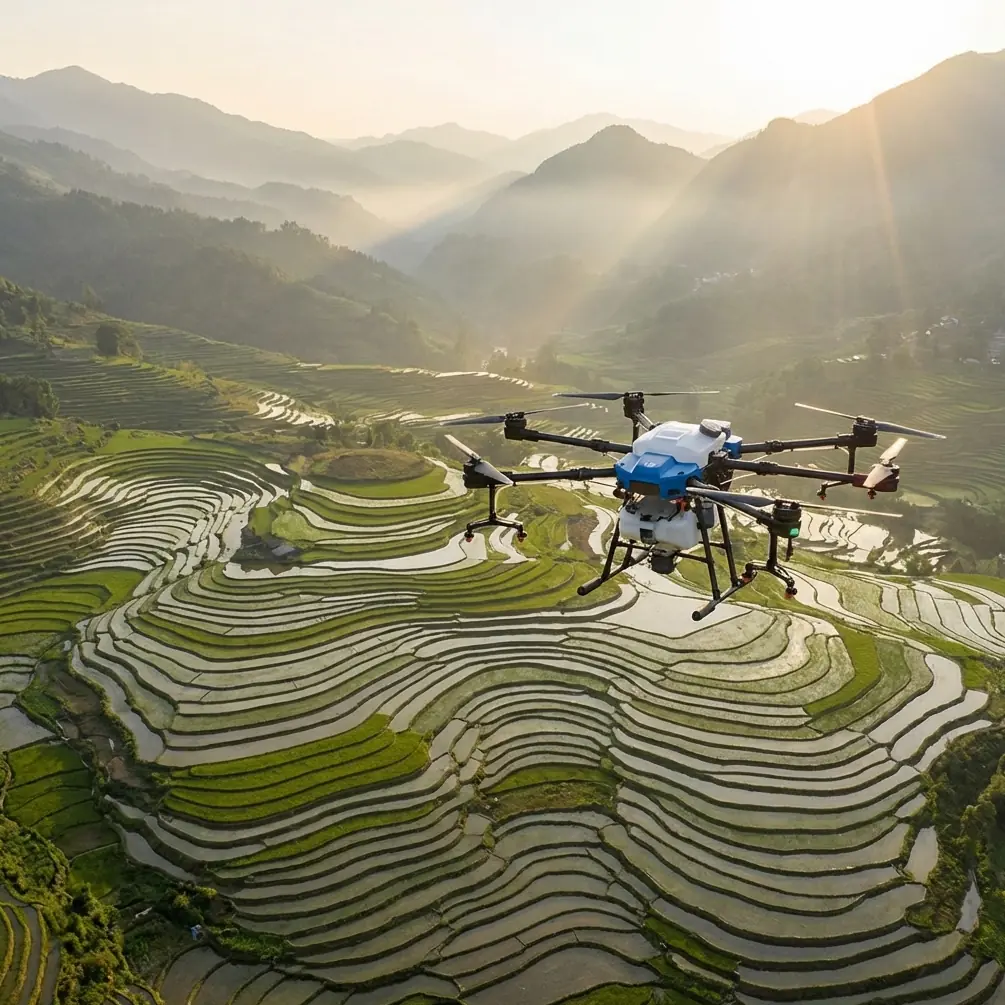
How I’d Use the Agras T100 to Monitor Vineyards in Extreme Temperatures
META: A field-focused guide to using the Agras T100 for vineyard monitoring in extreme heat and cold, with practical insight on spray drift, pilot training, system checks, and precision operations.
Vineyards punish weak workflows.
Rows are narrow. Terrain is uneven. Wind behaves differently at the edge of a block than it does in the center. Add extreme heat in late summer or sharp temperature swings during shoulder seasons, and small operating mistakes become expensive ones. I’ve seen this firsthand on sites where the morning looked manageable, then by midday the crop stress pattern changed, drift risk climbed, and the original flight plan no longer made sense.
That is the context where the Agras T100 becomes interesting—not as a generic “smart agriculture” platform, but as a tool that can simplify vineyard monitoring and treatment decisions when conditions are unstable.
If I were setting up a T100 workflow for vineyard monitoring in extreme temperatures, I would not begin with the aircraft. I would begin with discipline: pilot competency, system familiarity, and a repeatable field process. That may sound less exciting than talking about swath width or RTK fix rate, but in vineyards, reliability comes from the operator long before it comes from the airframe.
The first lesson: vineyard performance starts on the ground
One of the most useful reminders in the Chinese civil UAV pilot management rules is that operators are not supposed to improvise their way into competence. The regulation requires recorded ground training and a passed theory exam covering aviation rules, collision avoidance, radio communication, night operations, and high-altitude operations. It also requires practical or simulated flight training tied to the aircraft class being used.
That matters for the T100 because vineyards in extreme temperatures are exactly where “basic knowledge” stops being basic.
A pilot monitoring vines under thermal stress needs to understand more than route execution. They need to know weather interpretation, link performance, emergency procedures, and the characteristics of the specific unmanned system they are flying. The regulation explicitly calls for training on the aircraft’s own features, including takeoff and landing requirements, speed, climb and descent rates, turn performance, wind and precipitation limitations, and maximum endurance. In real vineyard work, those are not paperwork details. They determine whether you finish a block cleanly or come back with partial coverage, unstable data, or an unsafe recovery.
On pages 10–11 of that same document, the standard also sets minimum practical training times such as no less than 4 hours for route planning, 4 hours for system inspection procedures, 20 hours for normal flight command, and 20 hours for emergency flight procedures. For a T100 operator working in hot valleys or cold morning inversions, those numbers are a useful benchmark. They reflect a truth many growers only appreciate after an incident: flight consistency is built through repetition, not confidence.
Why vineyards are different from broadacre fields
A lot of agricultural drone advice gets borrowed from wider, flatter crop environments. Vineyards don’t forgive that shortcut.
The older agricultural UAV reference in the source material highlights several enduring advantages of low-altitude plant-protection operations: low drift, hover capability, no need for a dedicated runway, and rotor downwash that helps spray penetrate the crop canopy. It also notes that this method can reduce pesticide use by at least 50% and water use by 90% in suitable applications.
Those figures are not a promise for every vineyard. But they explain why the T100 class of aircraft is attractive in the first place.
Rows of grapes often need targeted work, not brute-force volume. A platform that can hover, work close to the canopy, and adjust to irregular block geometry is inherently better matched to vineyard structure than large conventional aerial methods. In hilly southern-style terrain, terraces, narrow access points, and fragmented parcels can make traditional machinery inefficient or impossible. The source document specifically points out that small plots and terraced land are a strong fit for UAV solutions. That observation may come from an earlier generation of ag drone adoption, but it still holds.
For the T100, this means the value proposition in vineyards is not only productivity. It is access and controllability.
My workflow for monitoring vineyards with the Agras T100 in extreme temperatures
When a client asks how I would approach this, I break it into six stages.
1. Define whether the mission is monitoring, spraying, or both
This sounds obvious, but crews often blur these objectives.
If you’re assessing vine stress in extreme heat, your priority may be pattern detection: weak irrigation zones, edge effects, heat concentration near reflective soil, or block sections where fruit exposure is too high. If you’re preparing a treatment mission after that, your priorities shift to nozzle calibration, droplet behavior, and drift management.
The T100 should be configured around the actual mission, not a vague idea of “checking the vineyard.”
If your setup includes multispectral support or another imaging layer in your broader operation, then use that data to inform the T100 mission design rather than flying every row at the same intensity. In extreme temperatures, variability usually isn’t random. It often follows irrigation pressure differences, slope orientation, canopy density, or airflow constraints. A good monitoring pass should help you isolate those patterns fast.
2. Build the flight plan around temperature windows, not convenience
Extreme temperatures compress your safe operating envelope.
In hot conditions, midday flights can create several issues at once: reduced battery efficiency, shifting wind behavior, increased evapotranspiration stress, and more volatile droplet performance if a treatment mission follows. In cold conditions, the challenge can be the opposite—slow starts, condensation risk, and delayed sensor stability in early morning.
This is where aircraft-specific knowledge becomes operationally significant. The pilot management rules emphasize knowing the drone’s performance limits, endurance, and weather-related restrictions. For a T100 operator, that translates into one simple discipline: never plan the block as if conditions will remain static.
I usually prefer three decision points:
- pre-dawn or early morning assessment for cold or stable air patterns
- mid-morning operational window for the cleanest routine flights
- a hard reevaluation point before afternoon heat peaks
A vineyard manager who flies by the clock instead of by microclimate will eventually lose precision.
3. Treat RTK fix quality as a crop-management variable
Centimeter precision is not a luxury in vineyards. It changes the usefulness of the result.
When you’re tracking the same rows repeatedly, RTK fix rate affects whether your comparisons are trustworthy. If row alignment drifts, your monitoring data becomes harder to interpret and your spray path consistency weakens. In broadacre work, a small positional error may be tolerable. In vineyards, especially on tight row spacing or sloped blocks, it can distort coverage assumptions.
That is why I treat RTK stability as part of agronomic quality control. If the T100 is not holding a dependable fix, I would rather pause and correct the issue than generate a neat-looking but misleading dataset.
This also links back to the training document’s focus on navigation and surveillance functions, as well as C2 link parameters and designated operating coverage. Precision flight is never just a GNSS problem. It is a system problem.
4. Use nozzle calibration and swath width conservatively when temperatures are extreme
Spray drift is one of the fastest ways to turn a technically successful flight into a poor vineyard outcome.
The older reference material praises low-altitude UAV spraying because drift is reduced and rotor downwash improves canopy penetration. That’s true in principle, but vineyards in hot or unstable weather demand restraint. The same downwash that improves penetration can also interact with canopy gaps, edge rows, and gust channels in ways that create uneven deposition if your nozzle calibration is off.
So with a T100, I would avoid treating the nominal swath width as an entitlement. I would validate it against:
- canopy density by block
- row orientation relative to wind
- slope-induced airflow changes
- temperature-driven evaporation risk
- target location within the vine wall
In practical terms, that often means tightening the effective swath, lowering assumptions about uniformity, and recalibrating nozzles sooner than a broadacre operator might expect.
You do not get points for theoretical coverage. You get results from repeatable deposition.
5. Run inspections like they actually matter
They do.
The pilot regulation requires no less than 4 hours of training on system inspection procedures, and that’s one of the most underrated details in the source material. In vineyard work, pre-flight checks are often the difference between a smooth morning and an aborted mission halfway through a row set.
On the T100, I would pay particular attention to:
- propulsion and arm condition
- spray system cleanliness and nozzle output consistency
- control link integrity
- RTK and navigation status
- battery thermal condition
- payload mounting security
- weather sealing after washdown or transport
If your operating environment includes dust, chemical residue, cold dew, or heat-soaked afternoon equipment, an IPX6K-style protection mindset matters even before you confirm the exact rating on a given configuration. In other words: don’t assume ruggedness replaces inspection. Ruggedness only widens your margin.
6. Prepare for communication and recovery failures before they happen
One surprising way the reference material helps modern ag operators is its attention to communication failure procedures. It specifically calls for knowledge of ATC communication issues, command-and-control data-link failure, and communication breakdowns between pilot and observer where applicable.
A vineyard crew might assume this is mostly for larger or more complex airspace operations. That is a mistake.
In high-temperature work, electronic stress rises. In remote or broken terrain, signal behavior can change. In steep vineyard blocks, visual continuity with the aircraft can also become less clean than expected. So before the T100 lifts off, I want the team aligned on:
- who owns mission authority
- where the fallback recovery points are
- what happens if the link degrades
- when the mission is abandoned rather than salvaged
That conversation is less glamorous than talking about autonomy, but it is what keeps a professional operation professional.
A past challenge that shaped how I look at the T100
Years ago, on a vineyard property dealing with intense late-season heat, the problem was not the drone. The problem was the assumption that one pass plan could cover the entire site.
The western rows were heating faster than the eastern side. Wind was negligible at launch, then started to channel through a low gap near midday. A treatment plan that looked efficient on paper was becoming progressively less precise in the field. The crew had decent flying ability, but weak process discipline. No structured pause. No meaningful recalibration of drift expectations. No row-by-row adjustment based on observed canopy response.
A platform like the Agras T100 makes that easier to fix because it supports a more controlled, repeatable operating style. But the aircraft only helps if the operator respects what the field is saying.
That is why, when people ask me how to monitor vineyards with a T100, I usually answer with a method rather than a feature list.
What separates a good T100 vineyard program from a mediocre one
The difference is not whether the drone can fly the row.
The difference is whether the team can turn that flight into decisions:
- which blocks need immediate intervention
- where heat stress is recurring
- whether deposition assumptions still hold
- whether precision remains reliable enough to compare flights over time
- when weather has invalidated the day’s original plan
The source material on China’s agricultural UAV development also contains a useful historical perspective. It describes the sector as having begun with many participants but relatively few fully developed agricultural entrants at the time, and notes that adoption was constrained partly because operators needed prior model-aircraft experience or at least four months of training. Even if hardware has progressed dramatically since then, the core lesson remains sharp: advanced ag drones do not remove the training burden. They make good training more valuable.
If you are building a T100 workflow for vineyard monitoring in extreme temperatures, that is the mindset worth keeping.
Final field advice
If I were handing a T100 program to a vineyard team tomorrow, I’d insist on five non-negotiables:
- Train to the aircraft, not just to drones in general.
- Build missions around temperature behavior and wind behavior, not around staff convenience.
- Verify RTK fix quality before trusting any row-level comparison.
- Recheck nozzle calibration whenever conditions change enough to alter drift or deposition.
- Use pre-flight and emergency procedures as operating tools, not compliance theater.
If you want to compare notes on a real vineyard setup, row spacing issue, or temperature-driven drift problem, you can reach me directly on WhatsApp for field planning.
The Agras T100 can absolutely make vineyard monitoring easier. But the real advantage is not that it flies. It is that, in the hands of a trained crew, it helps you see the vineyard more clearly and act with more precision when the weather is trying to take that precision away.
Ready for your own Agras T100? Contact our team for expert consultation.