
Agras T100 at Altitude: Practical Scouting Best Practices
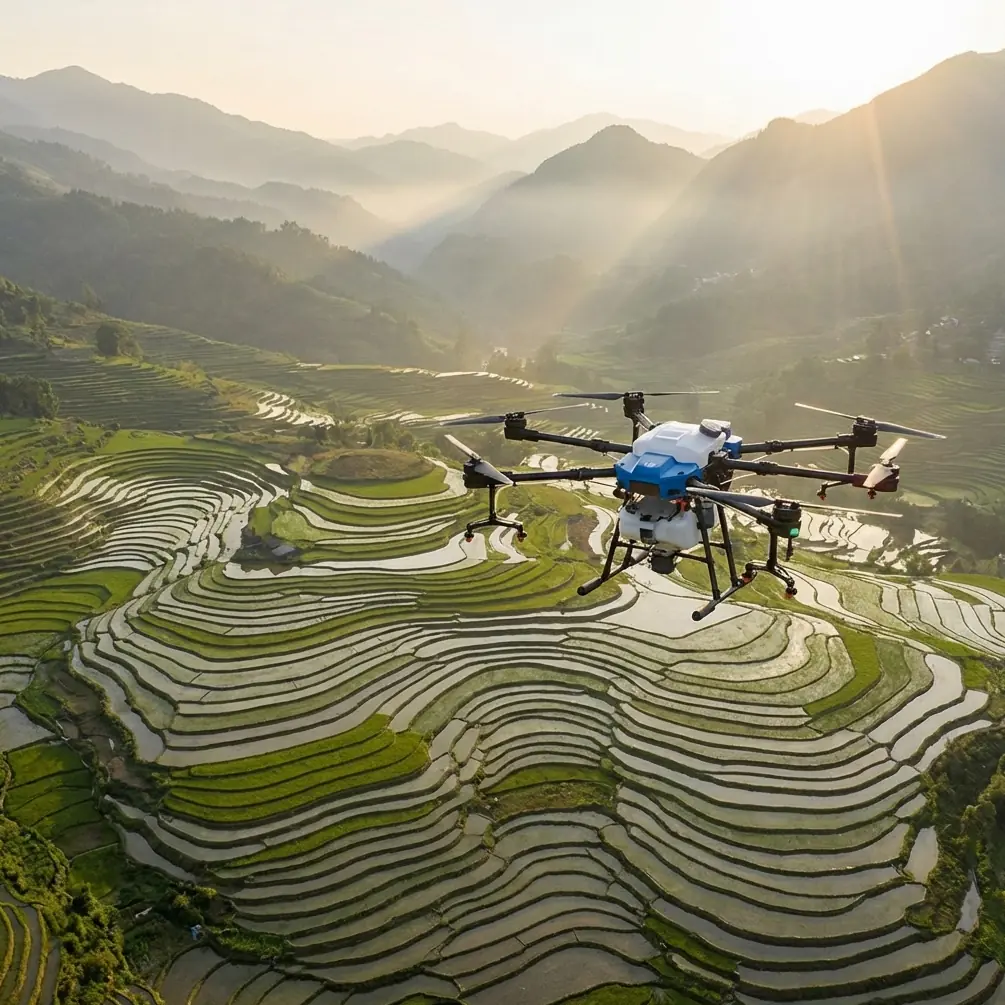
Agras T100 at Altitude: Practical Scouting Best Practices for Thin-Air Field Operations
META: Expert Agras T100 scouting guide for high-altitude field work, covering pre-flight safety, positioning accuracy, overlap logic, drift control, and what thin-air drone performance data really means.
High-altitude field scouting exposes every weakness in a drone program. Lift margins tighten. Battery behavior becomes less forgiving. Positioning errors that seem minor at lower elevations can ripple into missed coverage, poor data alignment, and risky returns. If you are evaluating the Agras T100 for scouting fields in mountain or plateau environments, the real question is not whether it can fly. The real question is whether your workflow is built for thin air.
That distinction matters.
A recent high-altitude heavy-lift test offers a useful benchmark for thinking about what “serious” drone capability looks like when the environment stops being cooperative. In Tibet’s Nagqu Amdo County, a JDY-100B heavy-lift multirotor completed a flight test at 5,380 meters above sea level, where air density was reported at roughly 60% of plain-level conditions. During the test, it hovered with a 30 kg suspended load for 15 minutes and landed accurately. The aircraft itself has a maximum takeoff weight of 221 kg and a 100 kg payload capacity.
That aircraft is not the Agras T100, and it should not be treated as a one-to-one comparison. But the test does tell us something operationally valuable: altitude punishes assumptions. If a platform is expected to perform consistently in plateau conditions, every part of the job has to be tightened up—lift planning, route logic, payload discipline, mission duration, and landing management. For Agras T100 scouting work, that translates into a much more methodical operating style than many crews use at lower elevations.
Why high altitude changes the scouting equation
At sea level, a drone can hide a lot of small mistakes. At altitude, it cannot.
Thin air means less rotor efficiency. That affects climb, hover stability, and reserve power during turns or recovery maneuvers. For an agricultural platform like the Agras T100, even when used for scouting rather than application, the practical impact is clear: every accessory, every fluid residue, every unnecessary attachment, and every rushed pre-flight decision eats into margin.
This is where many teams think only about batteries and motors, when they should also be thinking about cleanliness and drag. A surprisingly useful pre-flight habit is to clean the frame, arms, landing area, and sensor surfaces before launch, especially after spray work or dusty transport. Dried chemical residue around spray-related components can interfere with visual checks, conceal leaks, and collect debris that migrates toward moving parts or sensing surfaces. Mud on underbody structures can alter airflow and make inspections less reliable. On a platform expected to hold stable paths for scouting runs, a clean aircraft is not cosmetic. It is part of the safety system.
If your T100 has been rotated between spraying and scouting roles, this becomes even more critical. Residue around nozzles, plumbing junctions, or pump-adjacent surfaces can mask calibration problems that later affect spray drift control in application missions. Even if today’s sortie is only for field intelligence, the pre-flight should catch those issues early.
The smarter way to interpret altitude performance
The Tibet heavy-lift record is impressive because it combines three things that rarely coexist easily at altitude: meaningful load, stable hover, and controlled landing. For field scouting teams, that combination should reshape expectations.
You may not be hanging a 30 kg load under an Agras T100. But you are still dealing with a similar hierarchy of constraints:
- Can the aircraft maintain stable track and altitude over uneven terrain?
- Can it finish a planned mission with reserve power intact?
- Can it return and land safely if winds shift or GNSS quality degrades?
- Can it hold data quality standards, not just stay airborne?
That last point gets overlooked. A scouting mission that returns blurry, misaligned, or incomplete imagery is operationally equivalent to a failed flight.
One of the most practical reference points comes from mapping workflow guidance used in integrated ArcGIS collection environments. In that guidance, orthomosaic capture targets a spatial resolution better than 5 cm, and a 20 MP camera flying at 120 meters is cited as sufficient to achieve that output standard. The same workflow sets 70% forward overlap and 60% side overlap for mission planning.
Those numbers were described around a Phantom 4 Pro workflow, not the Agras T100. Still, the operational principle carries over perfectly: in high-altitude scouting, overlap is not a box to tick. It is your insurance against terrain variation, wind-induced attitude changes, and small positioning inconsistencies.
If your T100 scouting workflow is being built for agronomy decisions, drainage review, stand assessment, or stress detection, flying with disciplined overlap logic matters more than squeezing a few extra acres into a single sortie.
Centimeter precision is only useful if the workflow respects it
Many operators talk about RTK as if it automatically fixes weak mission design. It does not.
Centimeter precision is powerful, especially for repeatable field scouting where you want to compare passes over time, line up crop health observations, or match imagery to treatment zones. But in high-altitude operations, your RTK fix rate and your practical field registration method both deserve attention.
The reference workflow includes a field alignment step that is deceptively simple: find a recognizable point on the satellite basemap—such as a road intersection or building corner—stand at that point, align the cursor, and tap “I am here” so the system performs on-site registration automatically. That may sound basic, but its significance is huge in mountain agriculture. In areas where terrain, sparse infrastructure, or base map drift can create alignment uncertainty, field registration at a known visible point can prevent an entire mission from being offset.
For Agras T100 users scouting remote fields, this means one thing: do not rely on office planning alone. Confirm alignment on site before launching. If RTK is available, verify that the solution is stable rather than assumed. If RTK conditions are marginal, a visible ground reference check becomes even more valuable.
Good scouting is rarely ruined by too much discipline. It is often ruined by a crew believing the autopilot knows more than it does.
Return-to-home deserves more respect in plateau operations
One of the most useful details in the mapping reference is not about imagery at all. It is about landing behavior. After automated mission completion, the drone is described as returning and landing near the takeoff point, but with a possible offset of around 20 centimeters, with the advice to fine-tune the landing and switch to manual control at low altitude if necessary for safety.
That is the kind of operational detail experienced crews appreciate because it reflects reality rather than brochure language.
In high-altitude field environments, the same mindset should be built into Agras T100 SOPs. Landing zones are often uneven, dusty, narrow, or bordered by irrigation hardware, stones, parked vehicles, or crop edges. A small touchdown offset that feels trivial on a clean pad can become consequential in rough terrain. If the aircraft is descending with reduced performance margin in thin air, the crew should already be prepared to intervene.
For that reason, scouting flights should use a deliberately chosen takeoff and recovery area, not just the nearest open patch. Brush it clean. Remove loose debris. Confirm rotor clearance. Recheck surface level. If you need a second opinion on setting up a conservative high-altitude scouting workflow, you can message a field operations specialist here: https://wa.me/85255379740.
What this means for Agras T100 scouting missions
The Agras T100 is often discussed through the lens of agricultural productivity, but scouting at altitude is a distinct discipline. You are not only asking the aircraft to move efficiently. You are asking it to produce usable, repeatable field intelligence under conditions that punish poor preparation.
A workable high-altitude scouting routine should include these priorities:
1. Reduce unnecessary onboard burden
Keep the aircraft configured for the mission at hand. If the sortie is for scouting, avoid carrying anything that does not directly support data capture or flight safety. In thin air, margin matters.
2. Clean before every launch
This is the easiest step to skip and one of the smartest to standardize. Wipe down sensors, landing gear contact points, camera protection surfaces, and any area with chemical or dust buildup. If the aircraft has recently performed spray work, inspect nozzle areas and fluid paths so calibration issues do not get buried under residue. Clean hardware supports reliable safety checks.
3. Plan with overlap discipline
The mapping reference uses 70% forward overlap and 60% side overlap at 120 meters to support orthomosaic output better than 5 cm. Your T100 payload and mission profile may differ, but the lesson is consistent: overlap is what protects data integrity when conditions get messy. On sloped terrain or in gusty air, pushing overlap upward is often wiser than cutting it tight.
4. Verify field registration on site
Use clear visible landmarks when available. If your RTK fix rate is unstable or delayed, do not pretend that post-processing will solve every issue. Scouting value depends on positional trust.
5. Treat automated landing as assisted, not infallible
A recovery system can be accurate and still not be perfect for the exact landing surface you chose. Build in a low-altitude manual readiness habit, especially when operating near field infrastructure.
6. Respect drift, even during scouting
Spray drift is usually discussed during application work, but drift awareness belongs in scouting culture too. Why? Because the same wind patterns and terrain funnels that move droplets also affect aircraft attitude, path tracking, and image consistency. If valley winds or ridge turbulence are strong enough to compromise a future spray window, they are strong enough to compromise scouting quality today.
Don’t confuse ruggedness with immunity
Some operators evaluating agricultural platforms look at weather sealing or washdown-friendly construction and assume they can be casual about maintenance. Even if a platform offers robust environmental protection—many buyers look for traits associated with standards like IPX6K—that does not remove the need for careful inspection and cleaning. Ruggedness helps the aircraft survive demanding work. It does not excuse neglect.
The same goes for advanced sensors. If you are pairing scouting operations with multispectral analysis or planning repeated crop health missions, data quality will depend less on the spec sheet and more on consistency: stable altitude, repeatable track, clean optics, verified positioning, and conservative battery planning.
That is where serious field programs separate themselves. They do not chase theoretical maximums. They build reliable outputs.
The bigger lesson from the 5,380-meter test
The JDY-100B record flight matters beyond its headline because it highlights what commercial drone operations look like when the environment becomes the dominant variable. A crew traveled 11,078 kilometers to reach the test site. That kind of effort underscores a truth every mountain agriculture operator learns sooner or later: location is not a footnote. It is the mission.
For an Agras T100 scouting program, the same logic applies on a smaller scale. Altitude is not just a specification to mention in a procurement meeting. It should shape aircraft preparation, route design, overlap settings, landing procedures, and expectations for endurance. If your workflows are built on lowland habits, the field will expose them.
The upside is that good discipline scales quickly. Clean pre-flights, verified registration, overlap planning, nozzle calibration checks after spray cycles, and active landing supervision do not require exotic technology. They require standards.
And standards are what make drone scouting dependable when the air gets thin.
Ready for your own Agras T100? Contact our team for expert consultation.