
Scouting Mountain Highways with the Agras T100
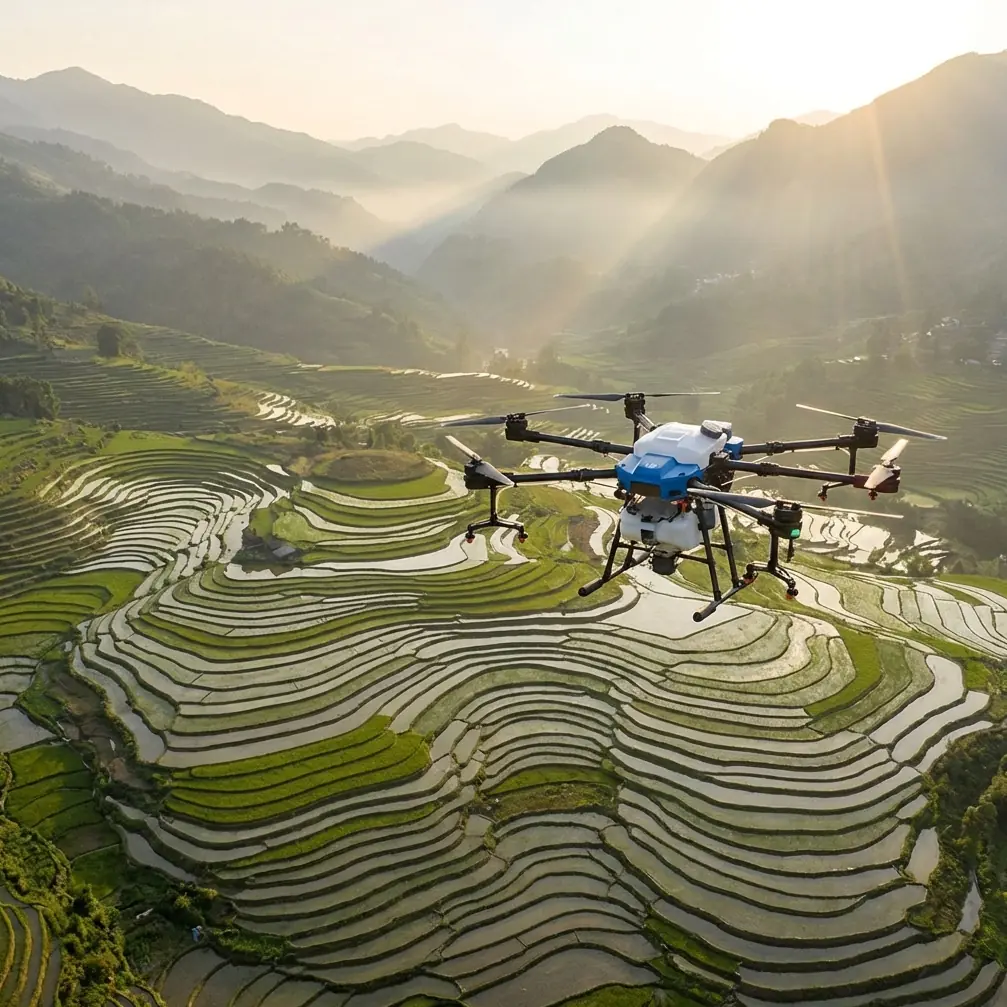
Scouting Mountain Highways with the Agras T100: What Better Flight Discipline Actually Looks Like
META: A field-focused look at using the Agras T100 for mountain highway scouting, with practical lessons on flight planning, altitude discipline, RTK precision, drift control, and operator training.
Mountain highways expose every weakness in a drone operation.
Wind rolls up cut slopes. GPS conditions shift along cliffs and retaining walls. Launch areas are rarely ideal. One turnout may feel wide enough for setup, while the next is little more than broken gravel beside a drop. In these environments, the drone itself matters, but the bigger variable is whether the mission has been designed to stay ahead of the aircraft instead of chasing it.
That distinction has shaped my view of the Agras T100.
On paper, the T100 attracts attention because it belongs to a serious working platform class. People naturally focus on hardware traits such as weather resistance, centimeter precision, nozzle calibration, swath management, and the practical value of a robust airframe in dirty, wet roadside conditions. Those are valid concerns. If you are scouting highways in mountainous terrain, IPX6K-grade protection and a stable RTK fix rate are not marketing footnotes. They influence whether the aircraft can keep working after repeated exposure to mist, mud splash, and constant relocation from one site to another.
But after enough fieldwork, I have come to a less glamorous conclusion: the real advantage comes when the aircraft supports disciplined, preplanned flying.
That idea is not new. One of the training references I often think about divides pilots into two types. The first reacts after the aircraft moves. The second thinks ahead, mentally breaking the maneuver into stages before takeoff. The difference sounds academic until you are flying beside a mountain road where there is very little room for hesitation. In a fast-changing corridor environment, being “behind the aircraft” is not just inefficient. It produces uneven data, awkward corrections, and preventable safety compromises.
The T100 is best understood through that lens.
The mountain highway problem is not just terrain
When teams say they need a drone for highway scouting, they often mean several jobs at once. They may be checking drainage paths above the road, documenting slope instability, scanning embankment vegetation, locating blocked channels, reviewing construction access, or inspecting disturbed surfaces after heavy rain. Sometimes they also need to assess spray drift risk near road-edge vegetation management, or plan treatment passes without affecting adjacent lanes, guardrails, or water runoff corridors.
In flat farmland, a route can often be simplified into repeatable lines. In mountain roads, the corridor bends, rises, narrows, and opens unpredictably. The aircraft may need to move from a constrained launch zone, climb to a safe transit height, hold line accuracy near irregular ground, and return to a controlled landing point that is not always directly below the aircraft’s last working position.
That last part is where training logic from education drones becomes surprisingly relevant.
A reference training exercise describes a drone taking off from a marked challenge card, assigning random x and y offsets between -35 and 35, and a random z value between 80 and 120 centimeters, then flying to that coordinate before returning. If battery drops by 30% or flight time exceeds 30 seconds, the aircraft first climbs to a safe height of 120 centimeters, then flies back above the target and lands. At first glance, this sounds like a classroom routine for beginners. In practice, it captures a serious operational principle: never return from an arbitrary position by the shortest emotional path. Return by a safe, structured path.
Scale that principle up to the T100 on a mountain highway mission and it becomes highly practical.
Why “safe height first” matters in real roadside operations
The training exercise’s 120-centimeter safe-height rule is obviously miniature in scale, but the logic is transferable. When the aircraft must exit a working segment near uneven topography, cut slopes, utility lines, signs, or roadside obstacles, climbing first to a known safe transit altitude can be smarter than trying to angle home directly from the last action point.
That is one reason the T100 makes sense for structured corridor work. A capable aircraft paired with RTK-based centimeter precision lets the operator define routes and recovery behavior with more confidence. In mountain environments, a strong RTK fix rate matters because lateral error is not just a mapping inconvenience. It can distort edge-following, affect swath width consistency, and create overlap or omission exactly where the road shoulder, slope toe, and drainage line meet.
For scouting, this shows up in two ways.
First, route repeatability improves. If the team needs to revisit the same kilometer after a rainfall event or compare vegetation changes across several dates, high positional consistency becomes operationally significant. You are not just “flying again.” You are aligning observations to the same real-world corridor with minimal guesswork.
Second, return behavior becomes more predictable. On constrained mountain sites, that predictability reduces cognitive load for the pilot. And that matters because a pilot under load tends to become reactive.
Reactive pilots waste bandwidth making late corrections. Proactive pilots fly the mission they already visualized.
The T100 is strongest when paired with a proactive operator
This is where the second source becomes useful beyond hobby training. It argues that the most effective operators think in advance, break each maneuver into stages, and issue correct commands early enough that fewer corrections are needed later. That is exactly how a professional T100 workflow should be built for mountain highway scouting.
Before takeoff, the operator should not merely know the route. The operator should already understand the route in layers:
- launch and recovery geometry
- safe climb profile
- expected wind effect at exposed bends
- likely communication shadows near terrain
- target swath width for the job
- whether multispectral capture is needed for vegetation stress assessment
- where nozzle calibration matters if the mission includes treatment rather than observation
- where spray drift risk rises because of cross-slope gusts or passing airflow channels
This is one reason I resist the simplistic view that larger agricultural UAVs are only about payload. In real field use, the most valuable trait is often mission composure. The T100 gives teams a platform that can support disciplined planning, but it does not replace disciplined planning.
A past challenge: roadside drift and poor repeatability
Several years ago, before platforms in this class became as workflow-friendly as they are now, I worked with a team assessing roadside vegetation management along a mountain section where one side dropped into a drainage gully and the other rose into fractured rock. The problem was not simply getting airborne. The real problem was making each pass consistent enough to compare conditions from one section to the next.
The aircraft we were using at the time demanded too much hand correction. Every gust near a cut face pushed us into small compensations. Every compensation affected line quality. And when it came time to evaluate potential treatment zones, we had weak confidence in our own repeatability. Spray drift analysis became harder because the flight path itself had not been stable enough.
A platform like the Agras T100 changes that conversation.
Not because it removes environmental complexity. It does not. Mountain air remains mountain air. But when you combine stable positioning, practical route discipline, and a well-calibrated application system, you gain something more valuable than raw capacity: trust in the geometry of the mission.
That trust is what lets nozzle calibration and swath width planning become meaningful rather than theoretical. If the aircraft cannot hold lines reliably, calibration only solves part of the problem. If it can, then application uniformity, corridor edge control, and drift mitigation all improve together.
What operators should pay attention to on highway scouting missions
1. Swath width is a terrain decision, not just a productivity setting
In mountain corridors, wider is not automatically better. If the road edge is bordered by steep runoff channels, retaining structures, or sensitive vegetation, the chosen swath width must match the actual shape of the roadside work zone. A platform such as the T100 is valuable when it can execute those lines with enough consistency that the planned swath remains the effective swath.
2. Nozzle calibration matters because mountain wind amplifies mistakes
Calibration is often treated as a maintenance checklist item. In roadside treatment work, it is a control variable. Miscalibration combined with shifting crosswinds can push deposition away from the intended shoulder or vegetation strip. In mountain sections, even minor inconsistency becomes visible because the road corridor creates sharp boundaries between target and non-target areas.
3. RTK performance is not optional if revisits matter
For one-off visual scouting, crews can tolerate more positional slack. For repeat inspections, treatment verification, or cross-date vegetation analysis, they cannot. A strong RTK fix rate supports centimeter precision, and that precision directly improves route replication along curving, elevation-changing corridors.
4. Multispectral capability can turn “looks stressed” into measurable evidence
When mountain highway teams need to evaluate vegetation condition near slopes, drainage outlets, or disturbed earth, multispectral workflows can reveal patterns that standard visual review may understate. The T100 discussion is usually dominated by application capability, but in scouting operations the ability to support structured data capture can be just as useful.
5. Weather sealing is operational, not cosmetic
IPX6K-grade protection matters when the day involves mist, wet brush, muddy setup areas, and repeated transport between pull-offs. Mountain roads are rough on equipment. A platform built for hard environmental exposure reduces downtime and lowers the odds that simple moisture or grime will interrupt a survey sequence.
The overlooked lesson from a beginner exercise
I keep returning to that small training exercise with the random coordinates: x and y values between -35 and 35, altitude between 80 and 120 centimeters, and a mandatory climb to 120 centimeters before returning when battery drops 30% or the clock passes 30 seconds.
Why? Because it teaches the exact habit that experienced commercial teams still need.
Do not improvise recovery from a bad position. Define the recovery path before you need it.
That mindset is what separates smooth highway scouting from stressful highway scouting. The T100 is powerful, but power without planned geometry leads to avoidable corrections. And in mountain work, avoidable corrections multiply quickly.
This is also why training should not stop at flight basics. Teams should rehearse corridor exits, emergency altitude transitions, return logic from offset positions, and terrain-aware recovery routes. If your crew would benefit from discussing real mountain-road workflows, a quick field-oriented conversation here can help: message our UAV team on WhatsApp.
Where the Agras T100 genuinely helps
The most useful way to describe the Agras T100 for mountain highway scouting is this: it reduces the penalty for complexity when the operator already has a plan.
That sounds modest, but it is a serious compliment.
On difficult corridors, the drone must support exact positioning, stable route execution, practical environmental resilience, and application discipline. The operator must be able to think ahead of the aircraft, not merely react to it. The T100 fits that operational style well because it belongs in workflows where centimeter precision, route repeatability, nozzle control, and structured recovery matter.
If your work includes roadside vegetation assessment, drainage corridor review, slope-edge observation, or controlled treatment along mountain highways, the T100 should not be evaluated as just another “big drone.” It should be evaluated as a platform for planned movement. That is a more demanding standard, but it is the right one.
In mountain terrain, good aircraft performance is valuable. Good mission structure is decisive.
The Agras T100 earns its place when those two finally meet.
Ready for your own Agras T100? Contact our team for expert consultation.