
Agras T100 for Low-Light Solar Farm Scouting
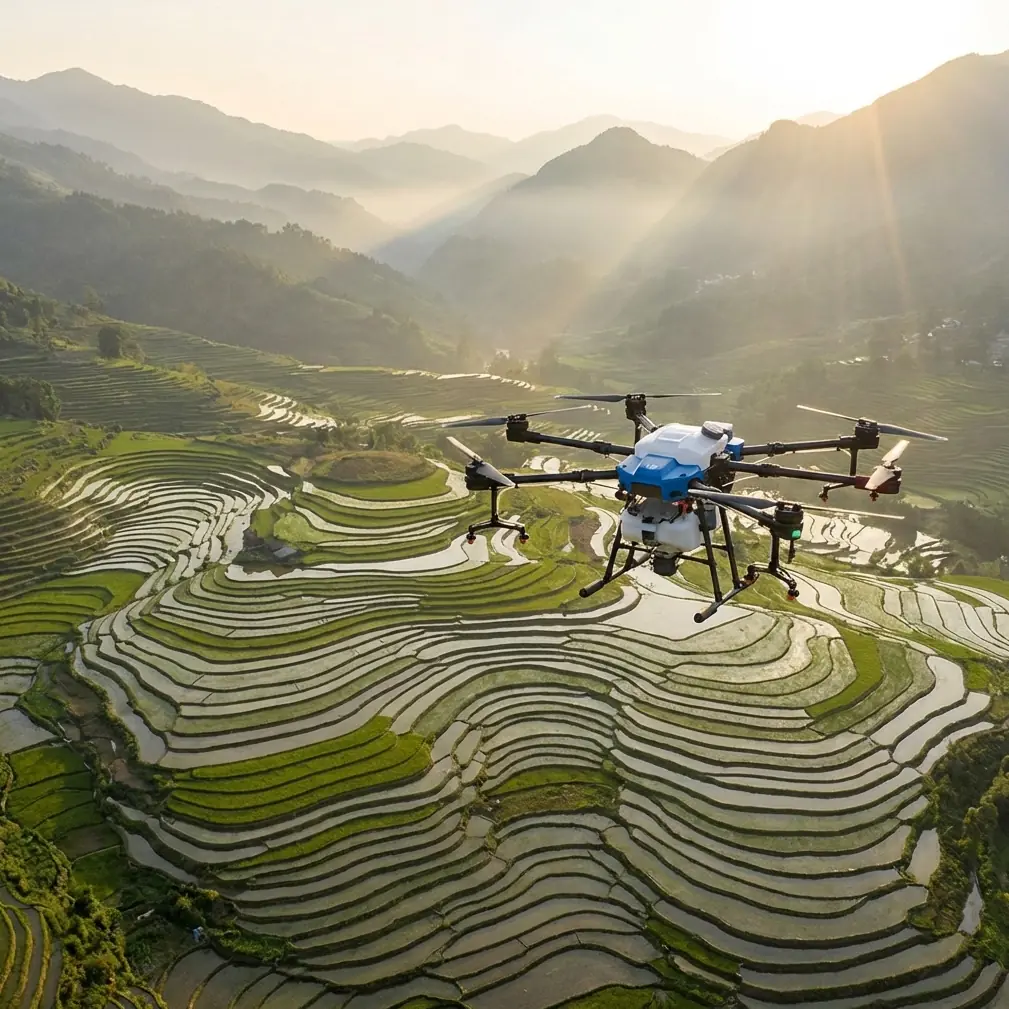
Agras T100 for Low-Light Solar Farm Scouting: A Field Tutorial That Prioritizes Precision
META: Practical Agras T100 tutorial for scouting solar farms in low light, with expert tips on RTK fix rate, nozzle calibration, spray drift control, sensor use, and safe wildlife-aware operations.
Low-light inspection work on solar farms exposes the difference between a capable airframe and a workable field method. That distinction matters with the Agras T100. While it is widely associated with crop protection, its value in solar-site scouting comes from a different combination of traits: stable navigation, repeatable positioning, strong environmental sealing, and the ability to operate methodically when visibility is marginal and obstacles are harder to interpret.
This guide is written for teams using the Agras T100 in early morning, dusk, overcast, or dust-laden conditions on utility-scale solar assets. The objective is not to turn an agricultural platform into something it is not. The objective is to build a disciplined workflow for reconnaissance over rows of panels, access roads, drainage channels, fence lines, and vegetation edges where low light increases both uncertainty and pilot workload.
I approach this as an operational problem rather than a spec-sheet exercise. On a solar farm, low light changes texture. Panel surfaces flatten visually. Glare disappears, then reappears in patches. Service roads blend into surrounding ground. Wildlife becomes more active. If you are scouting for standing water, encroaching vegetation, structural disturbance, blocked maintenance access, or habitat movement near infrastructure, the drone’s reliability is only part of the answer. The rest is planning.
1. Start with the mission, not the aircraft
Before launch, define what “scouting” means on that site for that time of day. Too many crews launch with a vague aim to “have a look around.” That wastes battery, creates inconsistent data, and encourages improvisation when conditions are least forgiving.
For low-light solar farm work, I recommend dividing the mission into four possible targets:
- edge-of-array vegetation and access path checks
- drainage and pooling assessment after overnight condensation or rainfall
- wildlife and perimeter movement review
- infrastructure anomaly scouting around combiner boxes, fencing, and service corridors
The Agras T100 is especially useful when your mission needs steady track-keeping and repeatable passes rather than ad hoc hovering. That is where centimeter precision and RTK-supported route discipline become operationally significant. On large solar sites, even small lateral errors can shift your path from service corridor to panel edge, which is not just inefficient; it can complicate later comparison with previous flights.
If your team logs a high RTK fix rate before takeoff and maintains it through the route, you gain something concrete: cleaner repeatability when revisiting drainage depressions, fence breach points, or recurring vegetation pockets. For solar farms with long, repeating geometry, that repeatability is more useful than flashy autonomy claims. It means the same swath width can be flown across comparable rows on different mornings, making changes easier to detect.
2. Why low light changes the way you should set up the T100
Low-light operations usually tempt crews to fly lower and slower, which is not always wrong, but it can create blind spots if done without structure. The better approach is to tune route geometry to the task.
A practical method is to begin with a conservative swath width that preserves visual confidence in the terrain transitions between panel rows and non-panel ground. Even if the aircraft can cover more area, wider spacing in dim conditions often leaves ambiguity along edges where cables, rocks, puddles, and animal movement can be missed.
For scouting work, swath width should be treated as an information-quality setting, not just a productivity lever. Narrowing it slightly can reveal subtle drainage channels or uneven vegetation growth that matters for maintenance access and fire risk. That is especially true when the light is weak and the site’s repeating panel geometry makes visual interpretation harder than pilots expect.
Weather sealing matters here too. An aircraft built to tolerate harsh field environments has a practical advantage on solar farms at dawn, when condensation, dust, fine mist, and residue kicked up from maintenance tracks often combine. An IPX6K-level protection profile is not just a durability bullet point in this context. It supports routine deployment when the site is damp, the roads are dirty, and the crew cannot afford to treat every morning flight like a lab exercise.
3. Sensor discipline beats guesswork
The biggest mistake I see in low-light scouting is overconfidence in what the pilot thinks they saw live. You need a sensor-led routine.
If you are using a multispectral workflow in parallel with visual scouting, use it selectively. Solar farms are not crop canopies, but the edges around them often contain vegetation stress patterns that tell you something useful about drainage, shading, erosion, and maintenance neglect. A multispectral pass along retention zones, berms, and perimeter growth can reveal where water movement is changing the site’s ecology or where invasive species are establishing close to infrastructure.
That matters because vegetation near panels is never just vegetation. It can alter maintenance access, harbor wildlife, increase fire load, and create recurring trimming costs. In low light, your visible interpretation of those zones may be incomplete. A targeted multispectral review helps compensate, especially when done along repeatable RTK-guided lines.
The T100 should not be treated as a magic sensor tower. It should be treated as a stable collection platform. Stability and route fidelity are what make sensor outputs useful later.
4. A field note on wildlife: the fox at Row 18
One morning during a perimeter-and-drainage scouting exercise on a solar site bordered by scrubland, the aircraft encountered a red fox moving between the rear service lane and the vegetation line near what the operations map called Row 18. This was not dramatic. It was brief, quiet, and exactly the kind of event that determines whether a crew is genuinely operating responsibly.
The key was not “spotting wildlife.” The key was how the aircraft’s sensing and the pilot’s route discipline worked together. Because the mission path was already structured around predictable spacing and controlled speed, the crew had enough margin to pause forward progression, hold position cleanly, and avoid pressing the animal toward fencing or energized infrastructure. No panicked stick input. No sudden descent. No attempt to chase the sighting for curiosity.
That matters on solar farms in low light because wildlife activity is often highest when human visibility is reduced. Birds, foxes, rabbits, deer, and ground-nesting species use the same edge corridors that crews inspect. A stable platform with dependable obstacle awareness and strong positional control supports a better outcome than a faster but less disciplined flight profile. The lesson is simple: build flight plans that leave room for wildlife decisions, because low-light scouting is never only about infrastructure.
5. If you are carrying liquid systems, nozzle calibration still matters
This point is often missed when operators adapt an agricultural platform for non-application tasks. Even when the mission is scouting rather than spraying, any installed spray-related hardware should be configured intentionally.
Nozzle calibration is not an abstract maintenance item. It affects weight distribution, residue behavior, and system readiness. If the aircraft is being used in a mixed operational environment where application duties and scouting duties alternate, poor nozzle calibration can carry consequences into both mission types. Uneven output later becomes a drift problem in the field; neglected cleaning now becomes contamination or false interpretation during inspection work.
Spray drift also belongs in this discussion, even if the day’s flight is inspection-only. Why? Because solar farms are often adjacent to agricultural land, habitat corridors, or managed vegetation strips. If the aircraft has recently been used for treatment work and the team has not enforced proper post-operation cleaning and calibration checks, residual liquid behavior and airflow patterns can create avoidable risk around panels, ground cover, and nearby sensitive zones.
Operationally, that means your low-light scouting checklist should include confirmation that spray components are either mission-ready for legitimate application work or fully cleaned and neutralized for reconnaissance tasks. The discipline is worth it. Cross-mission sloppiness is where incidents start.
6. RTK fix rate is not a background metric
Pilots often glance at RTK status, feel reassured, and move on. That is too casual for a solar site. Your RTK fix rate should influence route approval, not merely appear on the screen.
On a solar farm, centimeter precision has direct consequences:
- it keeps repeated passes aligned with maintenance lanes rather than drifting toward panel structures
- it improves change detection when comparing drainage or vegetation conditions across days
- it reduces unnecessary pilot corrections, which become more common when light is poor
- it supports cleaner geospatial notes for teams coordinating with ground crews
If the fix rate is unstable, your scouting quality drops before you notice it. The route may still look acceptable in real time, but later review becomes less trustworthy. That is why I recommend a simple rule: do not expand mission scope until RTK performance is consistently strong across the specific part of the site you plan to survey.
This matters even more on sites with metallic clutter, varied terrain, or perimeter sections near utility infrastructure. Low light already limits visual confidence. Weak positional certainty compounds the problem.
7. A practical low-light workflow for the Agras T100
Here is the field sequence I recommend.
First, walk one short segment of the route on foot before launch. Confirm surface moisture, standing water, access hazards, and any fresh wildlife traces. You are looking for context the drone cannot infer by itself.
Second, establish a narrow initial corridor. Do not begin with a site-wide sweep. Fly one controlled section to evaluate visibility, route readability, and signal stability.
Third, confirm RTK quality before scaling. If the fix rate is inconsistent, shorten the task and gather only the most critical observations.
Fourth, choose a swath width that favors interpretation. In low light, a slightly tighter pattern usually produces better operational decisions than aggressive coverage.
Fifth, log edge conditions separately from core array observations. The edges are where drainage, vegetation growth, fencing issues, and wildlife movement cluster.
Sixth, keep sensor use intentional. If you deploy multispectral tools, use them on vegetation and water-related questions, not as a decorative add-on.
Seventh, inspect mission configuration after any dual-use agricultural work. Nozzle calibration, system cleanliness, and component status should be verified before the aircraft is reassigned.
Eighth, preserve an interruption margin for wildlife. If an animal appears, your route and altitude should allow a calm hold and reroute rather than abrupt maneuvering.
Teams building their own low-light operating procedure often benefit from comparing notes with experienced field operators; if that helps, you can message a UAV specialist here and refine the checklist around your site conditions.
8. What the T100 does well in this role—and where restraint matters
The Agras T100 is well suited to solar farm scouting when the work rewards ruggedness, repeatability, and disciplined path control. Those qualities are more useful at dawn than abstract promises about intelligence. A reliable aircraft in a repeatable workflow beats a feature-heavy aircraft in a loose workflow every time.
Its strongest contribution in this scenario is not novelty. It is consistency under field conditions that are rarely pristine. Damp ground. Fine dust. weak light. Long rows. Repetitive geometry. Wildlife at the margins. Maintenance pressure. The T100 fits that environment when the crew respects what the mission requires.
Restraint matters too. Do not force the aircraft into roles that demand a different sensor architecture or a different payload logic. For detailed thermal diagnostics on energized components, for example, mission requirements may point elsewhere. But for low-light scouting of access, drainage, perimeter conditions, vegetation encroachment, and route-based repeat observations, the T100 can be highly effective.
That is the distinction professionals should keep in view. Good operations are built by matching the aircraft’s strengths to the site’s questions.
9. The real takeaway
Low-light solar farm scouting is not simply a harder version of daylight flying. It is a different decision environment. The Agras T100 earns its place when crews use its RTK-supported precision, field-tolerant build, and route stability to reduce ambiguity rather than accelerate blindly.
Two details matter more than they first appear: maintaining a strong RTK fix rate for centimeter precision, and treating nozzle calibration as part of operational discipline even during scouting-centered workflows. The first protects data quality and repeatability. The second protects mission integrity when the aircraft works across agricultural and inspection contexts. Add a sensible swath width, selective multispectral use, and a wildlife-aware flight plan, and the result is a method that is practical rather than improvised.
On a solar farm before sunrise, that difference is everything.
Ready for your own Agras T100? Contact our team for expert consultation.