
Agras T100 on Mountain Coastlines: The Flight
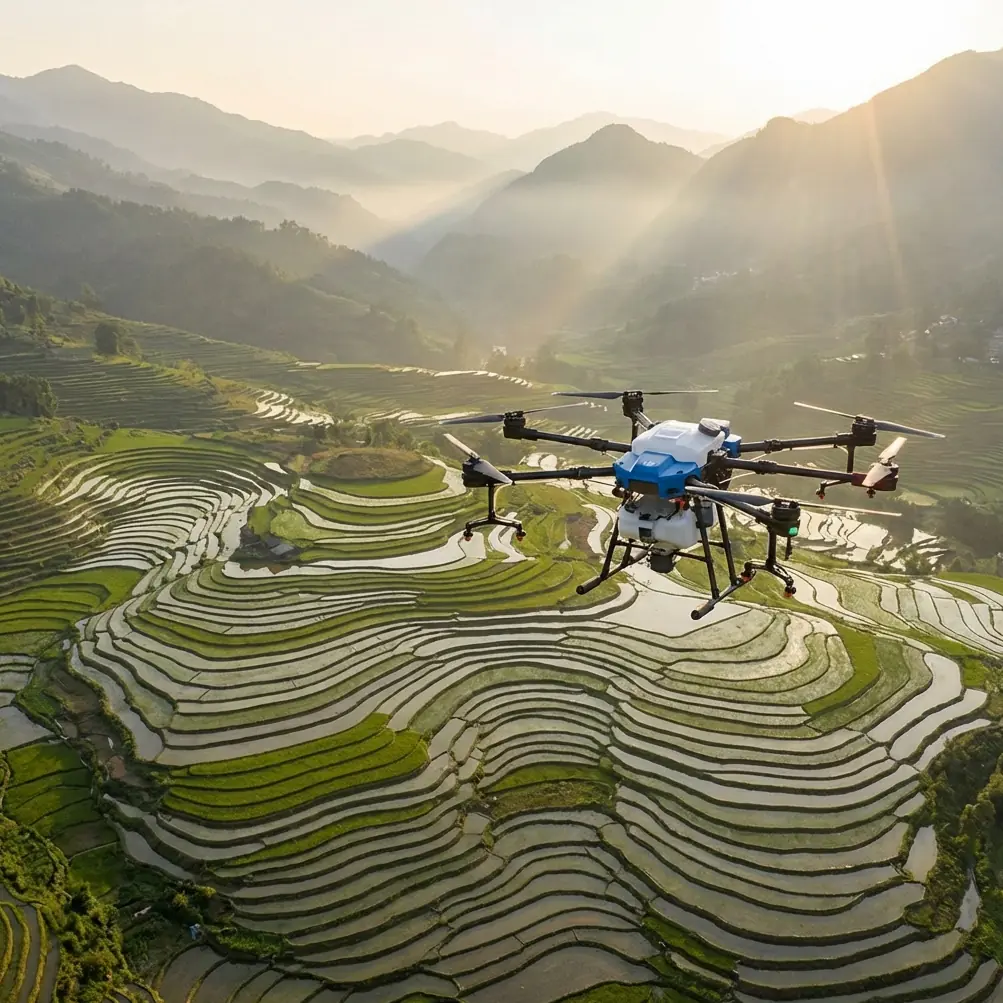
Agras T100 on Mountain Coastlines: The Flight-Altitude Lesson Most Operators Learn Too Late
META: A field-focused Agras T100 case study for mountain coastline spraying, covering flight altitude, spray drift, nozzle calibration, training requirements, and why terrain and visual perspective change application quality.
Mountain coastline spraying looks simple on a map and unforgiving in real life.
You are dealing with steep grade changes, shifting onshore winds, broken field geometry, and salt-laden air that can alter both visibility and droplet behavior. In that setting, the biggest mistake operators make with an Agras T100 is not usually hardware-related. It starts with how they “see” the mission.
That may sound odd for a spraying article, but the connection is direct. One recent photography discussion made a sharp point: the atmosphere of an image is often determined the moment the shooting distance is chosen. Move in close and the scene feels one way; stay far back and use a long lens, and the same subject feels completely different. For drone spraying, especially on mountain coastlines, the operational equivalent is flight altitude and stand-off geometry. Two passes over the same slope can look acceptable on the screen and still produce very different deposition on leaves, edges, and lower canopy.
With the Agras T100, that distinction matters because this is not flatland work. Coastal mountain plots force the aircraft to constantly negotiate terrain relief, uneven wind corridors, and changes in crop exposure. If the operator does not understand how altitude changes the spray picture, the machine’s precision is wasted.
Why mountain coastlines expose weak spraying decisions
Agricultural UAVs have a real advantage in this environment. The core strengths are already well established: they operate at low working height, drift less than higher-altitude methods, can hover in place, and do not require a dedicated takeoff and landing strip. Rotor downwash also helps push spray into the crop, improving penetration. In practical terms, that is why unmanned plant-protection work became so attractive for fragmented terrain where large conventional aviation methods struggle.
The older reference material on civilian agricultural drones is still useful here because it explains the physics plainly. Low-altitude operation reduces drift. Rotor wash improves canopy penetration. Remote spraying also keeps personnel away from direct pesticide exposure. Those are not abstract benefits. On a mountain coastline, where access paths are narrow and manual spraying often means climbing unstable edges, distance from chemicals and terrain hazards is a safety control, not a convenience.
The same source notes that spray application by unmanned rotorcraft can reduce pesticide use by at least 50% and water use by 90% under appropriate conditions. Those numbers should not be read as automatic results, but they reveal the scale of what becomes possible when droplet placement is controlled well. The T100’s job is to make that control repeatable. The pilot’s job is to stop environmental complexity from undoing it.
The case: a T100 mission above coastal terraces
Imagine a coastline orchard or terrace crop running along a mountain shoulder. On one side, the slope rises into vegetation and rock. On the other, the land falls away toward the sea. The field edge is irregular, not rectangular. Wind enters from the water, accelerates through saddles, then tumbles across contour lines. Some rows are sheltered; others are fully exposed. This is where generic spray plans fail.
An inexperienced operator often chooses one of two bad habits:
- Fly too high “to stay safe” over uneven ground.
- Fly a visually comfortable line from a distance, trusting the route display more than the crop response.
Both choices resemble the photography problem. From farther away, everything appears cleaner and more orderly. The perspective flattens complexity. In spraying, that false neatness hides what the droplets are actually doing.
At excessive altitude, the swath width may appear efficient, but the finer droplets spend longer in disturbed air. On a coastline, that means more opportunity for lateral displacement and edge loss. The rotor downwash weakens by the time it reaches the target, especially across height variations. The result is often a pass that looks well aligned in telemetry but under-treats the down-slope canopy and overexposes the windward fringe.
Too low, on the other hand, and the aircraft may overreact to terrain steps, induce unstable spray height over terraces, or create overly aggressive local downdraft effects on sparse crops. So the answer is not “fly lower” in a simplistic sense. The answer is to hold the right relative height over the crop, consistently, as terrain falls and rises beneath the aircraft.
That is the real altitude lesson.
Optimal flight altitude is a terrain-relative decision, not a single number
For mountain coastline spraying with an Agras T100, the useful question is not “What altitude should I use?” It is “What height above target canopy gives me stable deposition while preserving drift control across changing terrain and wind exposure?”
That shift in thinking changes mission planning.
The T100’s value in this scenario is tied to centimeter precision and route stability. If your RTK fix rate is inconsistent near ridgelines or signal conditions degrade, altitude discipline becomes even more critical because lateral and vertical error stack together. On a slope, a small height deviation is not small in effect. A few meters too high over a dropping shoulder can widen the effective spray pattern and reduce crop penetration at exactly the field edge where drift risk is highest.
So the optimal height is usually the lowest terrain-safe, crop-safe, obstacle-safe operating envelope that allows the rotor airflow to support deposition without forcing unstable pitch, abrupt climb behavior, or repeated altitude corrections. In plain language: close enough to control the spray, not so close that the aircraft is fighting the slope.
For coastline terraces, that often means planning the mission in shorter terrain segments rather than one broad block. Uniform altitude across a non-uniform field is a recipe for uneven application. Relative altitude should track canopy reality, not just map geometry.
Why nozzle calibration matters more near the sea
Coastal work punishes lazy calibration.
Nozzle calibration is often treated as a setup chore, but in this environment it becomes the hinge between precision and waste. Salty moisture, changing wind, and mixed vegetation density affect how droplets behave after exit. If output, droplet size, and speed are not matched to the crop and weather, the T100 can still fly a beautiful route while delivering poor biological effect.
The old plant-protection references emphasized reduced drift and better penetration as drone advantages. Those benefits are conditional. They depend on matching spray characteristics to low-altitude airflow. On a mountain coastline, a calibrated system lets you keep droplets heavy enough to resist sideways carry while still using rotor-induced movement to drive coverage into the target zone.
Operationally, this means checking more than total flow. You care about pattern consistency across the boom/nozzle arrangement, response at working speed, and whether the chosen setup remains appropriate when moving from sheltered inland rows to exposed coastal edges. One setting for the entire block is often a compromise. Good operators know where the compromise is acceptable and where it starts costing control.
If you are comparing canopy response from one hillside section to another, a short field note and recalibration checkpoint will save more time than re-treating a missed edge later. If you need a second technical opinion on setup logic for coastal terrain, this quick operator discussion line is a practical place to compare field assumptions before committing to a full mission.
Perspective in imaging and perspective in spraying
The photography reference may seem far removed from agricultural UAV work, but it captures a truth many pilots overlook: distance changes interpretation before it changes data.
Stand close to a subject and spatial relationships feel dramatic. Step back and compress them with a long lens, and the scene becomes visually denser and flatter. Spraying has an analogous trap. When operators plan or supervise from a detached visual perspective, they often underestimate terrain separation and airflow transitions. The route looks smooth. The slope is not.
This is especially relevant if you are using mapping layers, terrain visualization, or even multispectral data to identify treatment needs. A map may show stress patterns accurately, but it does not remove the need to translate those patterns into a spray geometry that respects real air movement over the crop. Multispectral intelligence can tell you where the problem sits. It cannot by itself guarantee that your chosen swath width, height, and droplet strategy will treat that area evenly on a sea-facing incline.
That is why experienced T100 crews spend time validating visual assumptions from the field edge, not just from the screen.
Training is not bureaucracy here; it is operational insurance
Mountain coastline spraying is one of those environments where pilot competence shows immediately. Civil UAV regulations rightly stress that applicants must receive and document ground training, complete relevant courses, and pass theoretical exams. The listed topics are not academic filler. They include aviation law, airport-area operations, collision avoidance, radio communication, night and high-altitude operation knowledge, meteorology, aerodynamics, flight principles, major UAV systems, and emergency procedures.
For this kind of T100 work, two parts of that framework deserve special attention.
First, meteorology. The regulation specifically requires training in recognizing critical weather conditions and using aviation weather reports and forecasts. On a coast, that directly affects spray drift decisions. Wind at launch point is not the whole story. Air moving upslope, cross-slope acceleration, and late-day sea-breeze shifts can alter deposition within a single task block.
Second, command-and-control knowledge. The same regulation highlights communication, navigation, and surveillance functions, including C2 data link performance, coverage range, and communication failure procedures. In mountain coastal areas, terrain masking and irregular control geometry are real issues. If your control link or situational awareness degrades at the same moment the aircraft crosses a shoulder line, your margin disappears quickly.
The flight-skills requirements are equally revealing. The document calls for at least 4 hours each for airspace application and ATC communication, route planning, and system check procedures, plus no less than 20 hours for normal flight command and another 20 hours for emergency flight procedures such as link loss and forced recovery. Those numbers matter because they show what serious drone operations actually demand. A coastline spray mission is not the place to discover that your route planning instincts are shallow or your emergency response is memorized but unpracticed.
This also aligns with another reference point: the spread of agricultural drones has long been constrained by the need for operational skill, with some users requiring at least four months of training. The machine can be advanced, but terrain and weather still separate casual operators from professionals.
IPX6K, hardware resilience, and what it does not solve
Readers often focus on ruggedness ratings such as IPX6K, and that is understandable. In wet, windy, chemical-heavy work, equipment durability matters. A T100 configured for harsh field conditions benefits from that kind of resilience, especially when salt mist, washdown routines, and repetitive fluid handling are part of normal operations.
But water-ingress protection does not solve application geometry. It keeps the platform working in demanding conditions; it does not decide the right swath width on a broken coastal contour. It does not correct poor nozzle calibration. It does not restore coverage lost to an avoidable altitude choice. Rugged hardware extends the operating envelope. It does not replace judgment inside that envelope.
The practical altitude rule for Agras T100 on coastal mountains
If there is one takeaway from this case study, it is this:
Do not choose a flight altitude because it looks clean on the plan. Choose it because it preserves a stable, terrain-relative spray distance across the crop, especially at exposed edges and elevation transitions.
That means:
- segmenting routes by terrain behavior, not just field boundaries
- validating RTK stability before trusting centimeter-level path assumptions
- calibrating nozzles for the actual coastal airflow environment, not a generic inland baseline
- tightening drift discipline at the sea-facing edge where overspray consequences are highest
- using pilot training as a performance tool, not a compliance checkbox
Agricultural drones became valuable in places like this precisely because they can work low, hover, avoid the need for dedicated runways, and improve penetration with rotor downwash. Those advantages are strongest where terrain is difficult. They are also easiest to squander there.
The Agras T100 is not merely a payload carrier for mountain coastline spraying. It is a precision application system whose results depend on whether the operator understands how distance shapes outcome. Photography teaches that the feel of an image changes when you alter shooting distance. Spraying teaches the harsher version: change the working distance over a coastal slope, and the biological result changes with it.
That is the lesson most people learn after a poor first mission.
The better way is to learn it before the tanks are filled.
Ready for your own Agras T100? Contact our team for expert consultation.