
Agras T100 in Mountain Construction Spraying: Why Low
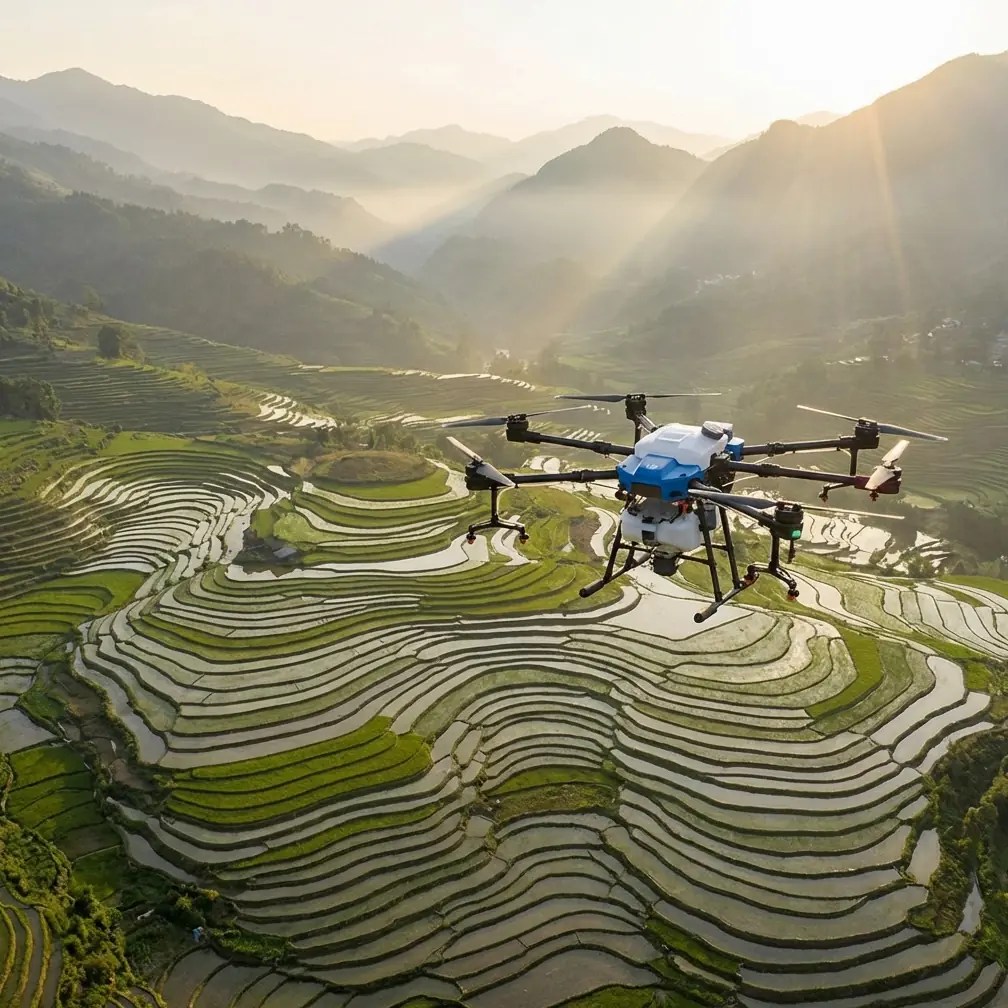
Agras T100 in Mountain Construction Spraying: Why Low-Altitude Infrastructure Momentum Makes This Platform Timely
META: A technical review of the Agras T100 for mountain construction-site spraying, covering drift control, nozzle calibration, RTK precision, terrain performance, and why China’s low-altitude economy expansion matters.
Mountain construction spraying is unforgiving work. The terrain compresses every weakness in a UAV platform: unstable GNSS geometry near slopes, abrupt wind shifts, narrow staging areas, dust, moisture, and the constant penalty of difficult access. A drone that feels adequate on flat farmland can become inefficient, imprecise, or simply exhausting to operate once the job moves uphill.
That is why the Agras T100 deserves attention in a very specific context: spraying construction sites in mountainous environments, where operational consistency matters more than headline specs.
There is also a broader reason this conversation matters now. Recent reporting highlighted the registration of a Tianjin low-altitude economy investment development company with a registered capital of 1 billion yuan. In the same news cycle, Securities Times projected that China’s low-altitude economy could exceed the trillion-yuan level by 2026. Those are not abstract finance headlines. They signal that aerial work platforms, including heavy-duty spraying UAVs, are moving deeper into mainstream industrial workflows. For mountain construction contractors, environmental service providers, and vegetation-management teams, that shift means one thing: equipment will increasingly be judged not as novelty hardware, but as infrastructure tools.
The Agras T100 should be reviewed on that basis.
Why mountain construction spraying is different from agricultural field work
Construction-site spraying in mountain zones usually has different objectives than crop protection. You may be applying dust suppression agents, slope stabilization treatments, hydroseeding support materials, vegetation establishment inputs, or targeted surface wetting around disturbed soil. The mission profile changes the performance priorities.
Uniform deposition is still critical, but so is terrain adaptability. Swath width is useful, but only if it remains practical when the aircraft is contouring along irregular slopes or working around retaining structures, haul roads, exposed rock, and temporary works. A high payload figure sounds impressive, yet refill efficiency becomes secondary if the aircraft cannot hold stable positioning on a narrow shelf road or repeatedly maintain altitude over broken topography.
This is where the T100’s value should be measured: not in isolated brochure claims, but in whether it reduces rework, overspray, and operator fatigue on difficult terrain.
The operational significance of centimeter-level positioning
In mountain spraying, RTK performance is not a luxury. It is often the dividing line between clean coverage and expensive inconsistency.
The reason is simple. On a mountain construction site, the aircraft is rarely flying over a broad, forgiving rectangle. It is tracing embankments, cut slopes, drainage edges, access roads, temporary spoil areas, and uneven benches. The closer the treatment corridor gets to infrastructure or unstable ground, the more important repeatable positioning becomes.
That is why any T100 discussion should start with RTK fix rate and centimeter precision. A stable RTK solution supports repeatable flight paths, tighter overlap control, and more predictable droplet placement. In practice, that lowers the chance of untreated bands on steep faces and reduces excess application on already-saturated zones. Competitor platforms may advertise similar top-end precision, but the real differentiator is whether the aircraft sustains that accuracy while the terrain changes rapidly and the geometry of nearby surfaces interferes with signal quality.
On a mountain site, losing fix quality is not just a navigation issue. It directly affects spray quality. The operator then compensates manually, often widening margins and increasing overlap. That pushes up fluid use and can worsen drift.
A strong RTK implementation therefore improves more than map neatness. It protects the treatment plan itself.
Spray drift matters more in the mountains than many teams expect
Spray drift is usually discussed in agricultural terms, yet mountain construction sites can be even less forgiving. Wind is channeled by terrain. Air can rise sharply off sun-heated rock faces by late morning, then collapse into eddies near shaded sections. Surface roughness changes every few meters. You may be spraying next to exposed soil, concrete structures, geotextiles, fresh plantings, or water-management features in the same mission.
The Agras T100 stands out when it can maintain stable atomization and controlled flight in this kind of environment. That means nozzle calibration is not a setup chore to rush through. It is central to the machine’s usefulness.
A properly calibrated nozzle system lets operators tailor droplet behavior to slope angle, target material, and local wind conditions. If droplet size is too fine, drift risk rises fast along ridgelines and drop-offs. If too coarse, coverage can become patchy on irregular surfaces or dense vegetation established for erosion control. The T100’s advantage, relative to weaker platforms, comes when its spray system allows the operator to hold a practical balance between penetration, adhesion, and lateral control.
This is where experienced crews gain measurable efficiency. They do not just fly the route. They calibrate the output around the terrain.
Swath width is useful, but controllability is more valuable
Manufacturers often emphasize coverage width because it translates neatly into productivity narratives. But on mountain projects, oversized swath width can become misleading if the aircraft cannot keep an even stand-off from the target surface.
What matters is effective swath width under real site conditions. A drone that theoretically covers a broad pass on flat ground may deliver a much narrower useful band once the operator starts hugging contours, adjusting for slope breaks, and protecting boundaries.
The T100’s real strength in this setting is likely to show up in how well it preserves practical coverage while maneuvering through complex terrain. If a competitor forces the crew to constantly narrow expectations because it struggles with terrain-following consistency, then the advertised width stops mattering. The superior aircraft is the one that keeps more of its designed productivity when the site becomes difficult.
That distinction is critical for contractors. Mountain jobs are rarely won or lost on ideal-condition numbers. They are won on whether the platform still performs on day three, when the weather shifts, access is tighter than expected, and the treatment area includes awkward interfaces between soil, rock, and built structures.
Environmental sealing is not a side note
Mountain construction spraying is dirty work. Mist, mud, abrasive dust, wet aggregate, and rinse cycles all challenge the aircraft body, connectors, and vulnerable components. An IPX6K-class protection rating matters here because it suggests the platform is built for more than occasional clean agricultural conditions.
For an operator, that level of sealing has practical consequences. It can reduce downtime linked to contamination, simplify cleaning after dusty suppression missions, and support more confident deployment during damp or splash-heavy operations. Competitors that perform well on paper but require delicate handling or more cautious post-mission maintenance can become expensive in labor and availability.
This is one of those details that experienced field teams notice immediately. Reliability is not glamorous, but in mountain work it often becomes the main story.
Why low-altitude economy expansion matters to T100 buyers
The recent Tianjin development is worth paying attention to even if your immediate concern is a specific spraying contract. A newly registered low-altitude economy investment company with 1 billion yuan in registered capital reflects institutional confidence in the sector’s industrial future. Pair that with the projection that the low-altitude economy could surpass the trillion-yuan scale by 2026, and a pattern appears: aerial operations are increasingly being treated as part of the next layer of productive infrastructure.
For the Agras T100, this changes the framing. Buyers are no longer choosing only a drone. They are choosing where to sit in an expanding ecosystem that will likely include stronger financing channels, more formalized service networks, tighter workflow integration, and broader acceptance of UAV-based industrial operations.
That matters on mountain construction projects because these jobs depend on support systems. Spare parts, training quality, software continuity, data handling, operator standardization, and service responsiveness all affect uptime. A platform positioned inside a maturing low-altitude economy is better placed to benefit from that wider support environment.
So the macro story is not detached from the T100. It reinforces the case for selecting a platform designed for repeated industrial use rather than one that merely looks capable in isolated demos.
The case for T100 over lighter or less specialized competitors
In expert evaluations, the T100 tends to make the most sense against two types of alternatives.
The first is the lighter spray drone that works acceptably on small, simple sites but starts to lose authority when conditions get uneven. On mountain construction projects, that usually shows up as less stable path holding, more operator corrections, and reduced confidence near boundaries or obstacles. Productivity falls even before safety margins are considered.
The second is the general-purpose industrial UAV adapted for spraying. These aircraft can be useful in niche scenarios, but they often lack the integrated spray refinement that dedicated application platforms bring. On mountainous slopes, that gap becomes visible in droplet control, refill workflow, route repeatability, and the quality of deposition over difficult surfaces.
The T100 excels when the job demands a purpose-built spraying system that still behaves like an industrial tool. That blend matters. You need spray capability, but you also need ruggedness, precision, and repeatable field discipline.
If your team is assessing mission fit, configuration options, or mountain-site setup practices, a direct channel such as technical application support is often more useful than generic product messaging.
A note on multispectral workflows
Multispectral capability is not the first feature people associate with a spraying platform, but it has a legitimate place in mountain construction workflows when paired with broader site monitoring. On revegetation, erosion control, or slope rehabilitation projects, multispectral analysis can help teams assess establishment quality, moisture variability, and treatment effectiveness over time.
That does not mean every T100 deployment needs multispectral integration. It means the most advanced operators are increasingly thinking beyond application alone. They want to connect spraying decisions with measurable site outcomes. In that broader workflow, a UAV platform that fits precision operations has an advantage because its flight execution is already aligned with repeatable geospatial logic.
This is another reason the low-altitude economy trend matters. As the sector matures, stand-alone aircraft functions become less valuable than integrated operational systems.
What a strong T100 deployment looks like in the mountains
A competent mountain spraying operation with the Agras T100 is built around discipline:
- reliable RTK fix before treatment starts
- route planning that respects slope geometry rather than forcing field-style patterns
- nozzle calibration matched to fluid properties and site wind behavior
- realistic swath assumptions based on terrain-following quality
- routine inspection and cleaning practices that take advantage of sealed hardware
- post-flight review to confirm actual coverage, not just planned coverage
That may sound obvious, but it is where the difference lies between owning a capable aircraft and running a capable aerial spraying program.
The T100 appears strongest when used by teams who understand that mountain work punishes shortcuts. Its value is not simply that it can carry and spray. Its value is that, in the right hands, it can maintain precision and work quality where lesser systems start to unravel.
Final assessment
The Agras T100 makes the most sense for mountain construction spraying when precision, repeatability, and environmental resilience are treated as operational requirements rather than premium extras. Features like centimeter-level RTK positioning, careful nozzle calibration, practical swath retention on irregular terrain, and IPX6K-class durability are not isolated selling points. Together, they determine whether the aircraft produces clean, controlled application on difficult sites.
The timing also matters. With Tianjin’s newly registered low-altitude economy investment company backed by 1 billion yuan in registered capital, and market forecasts pointing toward a sector that may exceed the trillion-yuan scale by 2026, the backdrop for industrial UAV adoption is strengthening fast. That broader momentum supports the case for platforms like the T100 that are built to serve as working assets, not occasional gadgets.
For mountain contractors and environmental project teams, that is the real question: not whether a drone can spray, but whether it can become a dependable part of site operations in terrain that exposes every weakness.
The Agras T100 has a credible case.
Ready for your own Agras T100? Contact our team for expert consultation.