
Agras T100 in Windy Fields: A Practical Case Study
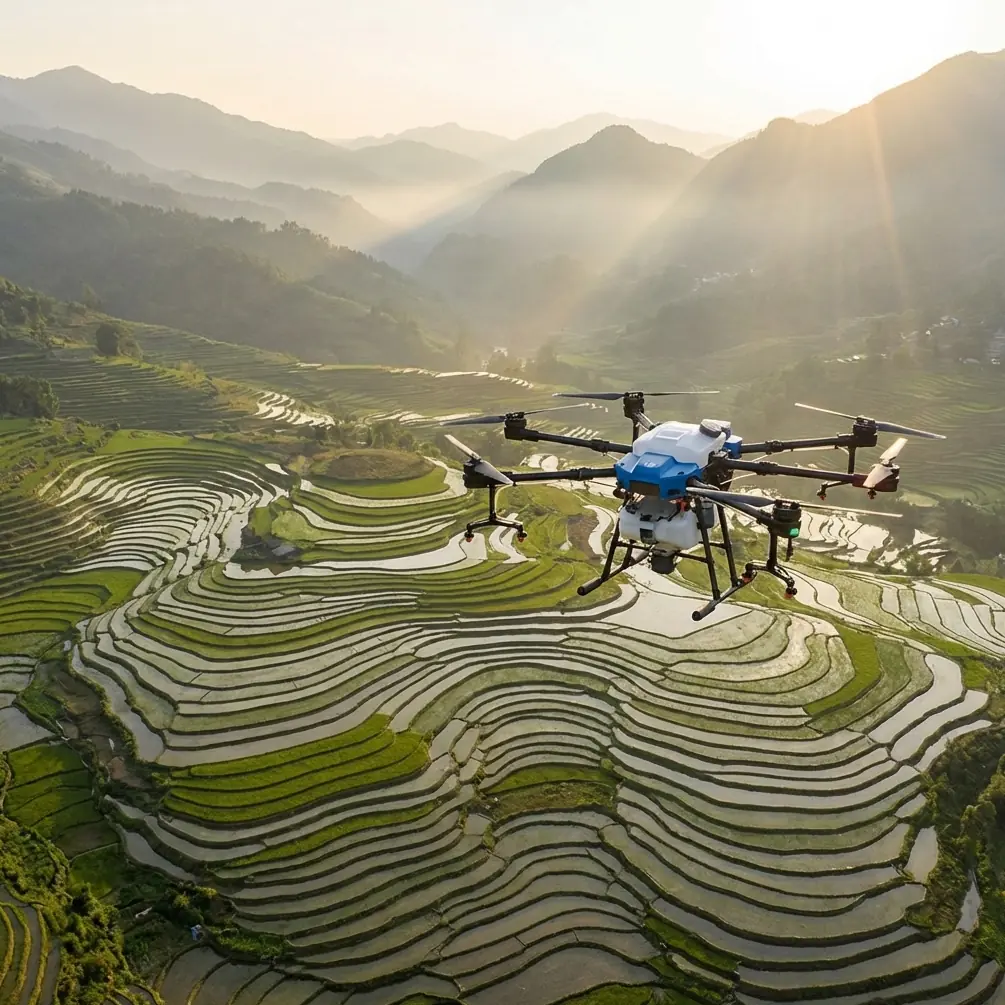
Agras T100 in Windy Fields: A Practical Case Study on Height, Drift, and Precision
META: Academic-style case study on using the Agras T100 in windy field conditions, with practical insights on flight altitude, spray drift control, nozzle calibration, RTK fix stability, and precision application.
Wind changes everything in crop spraying. Not in theory. In the field.
A calm-day setup that looks efficient on paper can become sloppy the moment gusts start pushing droplets sideways, widening the effective swath in one pass and starving the crop in the next. For operators working with the Agras T100, the central question in windy conditions is not simply whether to fly. It is how to preserve deposition quality, limit spray drift, and maintain centimeter-level repeatability when the air is no longer cooperating.
I want to frame this through a case-study lens, because that is where good operating decisions usually become clear. The T100 is often discussed in broad terms, but windy-field performance depends on a chain of small choices: flight altitude, nozzle calibration, line spacing, RTK fix stability, droplet behavior, and the operator’s discipline before the aircraft ever leaves the ground.
That last point is less glamorous than advanced avionics, but it matters. A recent technology piece published on 2026-04-15 by 御空逐影 made a simple argument in a completely different context: good results come less from hardware competition and more from technique and preparation. The article was about mobile photography, not agriculture, yet the lesson transfers surprisingly well. One of its practical tips was almost trivial on the surface—clean the lens with a soft cloth to remove fingerprints. Another advised turning off the shutter sound to make candid capture more natural. Different industry, same operational principle: preparation and unobtrusive execution often decide quality more than the device itself.
That is exactly how I approach the Agras T100 in windy spraying work.
The field scenario
Assume a broadacre field requiring uniform foliar application during a period of persistent but variable wind. Not extreme weather, not a grounded-aircraft day, but a day that tests the operator’s judgment. The crop canopy is developed enough that penetration matters, and the objective is even coverage with minimal off-target movement. The operator is relying on RTK guidance for repeatable path tracking and wants to preserve usable swath width without inviting drift losses.
In these conditions, the T100’s capabilities can help, but only if the setup is tightened before launch. Wind magnifies every weak link. A nozzle that is slightly out of calibration, a height profile that is too ambitious, or a line plan built for still air can all show up immediately as uneven deposit patterns.
The most useful altitude insight: lower is usually better, but only until airflow quality degrades
For windy fields, the optimal flight altitude is generally the lowest height that still preserves stable rotor wash interaction with the canopy and safe terrain clearance. That sounds obvious, but operators often apply it too aggressively or too loosely.
Too high, and drift increases because droplets stay airborne longer. Crosswind has more time to move the spray cloud laterally, which erodes deposition accuracy and distorts swath width. Too low, and the aircraft may struggle to maintain consistent spray geometry over uneven ground or crop height variation, while rotor-induced turbulence can produce patchy distribution if the system is forced into an unstable envelope.
The practical answer is not a universal number for every field. It is a controlled height band, validated in relation to canopy height, wind direction, and droplet spectrum. In many windy applications, lowering the spray altitude relative to a calm-day profile reduces off-target movement because the spray spends less time exposed to lateral airflow. Operationally, that means improved deposition where it belongs and a narrower uncertainty zone at the field edge.
This is where centimeter precision is not just a marketing phrase. If the T100 is holding a strong RTK fix rate, the aircraft can maintain far more consistent path placement and altitude behavior across repetitive runs. In wind, consistency matters as much as raw accuracy. A line that is exactly where it should be on one pass but wanders on the next will produce visible overapplication and misses long before the operator notices it from the ground.
Why RTK fix rate becomes more important when the air gets messy
In a calm field, operators can sometimes tolerate small positional inconsistencies without severe consequences. In a windy field, those same inconsistencies stack up against droplet drift and create compounding error.
A stable RTK fix rate supports repeatable spacing, cleaner overlap, and better confidence in effective swath width. If the system is maintaining centimeter-level positional quality, the operator has a much better chance of keeping each pass aligned with the intended treatment map, even when wind is pushing spray behavior toward the margins. The result is not just neat track lines on a screen. It is more uniform biological performance in the crop.
I often tell operators that windy-day precision is a systems problem. The aircraft’s navigation, the spray system’s calibration, and the operator’s route design all have to agree with one another. If one drifts, all three do.
Nozzle calibration is not routine paperwork here; it is the hinge point
Nozzle calibration in windy conditions deserves more attention than it typically gets. On calm days, minor variation may be masked by acceptable coverage. In wind, those small deviations become exaggerated. If one nozzle is delivering a slightly different output or producing a droplet profile outside the intended range, crosswind will amplify the inconsistency across the boom pattern.
With the T100, proper calibration should be treated as a pre-flight control measure, not an afterthought. Operators need to verify output uniformity, confirm the intended application rate, and understand how nozzle performance interacts with flight speed and swath width under current wind conditions.
The operational significance is straightforward:
- Correct calibration helps maintain predictable droplet density across each pass.
- Predictable droplet density allows realistic swath planning.
- Realistic swath planning reduces overlap waste and underdosed corridors.
That sequence becomes especially valuable near sensitive edges, watercourses, roads, or neighboring plots where spray drift carries agronomic and compliance consequences.
Swath width in wind is an agronomic decision, not a geometric one
One of the more common mistakes in windy work is treating swath width as if it were fixed by the aircraft alone. It is not. Effective swath width is the result of aircraft speed, altitude, nozzle output, droplet characteristics, canopy interaction, and crosswind.
So when the wind rises, the operator should expect usable swath width to narrow. That is not inefficiency. It is control.
A slightly reduced swath width can improve overlap quality and protect application uniformity. Operators who insist on preserving maximum spacing from calm-day conditions often pay for it later in visible banding or poor crop response. The T100’s precision platform gives room to make this adjustment intelligently, especially when RTK guidance is stable and field boundaries are well defined.
If a grower is evaluating whether the line spacing should be tightened for a specific crop or wind profile, it is worth discussing the setup directly with a technical team familiar with agricultural drone workflows; one practical route is to message an Agras application specialist here.
Preparation habits matter more than people like to admit
This is where the photography reference becomes surprisingly useful. That article highlighted 100 technique-based tips and emphasized preparation before shooting as much as execution in the moment. The soft-cloth lens cleaning advice is a reminder that tiny contaminants can degrade the final result in ways users overlook. In drone spraying, the equivalent may be checking nozzles, filters, sensors, and exposed surfaces before takeoff.
A dirty sensor, partial nozzle obstruction, residue at a connection point, or reduced visibility on a forward sensor housing can all reduce confidence when the field is already challenging. Wind leaves less margin for overlooked details.
The second photography tip—turning off shutter sound for more natural candid shots—also translates conceptually. Good operators in difficult conditions avoid unnecessary disturbance in the workflow. They do not overload the mission with avoidable complications. They simplify. In practical T100 use, that means choosing a conservative route plan, avoiding needless speed changes, keeping altitude transitions smooth, and not chasing theoretical productivity at the expense of deposition quality.
Technique over hardware competition. That was the original point in the article, and it applies cleanly here.
What about multispectral planning?
Multispectral data can be useful upstream of the spray mission, especially when variable crop vigor or stress patterns suggest that some zones are more vulnerable to coverage loss under windy conditions. While the T100 spraying decision itself is made in real time, prior multispectral interpretation can help operators understand where canopy density changes and where deposition risk may increase.
That is operationally significant because the field is rarely uniform. Wind interacts differently with open gaps, dense rows, lodged areas, and edge zones. If the operator already knows which sections are agronomically sensitive, route planning can be more intelligent. Height discipline and swath adjustments can then be made with the crop, not just the aircraft, in mind.
IPX6K matters, but not for the reason people first think
When operators see an IPX6K-style durability reference, the first reaction is often about resilience in harsh farm environments. That is fair. Agricultural drone work involves liquid exposure, washdown routines, dust, and repetitive contamination risk.
In windy spraying, though, environmental protection also supports consistency over time. The more robust the aircraft is in wet, dirty, and chemically active working conditions, the more reliable its day-to-day field performance is likely to be. Reliability is not merely convenience. It underpins calibration confidence, operational uptime, and trust in repeatability. If you are trying to fly tight, accurate missions in marginal weather, you do not want hidden maintenance drift shaping your output.
A realistic operating framework for windy-field T100 work
Here is the framework I teach for this type of mission:
1. Start with drift risk, not throughput
Before planning productivity, assess whether the day allows biologically sound application. The aircraft can fly in conditions that the agronomy may not forgive.
2. Set altitude conservatively
Use the lowest stable flight height that maintains safe canopy clearance and acceptable rotor wash behavior. If wind is increasing, revisit that height rather than assuming the original setting still works.
3. Recalibrate and verify
Treat nozzle calibration as essential. In wind, small flow irregularities become large field defects.
4. Narrow swath width when needed
Do not force a calm-day spacing model into a windy-day mission. Effective swath width is situational.
5. Watch RTK quality closely
A strong RTK fix rate supports repeatable paths, cleaner overlap, and genuine centimeter precision where it matters most.
6. Use field intelligence
If multispectral or historical block data exists, identify the zones where deposition quality matters most and plan accordingly.
7. Keep the aircraft and spray system clean
This sounds basic because it is basic. It is also one of the easiest ways to preserve performance.
The larger lesson
The most interesting thing about windy-field spraying with an Agras T100 is that success rarely comes from one spectacular feature. It comes from a disciplined stack of ordinary choices done well. Height selection. Calibration. Positioning quality. Spacing logic. Pre-flight cleanliness. Stable execution.
That is why the unrelated photography article published on 2026-04-15 is more relevant than it first appears. Its premise was that better outcomes come from technique and aesthetics, not mere equipment comparison. It even reduced one quality problem to a simple remedy: wipe the lens with a soft cloth, remove fingerprints, and image quality improves immediately. Agriculture has its own version of that truth. In a windy field, the operator who checks the basics and adapts the profile intelligently will usually outperform the operator who assumes the machine alone can absorb the conditions.
For the Agras T100, the best altitude in wind is not the highest safe setting or the lowest possible skim over the crop. It is the height that shortens droplet exposure to crosswind while preserving stable, repeatable deposition. Everything else flows from that decision.
Ready for your own Agras T100? Contact our team for expert consultation.