
Agras T100 in Dusty Field Conditions: What Really Matters
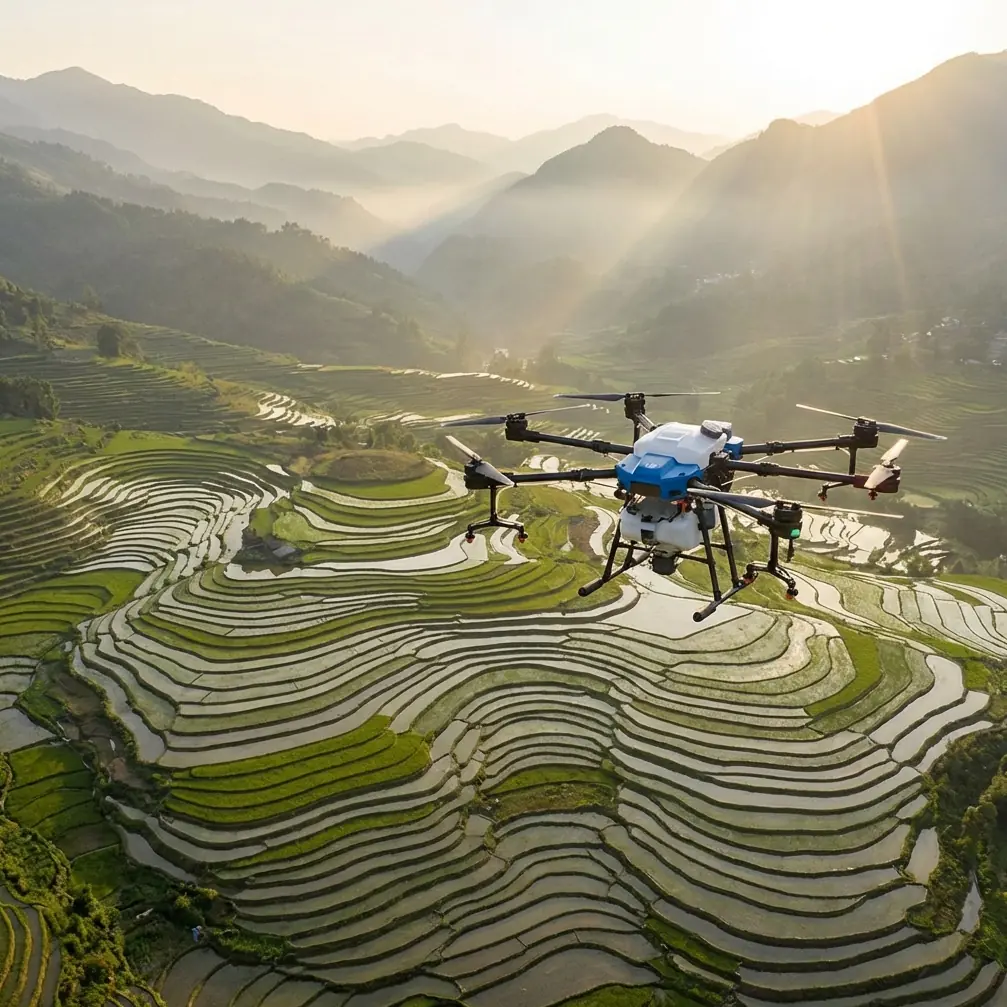
Agras T100 in Dusty Field Conditions: What Really Matters Beyond the Spec Sheet
META: A technical review of the Agras T100 for dusty field spraying, with practical insight on precision control, drift management, training logic, and why compliant operations matter as much as hardware.
Dust changes the conversation.
A drone that looks strong on paper can become inconsistent once it is working low over dry ground, pulling fine particulate into sensors, disturbing crop canopies, and trying to hold a clean spray line in unstable air. For operators evaluating the Agras T100 for field spraying in dusty conditions, the real question is not simply whether it can lift, spray, and map. The question is whether it can maintain repeatable application quality when visibility, airflow, and field discipline all get harder at once.
That is where the T100 deserves a closer technical reading.
I approach this as a field operations problem, not a marketing one. Dusty plots expose weaknesses in positioning confidence, nozzle setup, path fidelity, and pilot training. They also expose something many buyers overlook: the gap between owning an advanced aircraft and running one legally and safely. One recent case reported by youuav described the first local enforcement action in Yongxiu County against illegal or non-compliant drone flying, handled by the public security authorities. That detail matters more than it may seem. In agriculture, especially when operating over production land near roads, villages, or shared airspace, compliance is not paperwork sitting in a folder. It is part of the operating envelope.
The strongest T100 operators will be the ones who treat precision, training, and regulatory discipline as one system.
Dusty spraying work is a precision problem first
In dry fields, spray drift risk rises fast. Rotor wash interacts with loose topsoil and crop residue. Dust can create the illusion of coverage while reducing confidence in where droplets actually land. This is why nozzle calibration and stable flight geometry matter more than raw throughput.
For the T100, one of the key advantages in this kind of work is how well a high-end agricultural platform can hold a planned route with centimeter-level intent when the positioning solution is stable. If your RTK fix rate is strong, the aircraft can maintain cleaner line spacing and reduce overlap error between passes. That directly affects swath width consistency. In practical terms, steadier lane discipline means fewer underdosed strips and fewer sections that receive excess liquid because the aircraft wandered during a dusty gust.
Competitor machines in this class often claim equivalent precision. The difference usually shows up in edge cases: partial dust obscuration, rough field contours, and repeated stop-start work around obstacles. A platform that recovers line tracking faster after a disturbance saves more chemical than one that merely posts similar best-case numbers in ideal conditions.
That is where the T100’s value should be judged. Not on a brochure phrase about precision, but on whether it keeps application geometry intact once field conditions become messy.
Why training logic from education drones actually matters to large ag platforms
At first glance, a teaching document for the DJI TT educational drone might seem unrelated to the Agras T100. It is not.
The TT material describes a very clear control concept: the drone rises to 150 centimeters and hovers, then recognizes a challenge card beneath it and reacts according to the card’s identity. In one training mode, the aircraft keeps a constant relative height of 80 centimeters above a moving card and follows it until card number 2 triggers landing. In another, recognized card numbers command directional actions such as moving up or down by 30 centimeters.
These are small-scale educational routines, but they capture a foundational truth about advanced UAV work: reliable flight comes from disciplined state changes triggered by validated inputs.
For agricultural spraying, that logic translates directly into operations. The T100 does not need challenge cards in the field, of course. But the same design philosophy applies:
- detect accurately,
- hold relative position,
- maintain stable height over a changing reference,
- execute only the command that matches the confirmed signal,
- terminate the action safely when the stop condition appears.
That sequence is exactly what you want when spraying dusty fields. The aircraft should not merely fly a route. It should maintain a consistent relation to terrain and crop surface, resist false corrections, and avoid erratic altitude swings that widen drift or distort droplet distribution.
The educational reference gives us two concrete details with operational significance. First, the 150 cm hover standard shows how training frameworks build from a known stable altitude before introducing task complexity. For T100 operators, the lesson is to establish repeatable setup states before every mission: calibrated nozzles, verified RTK status, confirmed flow logic, and a clean initial hover check before entering a spray lane. Second, the 80 cm constant offset above a moving card is a simplified model of terrain-following discipline. In crop protection, keeping a stable standoff from the canopy is one of the biggest determinants of drift control and even deposition.
The best agricultural pilots I know are not the ones with the fastest hands. They are the ones who think like systems engineers.
Spray drift control is where the T100 must outperform, not just participate
Every agras platform is judged by acres covered. Experienced operators judge them by what the field looks like three days later.
In dusty environments, drift control is not just about weather. It is also about how precisely the aircraft manages height, speed, and droplet release across variable terrain. A machine that nominally supports a wide swath width can become less efficient if the pilot has to narrow operating assumptions to keep deposition acceptable in dry conditions.
The T100’s advantage, when properly configured, should be its ability to preserve productive swath width without letting the outer edge of the pattern become unreliable. That is what separates a serious application aircraft from a merely powerful one. Competitors may offer respectable tank capacity or broad-area claims, but if they force frequent correction passes because edge consistency degrades under dust and gust interaction, the field math turns against them.
Here nozzle calibration becomes decisive.
Calibration is often treated as a preflight checkbox. In truth, it is how you convert the drone from a flying machine into an agronomic tool. In dusty plots, partial nozzle contamination, pressure variation, or poor atomization choices can amplify drift or leave heavier droplets where finer coverage is needed. A stable platform like the T100 only reaches its potential when the liquid delivery side is just as disciplined as the navigation side.
If I were auditing a T100 deployment for dry-field spraying, I would care about these points before anything else:
- whether the operator validates nozzle output before each block,
- whether line spacing is based on observed deposition rather than theoretical maximum swath width,
- whether RTK fix quality is monitored continuously rather than assumed,
- whether low-altitude passes are adjusted for dust plume interaction near bare patches,
- whether route planning accounts for field edges where drift consequences are highest.
That is the difference between owning a premium drone and running a premium operation.
Dust also punishes weak hardware habits
The included Pixhawk 2.4.5 reference is not about the T100 directly, but it reminds us of something useful: serious UAV reliability starts with board-level discipline. That document mentions details such as production testing pads, analog power, and a minimum trace width of 0.15 mm on an FR4 board. Most operators never need to think at that layer, and that is fine. But the operational lesson is still relevant.
Agricultural drones live in vibration, dust, moisture, and repetitive load cycles. In other words, they are punished every day. When a manufacturer builds a robust platform, the result is not just better electronics on a bench. It shows up as fewer intermittent faults, steadier comms behavior, and more predictable sensor performance under field stress.
That matters in dusty spraying because borderline electrical or sensing inconsistencies rarely announce themselves dramatically at first. They show up as small hesitations: a delayed response, an unstable altitude hold moment, a variable flow event, an RTK reacquisition lag. A premium machine earns its reputation by reducing those small failures before they become field errors.
This is one reason operators often prefer top-tier ag platforms over lower-cost alternatives built around more generic flight stacks. On paper, many can fly autonomous routes. In dusty commercial work, the better-integrated machine usually holds its quality longer.
RTK fix rate is not a vanity metric
Readers looking at the T100 should pay attention to RTK behavior for one practical reason: drift correction starts before the liquid leaves the nozzle.
Poor positional stability creates uneven overlap. Uneven overlap causes variable dose. Variable dose changes efficacy and can increase the need for respraying. In dry environments, respraying compounds risk because each additional pass stirs more dust and often takes place in less favorable midday conditions.
A strong RTK fix rate helps the T100 maintain lane repeatability at the kind of standard that makes centimeter precision meaningful rather than decorative. That precision is especially valuable at field boundaries, tapered corners, and obstacle-adjacent segments where manual correction can introduce inconsistency.
If you are comparing the T100 with competing aircraft, ask a blunt question: which platform lets your team trust the route line enough that they can focus on agronomy instead of babysitting navigation? That is usually where the real operational winner emerges.
Multispectral workflows make more sense when the spray platform is dependable
Not every T100 operator will integrate multispectral data into routine treatment planning, but the ones who do need a spray platform that can execute prescriptions faithfully. Dusty field conditions often coincide with stress patterns that are spatially uneven: soil moisture differences, emergence variability, or pest pressure concentrated along margins. If mapping identifies these zones, the spray aircraft must be able to work them accurately.
This is where precision navigation, reliable hover behavior, and stable application height become linked again. Prescription spraying only creates value if the aircraft can reproduce the intended pattern over real terrain under real field conditions.
The educational drone example is useful here too. A simple command-recognition system that displays a card number and then performs a matched movement may seem basic, yet it models something advanced operators need from larger systems: trustworthy input-to-action behavior. In the T100 context, that means the prescription, route, and release behavior should agree with each other every time.
Compliance is part of field efficiency
That Yongxiu enforcement case should not be read as a distant legal anecdote. It is an operations warning. Agricultural drone teams often work under schedule pressure, especially during narrow spray windows. That is exactly when shortcuts creep in: rushed site checks, uncertain airspace assumptions, and poorly documented procedures.
But non-compliant flights are not just legal risks. They are workflow risks. Once an operation is interrupted, inspected, or grounded, the agronomic cost can be worse than the delay itself.
For T100 operators, the practical takeaway is simple: build legal and procedural readiness into the job, the same way you build nozzle checks and battery rotation into it. If you need a field deployment checklist tailored to your region and crop pattern, this operator support channel is a practical place to start the conversation.
My technical verdict on the Agras T100 for dusty fields
The Agras T100 should be judged as a precision application platform, not just a heavy-duty sprayer. In dusty field work, that distinction matters. Its real value lies in how well it can preserve clean flight geometry, stable canopy-relative height, and consistent route execution when the environment is trying to degrade all three.
The most revealing reference point is not a competitor’s claimed capacity. It is the small but disciplined logic shown in the TT training material: start from a stable hover at 150 cm, maintain a controlled relative offset like 80 cm, react only to validated triggers, and end safely when the stop condition is met. Scaled up to agricultural operations, that is exactly how good spray work is built.
Pair that with strong RTK fix behavior, careful nozzle calibration, realistic swath width settings, and strict compliance habits, and the T100 becomes more than capable. It becomes the kind of aircraft that keeps field quality intact under conditions that expose weaker systems.
That is what serious operators should be looking for.
Ready for your own Agras T100? Contact our team for expert consultation.