
Agras T100 in Forest Spraying: A Field Report on Extreme
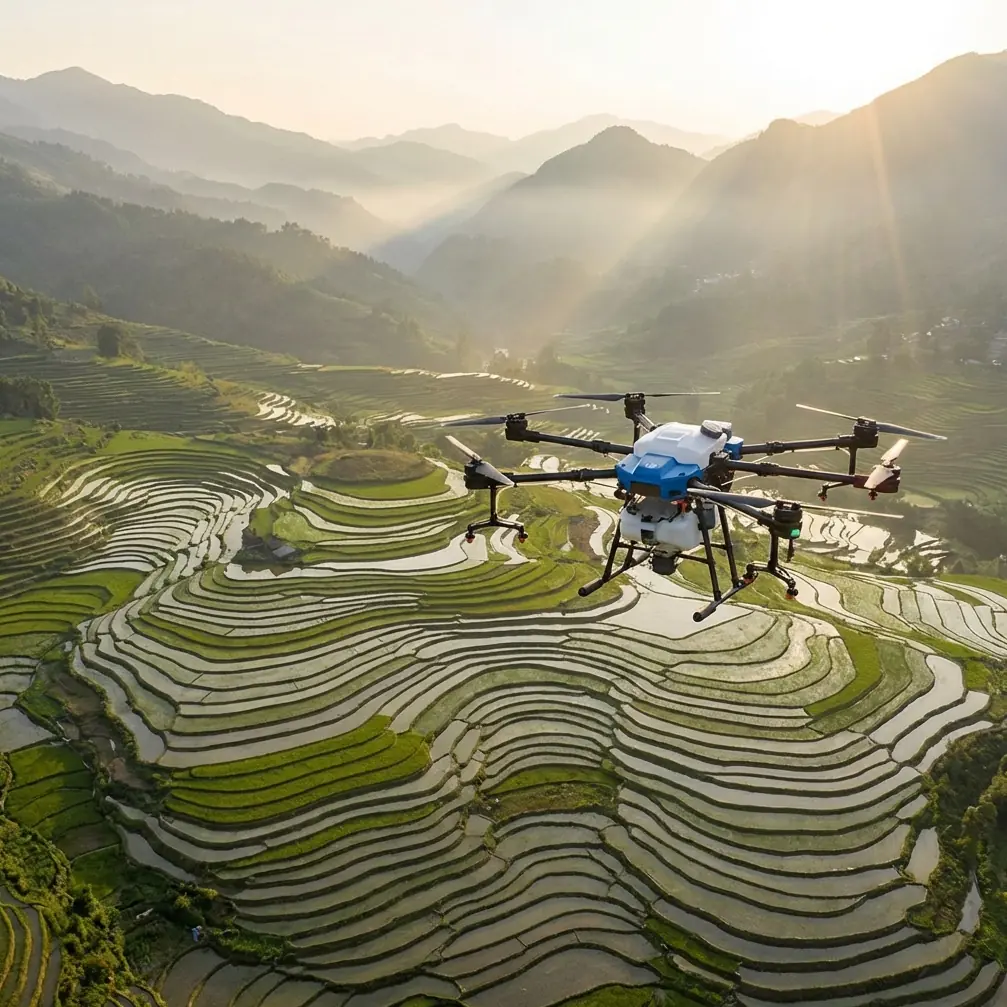
Agras T100 in Forest Spraying: A Field Report on Extreme-Temperature Work, Drift Control, and Why LiDAR Now Matters
META: Expert field report on using the Agras T100 for forest spraying in extreme temperatures, with practical insight on spray drift, nozzle calibration, RTK precision, and why DJI’s new Zenmuse L3 LiDAR changes planning in hard-to-reach terrain.
Forest spraying exposes weaknesses fast. Heat changes droplet behavior. Cold affects viscosity, pump consistency, and battery performance. Dense canopy alters airflow in ways that open-field operators often underestimate. Slopes and narrow access routes punish any workflow built around “good enough” positioning.
That is exactly why the Agras T100 deserves to be discussed as a forest machine, not just as a larger agricultural platform. In difficult timber blocks, shelterbelts, reforestation zones, and uneven upland plots, the question is not simply whether the aircraft can carry liquid and cover acreage. The real question is whether it can maintain treatment quality when the environment is actively trying to degrade it.
This field report looks at the T100 through that lens: extreme temperatures, forest-edge turbulence, spray drift pressure, and route precision. It also connects that work to a new development from DJI Enterprise that matters more than many spraying teams may initially realize. On 2025-11-04, DJI introduced the Zenmuse L3, described as its first aerial LiDAR system built for long-range sensing and high-accuracy mapping. The launch language was spare but revealing: it highlighted data capture from multiple angles and framed the system for “roads less traveled” and hard-to-reach fieldwork. For forest spraying teams, that is not a side story. It points toward a better operating model.
Why forests are harder than broadacre fields
In row crops, spray planning tends to assume relative uniformity. Forest work breaks that assumption. Tree height varies. Canopy density changes by section. Wind can be calm at the takeoff point and unstable just above the treeline. Temperature inversions can linger in low pockets. A route that looks simple on a 2D map may hide abrupt elevation shifts or dead zones in GNSS performance.
That complexity affects three things immediately:
- Drift risk
- Coverage consistency
- Repeatability of treatment lines
An aircraft can have strong throughput on paper and still underperform in a forest if it cannot hold stable application geometry. That is where operators begin to care less about headline payload talk and more about swath width discipline, nozzle calibration integrity, and RTK fix rate under partial canopy conditions.
The T100 enters this conversation because forestry spraying is not a volume contest. It is a control problem.
Extreme heat: where drift starts to get expensive
In hot conditions, droplet evaporation accelerates. Smaller droplets become even smaller before reaching the target zone. Forest edges can create strange convective currents, especially in open gaps between dense stands. If the operator pushes speed to preserve daily output, the penalty often appears as off-target deposition or weak lower-canopy coverage.
With the Agras T100, the practical answer is not one setting. It is a calibration discipline.
Nozzle calibration matters more in forests than in flat crop blocks because forest targets are vertically layered. If nozzle output is uneven, the aircraft may still appear productive from a coverage map perspective while delivering poor biological performance. In high heat, that margin gets thinner. A slightly wrong droplet spectrum can become a major miss by midday.
This is also where the T100 can separate itself from weaker competitors. Some platforms look acceptable when conditions are forgiving, but their real-world spray quality falls apart when wind and heat combine with uneven terrain. A stronger system is not just one that flies. It is one that helps the operator preserve predictable atomization and track spacing when the air is unstable.
That is why I advise forest crews to think in terms of effective swath width, not nominal swath width. Nominal figures are easy to advertise. Effective swath width is what remains once drift pressure, canopy interception, and edge turbulence are accounted for. In extreme temperatures, the T100’s value is tied to how well it supports controlled, repeatable passes rather than theoretical maximum spread.
Cold weather creates a different problem set
Cold conditions tempt crews into a false sense of security because drift can appear visually lower. But cold introduces other issues. Fluid characteristics change. Pumps and lines can respond differently. Batteries can show reduced performance if they are not managed correctly before sortie launch. Trees with moisture, frost, or mixed canopy density can alter how droplets behave on contact.
The T100 is relevant here because forest work in cold conditions rewards aircraft that can maintain stable flight behavior and precise route adherence despite a more demanding thermal environment. If your aircraft wanders, hesitates, or varies speed through terrain transitions, your application pattern changes. In forests, those changes do not average out nicely. They stack up along slope breaks, stand edges, and turn entries.
That is where centimeter precision enters the conversation. Many operators use the phrase casually. In forest spraying, it should be treated as operationally consequential. If the aircraft holds its line with true consistency, overlap can be tightened intelligently and skipped pockets reduced. If the precision degrades, over-application and untreated bands become more likely, especially in irregular blocks.
RTK fix rate is therefore not a technical vanity metric. It directly affects treatment quality. A high fix rate gives crews confidence that the line flown is the line intended. In mixed-canopy environments, that confidence is worth more than broad spec-sheet claims.
The overlooked link between the T100 and DJI’s new Zenmuse L3
DJI’s launch of the Zenmuse L3 may sound distant from an Agras discussion at first. It is a LiDAR story, not a spraying story. But the reference facts tell us exactly why it matters.
DJI positioned the L3 as:
- its first aerial LiDAR system focused on long-range sensing and high-accuracy mapping
- a Zenmuse payload intended for aerial data collection
- a system designed to gather data from multiple angles
- a tool for fieldwork in hard-to-reach or less-traveled areas
Every one of those details is relevant to forest spraying.
Forests are the definition of hard-to-reach terrain. Access roads are limited, topography is often uneven, and visual interpretation from standard orthomosaics can miss important vertical structure. A multi-angle LiDAR workflow changes the quality of the planning surface before the T100 ever leaves the ground.
Here is the operational significance.
1. Multiple-angle data capture improves route design in forested terrain
Traditional mapping can flatten the real challenge. Forest edges, breaks in canopy, drainage dips, and embankments may not be represented well enough to support precision spraying at low altitude. DJI’s emphasis on collecting data from multiple angles suggests a more robust 3D understanding of difficult sites.
For T100 crews, that means better pre-mission planning:
- cleaner terrain-following expectations
- improved identification of obstructions
- more realistic route segmentation
- smarter launch and recovery point selection
In forests, that planning quality directly affects treatment consistency and aircraft safety margins.
2. High-accuracy mapping supports repeatable application blocks
DJI explicitly framed the L3 around high-accuracy mapping. That matters because forest spraying often involves follow-up passes, edge treatments, spot revisits, or seasonal repetition. If your base map is weak, every repeat mission inherits that weakness.
A stronger mapping layer allows T100 operators to define more precise treatment boundaries. That can reduce overspray into non-target vegetation and tighten execution around sensitive forest margins. It also helps when different crews need to reproduce the same work later under different weather windows.
In practical terms, high-accuracy mapping is not a luxury add-on. It is how a spraying program becomes auditable and repeatable.
Why this matters more in “roads less traveled” sites
The launch text for the L3 included a phrase about work for “roads less traveled.” That line is marketing shorthand, but it points to a real operational truth. The farther a forestry block is from easy access, the more expensive bad assumptions become.
If a team drives deep into a remote site only to find that route planning was based on incomplete surface understanding, the penalty is immediate:
- setup delays
- reduced sortie count
- increased battery turnover pressure
- more conservative application settings
- possible retreatment later
This is the hidden economic argument for pairing better mapping intelligence with a capable spraying platform like the T100. Remote forestry work punishes inefficiency. Stronger pre-mission data and stronger in-mission precision reinforce each other.
Spray drift in forests is not just about wind speed
Too many teams reduce drift management to one variable. In practice, forest drift behavior is shaped by a combination of:
- ambient temperature
- humidity
- canopy-induced airflow
- rotor downwash interaction
- droplet size
- flight height
- route spacing
- edge turbulence
The T100 should be evaluated by how well it allows the operator to tune these variables, not by simplistic assumptions about area coverage. Nozzle calibration is central here. If nozzles are not checked carefully and often, especially when moving between chemical mixes or working across temperature swings, the operator may be making route decisions based on a false application profile.
That is one reason I recommend treating nozzle checks as part of the mission architecture, not a maintenance afterthought. In forest blocks, a small calibration deviation can become visible only after the biological result disappoints. By then, the aircraft may have done everything the flight log says it should. The problem was not navigation. It was deposition.
A note on multispectral workflows
Multispectral data is often discussed in crop health contexts, but it has a place in forestry treatment planning as well, especially in identifying stress variation, stand boundaries, or regeneration inconsistencies. For the T100 operator, that data becomes far more useful when aligned with a high-quality 3D understanding of terrain and canopy structure.
That is why the arrival of a long-range, high-accuracy LiDAR tool in DJI’s ecosystem deserves attention from spraying teams. It suggests a maturing workflow where treatment decisions are no longer based only on surface imagery or pilot familiarity. Instead, the spray plan can be built around better structural knowledge of the site.
The T100 stands to benefit from that shift because a precise application platform becomes more valuable as the quality of planning data improves.
Where the T100 can excel against competing platforms
Competitors often claim similar outcomes in promotional material. Forest work reveals which claims survive contact with reality.
The T100 has the opportunity to excel when operators need a platform that can do three things well at once:
- hold disciplined lines in irregular terrain
- support careful spray tuning under temperature stress
- integrate into a workflow that depends on accurate mapping, not guesswork
Some competing aircraft may look strong in open, repetitive fields but become cumbersome in fragmented forest geometry. Others may handle basic route execution yet lack the ecosystem momentum that now matters as mapping and treatment planning converge. DJI’s 2025 launch of the Zenmuse L3 is significant because it signals investment in the data side of difficult aerial fieldwork, not just the application side.
That should matter to any forestry operator choosing equipment for the next several seasons rather than the next demonstration day.
What I would watch before a real forest spraying mission
If I were supervising a T100 deployment in extreme temperatures, my checklist would not start with acreage ambitions. It would start with control points:
- Verify RTK fix rate performance in the actual forest environment, not just in an open staging area.
- Confirm nozzle calibration with the intended mix and ambient temperature window.
- Adjust expectations for effective swath width based on canopy turbulence, not brochure assumptions.
- Build route logic around terrain and edge effects, ideally from a mapping stack that includes stronger elevation and structural data.
- Review whether battery handling and launch cadence are suitable for heat or cold stress on the day.
- Reassess drift risk after sunrise warming or late-day cooling, because forest airflow can change faster than teams expect.
If your team needs a second opinion on route setup or forest application planning, you can message a UAV specialist here.
The bigger picture
The Agras T100 becomes more interesting when viewed as part of a serious forestry workflow rather than as an isolated spray aircraft. Forest spraying in extreme temperatures is unforgiving. It rewards precision, disciplined calibration, and route planning rooted in real terrain knowledge.
DJI’s November 2025 launch of the Zenmuse L3 adds an important piece to that puzzle. Long-range sensing. High-accuracy mapping. Multi-angle data capture. A focus on hard-to-reach areas. Those are not abstract features. They address exactly the kind of problems that make forest spraying difficult: incomplete site understanding, hidden terrain complexity, and weak repeatability.
For operators working in harsh conditions, the T100’s true value is not just what it can carry across a block. It is what it can do when combined with better planning, stronger positional confidence, and careful spray management under pressure. That is where performance stops being theoretical and starts showing up in the stand.
Ready for your own Agras T100? Contact our team for expert consultation.