
Agras T100 for Solar Farm Spraying in Low Light
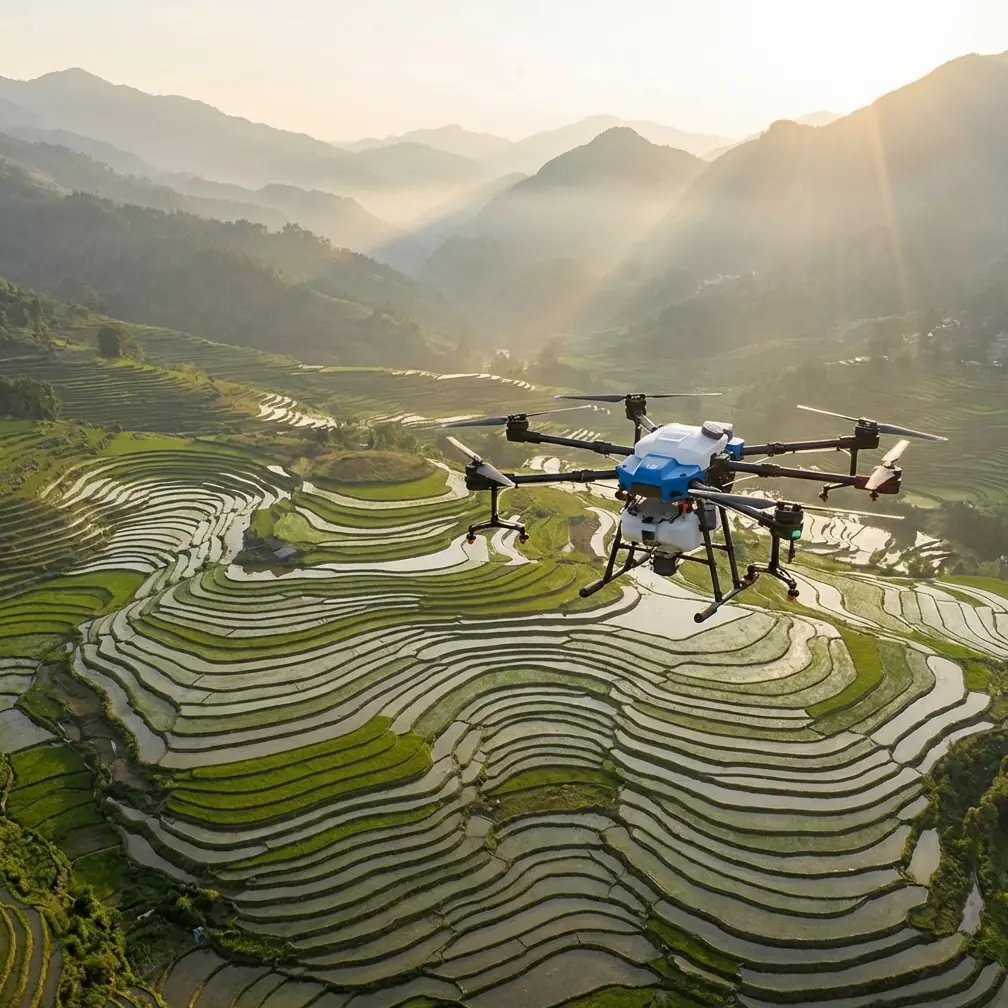
Agras T100 for Solar Farm Spraying in Low Light: Flight Height, Drift Control, and Why Aerodynamics Still Matter
META: Expert Agras T100 spraying guidance for solar farms in low light, with practical insight on flight altitude, spray drift, nozzle calibration, RTK precision, and route stability.
Low-light spraying around solar farms sounds simple until you are actually on site. Rows repeat. Visual contrast falls off fast. Panel edges, cable trays, perimeter fencing, and weed growth patterns all start to blend together. The aircraft still has to hold a clean line, maintain even deposition, and avoid pushing droplets where they do not belong. That is where the Agras T100 conversation gets serious.
For this kind of work, the biggest operator mistake is usually not speed. It is altitude discipline.
Too high, and the spray pattern becomes vulnerable to drift, rotor wash distortion, and uneven deposition along the panel rows. Too low, and you risk unstable flow around structures, inconsistent swath overlap, and unnecessary stress when flying in reduced visibility. The sweet spot is not a marketing number. It is an aerodynamic decision tied to how air actually moves around the aircraft and the site.
The real problem on solar farms after sunset or before sunrise
Solar farm vegetation control is different from broadacre field spraying. You are not covering an open, forgiving canopy. You are working in a built agricultural-industrial environment with hard surfaces, narrow corridors, and repetitive geometry.
Low light adds three operational penalties:
- Depth perception degrades.
- Surface contrast drops, especially on dark panels and damp ground.
- Crosswind cues become harder to read visually.
That third point matters more than many crews admit. Spray drift often starts as a judgment failure before it becomes a nozzle or droplet problem. If you cannot read subtle wind movement off the site, you tend to rely too much on the aircraft’s stability and not enough on setup.
The Agras T100 is well suited to structured, repeatable routes when the operator treats precision systems and spray physics as one integrated workflow. RTK fix rate, nozzle calibration, route spacing, and flight altitude are not separate checkboxes. They interact.
Why flight altitude is the pivot point
When operators ask me for the best starting altitude for solar farm spraying in low light, I usually frame it this way: fly only high enough to protect stability and swath consistency, but low enough to keep droplets inside a controlled application envelope.
That sounds obvious. It is not. Many teams default to a higher pass because it feels safer in poor visibility. In practice, raising the aircraft can make the application less controlled.
The source material behind this discussion is educational rather than product-specific, but it gets at something operators often forget. It explains lift through pressure difference: when air moves over a curved upper surface, pressure drops relative to the flatter lower side, producing upward force. It also uses a simple but useful analogy from a narrowing pipe, where flow speeds up in the constricted section and pressure falls. Those are not academic side notes. They tell you why a spray aircraft never exists in still air, even when the weather looks calm.
Air acceleration changes pressure. Curved surfaces redirect flow. Faster flow zones behave differently from slower ones.
On a multirotor spraying platform like the Agras T100, you are not dealing with a fixed wing, but the lesson is still operationally valuable. The aircraft is constantly generating complex air movement around rotors, frame, booms, and droplets. The moment that downwash interacts with solar table edges, row gaps, or terrain undulation, your spray cloud stops behaving like a clean textbook pattern.
That is why altitude matters so much. A few extra feet can give droplets more time to be displaced by crossflow or recirculating air near structures. A few feet lower can tighten deposition, but only if the route is stable and the pilot is not fighting obstacle anxiety.
A practical starting point for Agras T100 height on solar sites
For low-light solar farm spraying, I recommend treating 2 to 3 meters above the target zone as the primary starting range for tuning, not as a fixed rule. That range is usually low enough to reduce drift exposure and keep the swath coherent, while still giving the Agras T100 enough operating margin to track cleanly over uneven ground and site hardware.
Why not simply go lower?
Because solar farms are not flat grass strips. You may encounter panel tilt changes, inverter pads, drainage cuts, and vegetation that varies from sparse to dense. In low light, a margin that feels excessive in daylight can become the difference between a calm mission and a rushed correction.
Why not higher?
Because the longer the droplet spends suspended between nozzle and target, the more chances the environment has to alter placement. Drift is not only a weather event. It is a time-and-distance problem. Extra altitude increases both.
So the operational answer is this: start in the 2 to 3 meter band, verify deposition, confirm swath width under actual site conditions, and only then adjust. If weed pressure is concentrated in narrow strips beneath panel rows, bias lower within that range. If terrain undulates or visual reference is poor, bias slightly higher, but do so reluctantly and with overlap checks.
What Bernoulli has to do with spray drift
A lot more than most field guides admit.
The educational source explains that in a narrowed flow path, fluid velocity rises and pressure drops. It also describes how air follows a curved surface due to an attachment effect, creating low-pressure regions. On a solar farm, this matters because panel geometry and row spacing can create localized flow changes. Air does not just move across the site as a flat sheet. It accelerates through gaps, curls around edges, and shifts near angled surfaces.
That means drift risk can spike in places that seem sheltered.
A corridor between rows may look calm at ground level, but the aircraft’s own downwash can combine with channelized ambient airflow and produce lateral transport. If you are flying too high, those interactions have more room to distort the droplet path before impact.
This is also why a well-calibrated nozzle set matters. Nozzle calibration is not a maintenance chore you finish once and forget. If your output profile is inconsistent, you cannot separate an airflow problem from a flow-rate problem. Operators then start correcting with altitude or speed when the root cause is actually at the nozzle.
RTK precision matters more in low light than in daylight
Solar farms reward repeatability. In reduced light, repeatability becomes protection.
Centimeter precision is not just a mapping phrase. It directly affects how confidently the Agras T100 can hold line spacing, especially when visual references flatten out. A healthy RTK fix rate helps maintain route integrity and overlap consistency when your eyes are doing less of the work.
This is where the mapping reference is useful even though it comes from a different UAV discipline. The 2014 paper on low-altitude UAV remote sensing in surveying reflects a broader truth: low-altitude drone work becomes valuable when precision and controllability are high enough to trust the data or application outcome. In mapping, that means positional accuracy. In spraying, it means your pass-to-pass geometry remains dependable enough to support even coverage.
On a solar site, that translates to fewer misses along the edges of vegetation bands and less over-application where rows converge visually in low light.
If your RTK fix rate is unstable, do not try to “fly through it” because the site looks easy. Low-light missions reduce your capacity to catch subtle line drift by eye. Precision positioning is doing more than holding a path; it is reducing cumulative error across an entire block.
Swath width is not a brochure number on a solar farm
In open acreage, operators often think in terms of maximum productivity. On solar farms, usable swath width is a site-specific outcome.
Panel elevation, row spacing, weed height, nozzle state, ambient humidity, and crosswind all affect the effective pattern. The Agras T100 may be capable of a broad pass in one context and require a narrower, more conservative setup in another. Low light pushes you toward the conservative end.
This is where test strips are worth the time. Run a controlled section, inspect deposition at multiple points across the target band, and do not assume centerline performance tells the whole story. Edge behavior is where low-light errors often hide.
When people talk about drift, they usually imagine off-target movement beyond the treatment zone. On solar farms, another problem is partial underdosing at the far edge of the intended swath. The aircraft appears productive, but the control result a week later tells a different story.
IPX6K is useful, but it does not replace process discipline
Solar farm work often starts when moisture is still around: dew on vegetation, damp surfaces, residue from cleaning, or misty pre-dawn conditions. A robust environmental protection rating such as IPX6K is relevant because these sites are not clean-room environments. Water exposure, washdown demands, and residue contact are real parts of the job.
But crews sometimes let ruggedness become a psychological shortcut. A durable aircraft still needs a methodical preflight and postflight routine. Moisture changes droplet behavior. Residue buildup changes nozzle performance. Fine contamination around spray components can alter consistency long before it creates a failure.
The tough airframe helps the operator. It does not absolve the operator.
A field workflow that works
My preferred sequence for Agras T100 low-light solar spraying is straightforward:
- Confirm RTK health before takeoff and monitor fix stability, not just initial lock.
- Calibrate nozzles and verify actual output uniformity.
- Start with a conservative route plan and a working altitude around 2 to 3 meters above the target.
- Use a reduced test block to validate swath width and edge deposition.
- Watch for row-specific airflow effects, especially near gaps, corners, and infrastructure transitions.
- Adjust altitude last, not first.
That last point saves time. If deposition looks off, many operators immediately change height. Often the better first questions are: Is the nozzle set truly balanced? Is the route overlap realistic for this site? Is the aircraft holding a stable RTK solution? Is there channelized airflow between rows?
If you want to compare your site conditions or discuss a spray pattern issue with someone who has seen this exact scenario, you can message me here: https://wa.me/85255379740
Should you bring multispectral thinking into a spray mission?
Not necessarily as payload on the same operation, but certainly as a planning mindset.
Multispectral data can help identify where vegetation pressure is strongest, where moisture retention changes regrowth behavior, and where site-specific weed bands may justify tighter route tuning. The value is not in adding complexity for its own sake. The value is in avoiding the assumption that every row deserves the same treatment geometry.
On large solar assets, a precision spray plan informed by prior imaging often outperforms a uniform plan flown perfectly.
The takeaway for Agras T100 operators
If you are spraying a solar farm in low light, the best altitude is rarely the one that feels safest from the pilot’s perspective. It is the one that keeps droplets in a short, controlled path while preserving route stability. In many cases, that means beginning around 2 to 3 meters above the target and validating from there.
The deeper reason comes back to airflow. The source material’s explanation of pressure difference and accelerated flow in narrower passages is not just classroom theory. It is a reminder that spray behavior is always being shaped by moving air, changing pressure zones, and surface geometry. Solar farms amplify those effects because they are built landscapes, not open fields.
Pair that aerodynamic awareness with strong RTK fix performance, disciplined nozzle calibration, realistic swath expectations, and respect for moisture-heavy operating conditions. That is how the Agras T100 becomes precise instead of merely capable.
Ready for your own Agras T100? Contact our team for expert consultation.