
How I’d Set Up an Agras T100 to Spray Solar Farms in Extreme
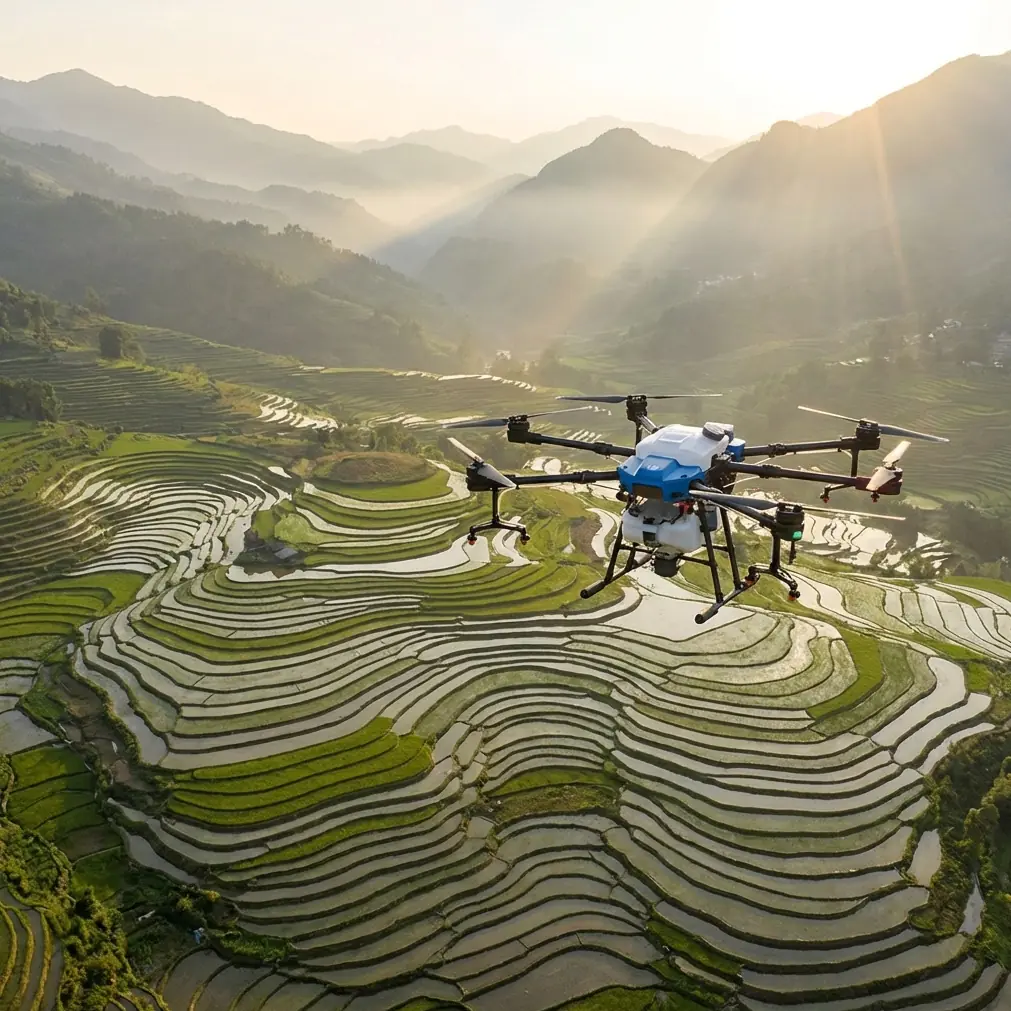
How I’d Set Up an Agras T100 to Spray Solar Farms in Extreme Heat Without Losing Accuracy
META: A field-focused tutorial on using the Agras T100 for solar farm spraying in extreme temperatures, with practical notes on drift control, calibration discipline, RTK precision, sensor awareness, and mission reliability.
Solar farm vegetation control looks simple from the access road. It never is.
The rows are repetitive, the obstacles are unforgiving, and heat changes everything. By midafternoon, the shimmer rising off dark panels can distort depth cues, push droplets off target, and expose every weak point in a spray workflow. If you’re planning to use an Agras T100 in that environment, the machine matters, but setup discipline matters more.
I approach these sites less like open-field agriculture and more like precision corridor work. You’re not just treating weeds. You’re protecting electrical infrastructure, avoiding overspray onto panels, maintaining ground coverage consistency, and doing it in a place where thermal load can punish batteries, pumps, operators, and decision-making.
This tutorial lays out how I’d prepare an Agras T100 for solar farm spraying in extreme temperatures, with special attention to spray drift, nozzle calibration, RTK fix rate, swath width, and sensor behavior around reflective surfaces and wildlife.
Start with the site, not the drone
Before I power up the T100, I want a practical map of the site conditions that matter to spraying:
- row spacing
- panel tilt and height
- vegetation density
- service roads
- inverter pads and cable runs
- wind lanes created by the array geometry
- heat pockets around gravel and dark equipment pads
Solar farms create their own microclimate. Wind doesn’t always behave the way it does in open farmland. Some rows funnel it. Some block it. Some produce sudden cross-currents near the ends of strings. That matters because drift on a solar site is not an abstract compliance issue. Drift means residue on panels, retreatment costs, cleanup labor, and tense conversations with site management.
If I have current vegetation imagery, I’ll review it first. If the operator is also using multispectral data from another platform, that can help classify where growth pressure is worst and where a full-rate application is unnecessary. The T100’s mission then becomes targeted execution, not blanket treatment.
Extreme temperatures change your mission timing
On hot solar sites, the best operational decision is often made before takeoff: don’t fly at the hottest part of the day unless you have to.
Extreme heat affects atomization consistency, evaporation, battery performance, and pilot stamina. It also amplifies panel glare and thermal turbulence. I prefer early morning windows when droplets have a better chance of reaching the intended target and the aircraft is not constantly fighting rising heat plumes.
When a midday flight is unavoidable, I shorten the mission blocks. That means more frequent tank checks, more deliberate battery rotation, and tighter monitoring of spray pattern quality. Long heroic runs are how errors compound.
RTK fix rate is the difference between “close enough” and clean work
On solar farms, centimeter precision is not a luxury phrase. It’s operationally significant.
The Agras T100 needs stable positioning if you want repeatable passes along tight corridors without creeping too close to tables, posts, and perimeter fencing. A weak RTK fix rate can show up as small lateral deviations that don’t look dramatic on the screen but absolutely show up in the spray result.
Why does that matter here more than in broadacre work? Because your swath width is only useful if the aircraft is where you think it is. On a solar farm, an offset pass may create three problems at once:
- missed vegetation under one edge of the row
- excessive overlap in the adjacent strip
- increased chance of spray contacting panel surfaces or support hardware
I treat RTK status as a live operational metric, not a checkbox during setup. If fix quality is unstable near substations, metal structures, or control buildings, I adjust the mission architecture. That can mean changing takeoff position, breaking the site into smaller sectors, or altering route direction to preserve signal confidence.
Nozzle calibration is where most “mystery inconsistency” begins
When people talk about poor coverage in hot conditions, they often blame the weather first. I usually inspect the nozzles first.
Nozzle calibration on the T100 isn’t glamorous, but it directly controls whether the aircraft is actually delivering the intended application rate. On solar farms, where bare gravel, patchy weeds, and denser perimeter growth can all appear in one mission, a sloppy calibration creates visible inconsistency fast.
I want three things verified before spraying:
- even output across the boom/nozzle set
- droplet profile matched to the site’s drift risk
- flow behavior confirmed at the actual flight speed planned for the mission
A calibration done casually in the shade at dawn can still fail once the system is working over heat-radiating surfaces. Viscosity, pressure response, and evaporation behavior all become more unforgiving.
This is why I advise operators to perform a short validation run after setup rather than trusting that a previous profile is still correct. The T100 may be sophisticated, but liquid systems still answer to physics.
Swath width should be conservative on panel-heavy sites
The temptation is to maximize productivity by stretching swath width. On solar farms, that usually backfires.
The practical swath width is not just what the aircraft can theoretically cover. It’s what it can cover consistently while keeping drift, overlap, and corridor alignment under control. Narrowing the effective swath slightly often improves the real-world result because it protects coverage quality when wind changes between rows.
That matters especially around array edges, culverts, security fencing, and drainage channels where weeds often grow thicker and airflow gets messy. A slightly conservative swath plan reduces retouch work later.
If you are seeing inconsistent edge coverage, don’t jump straight to chemistry changes. Revisit altitude, speed, and swath assumptions first.
Sensor behavior matters more than people expect around reflective infrastructure
One thing many crews learn late is that solar farms can confuse visual interpretation. Repetitive geometry, glare, shadow bands, and thermal shimmer can all affect how comfortable an operator feels, even with a highly capable platform.
That’s why I like to think in terms of “recognition envelopes.” A useful reference point comes from DJI educational vision-based challenge card material, which notes an effective recognition height range of 30 to 120 centimeters, with the recognized area expanding from 40 cm x 40 cm at 30 cm height to 100 cm x 100 cm at 120 cm height. That document is not about the Agras T100 specifically, but it highlights a principle that absolutely carries over to sensor-reliant UAV work: visual recognition only works reliably inside defined spatial conditions.
Operational significance? Don’t assume the drone will interpret every visual cue equally well just because the row pattern looks obvious to a person standing nearby. Height, angle, light, and texture all affect what the system can detect cleanly. On a solar site, reflective panels and low-texture gravel strips can reduce the margin for sloppy assumptions.
That same reference also states that recognition should occur on a surface with clear texture and moderate ambient light, and that commands tied to the marker can fail if the aircraft is outside the recognizable space. Again, the lesson for T100 operators is straightforward: when the environment becomes visually harsh, rely less on guesswork and more on deliberate altitude control, verified mission planning, and strong positioning data.
Wildlife is not a side issue on solar farms
A lot of solar sites attract wildlife because the perimeter is controlled and the shade under panels creates habitat. I’ve seen rabbits, snakes, ground birds, and once, during a heat-stressed afternoon inspection pass, a red-tailed hawk drop low across an access lane chasing prey between panel rows.
That kind of moment is exactly why the T100’s sensing and obstacle awareness should never be treated as background features. In that hawk encounter, the aircraft’s situational awareness let the operator pause progression and avoid a rushed correction that could have pushed the drone toward the array structure. No collision, no wildlife strike, no damaged hardware.
The lesson is simple: on a solar farm, the safest path is not always the straightest path. Keep enough buffer in your route design to let the aircraft and operator respond calmly to moving hazards, especially in periods of thermal activity when birds are more dynamic in the air.
Don’t ignore compass health around electrical infrastructure
Solar farms are full of things that can stress navigation confidence: buried lines, inverters, combiner boxes, steel, and current-carrying equipment. While the T100 is a modern agricultural platform, the underlying lesson from older compass calibration guidance remains relevant.
A technical calibration reference in the provided material notes that a second Z-axis compensation value often falls above 300 and below 400, and values over 400 should prompt recalibration. It also emphasizes that magnetic interference can come from motors, power wiring, and related electrical components, and that compensation procedures should be performed carefully and slowly.
Why does that matter operationally for a solar spraying mission? Because solar infrastructure is exactly the kind of environment where magnetic irregularities and electrical clutter can expose weak preflight habits. If heading behavior looks odd near energized equipment or staging areas, I do not push forward and hope the system settles down. I relocate, recheck, and confirm the aircraft is behaving normally before loading the mission.
This isn’t about overreacting. It’s about respecting the fact that a drone can be perfectly airworthy and still be poorly positioned for a clean compass environment on a given launch point.
Use route logic that matches the geometry of the farm
A good solar farm mission is boring in the best way. Predictable entry, predictable turns, predictable exit.
One useful concept from the training material is coordinated movement between recognized positions using defined paths, including arc-style transitions, with one example citing a speed of 60 centimeters per second between programmed coordinates. The number itself comes from an educational context, not a production spray profile, but the principle holds up: controlled path geometry matters.
For T100 work, that means:
- smooth turns at row ends
- avoiding aggressive lateral corrections
- minimizing abrupt speed changes over treatment zones
- preserving a repeatable orientation relative to the arrays
In plain terms, every violent correction in a hot, drift-prone environment is a chance to ruin distribution uniformity.
IPX6K-style durability is useful, but it does not replace cleanup discipline
Readers looking at the T100 for harsh sites often focus on ruggedness, and fair enough. A machine built for demanding agricultural work needs to tolerate moisture, dust, and washdown conditions. But solar farm spraying has its own contamination profile: fine dust, chemical residue, pollen, and heat-baked grime.
Even if the aircraft is built to handle aggressive field conditions, post-mission cleaning still affects long-term reliability. Residue around nozzles, pumps, connectors, landing gear, and sensor windows is not just cosmetic. It changes future spray consistency and can degrade sensor confidence.
High-temperature sites make this worse because deposits dry fast and bake on.
A practical workflow I’d use on the day
Here’s the sequence I recommend for an Agras T100 spraying mission on a hot solar site:
1. Walk the first section
Confirm row clearance, obstacle anomalies, and any wildlife activity.
2. Check weather at row level
Don’t rely only on a general forecast. Measure what the air is doing inside the array.
3. Confirm RTK stability
If fix quality is inconsistent, adjust your operating position before building confidence around bad data.
4. Inspect and calibrate nozzles
Then validate output with a short test, not just a menu confirmation.
5. Set a realistic swath width
Choose repeatability over headline productivity.
6. Build mission segments
Shorter blocks are easier to supervise in extreme temperatures.
7. Watch for heat-induced drift change
Conditions at 8:30 and 11:30 may not remotely match.
8. Keep visual and sensor surfaces clean
Dust and residue matter more than many crews think.
9. Reassess after every battery and refill cycle
Don’t assume the fifteenth pass behaves like the first.
If you’re trying to sort through setup decisions for a specific site, row geometry, or temperature window, you can message a T100 workflow specialist here.
The real standard is repeatability
Anyone can make a drone spray a solar farm once. The professional standard is making it repeatable across changing temperatures, different vegetation pressure, and tight infrastructure spacing.
That’s why I keep coming back to the same fundamentals: stable positioning, disciplined nozzle calibration, conservative swath planning, and respect for how sensors behave in visually difficult environments. The reference materials behind this discussion may come from very different contexts—vision recognition training and compass interference calibration—but both point to the same truth. UAV performance is bounded by conditions. The best operators know those bounds and plan inside them.
With an Agras T100, that mindset is what turns a stressful summer site into a manageable, efficient operation.
Ready for your own Agras T100? Contact our team for expert consultation.