
Agras T100 in Complex Terrain: A Field Report from Solar
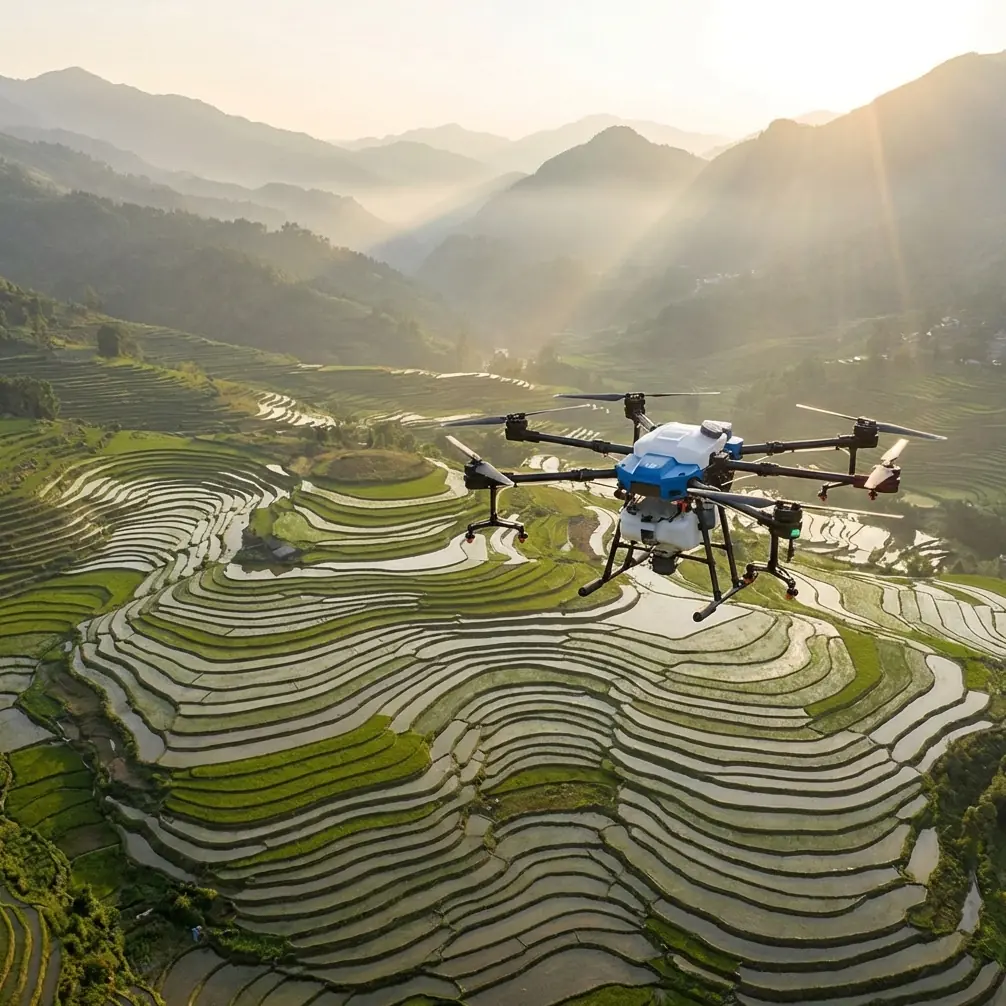
Agras T100 in Complex Terrain: A Field Report from Solar Farm Spraying
META: A field report on how the Agras T100 fits solar farm spraying in complex terrain, with practical insight on drift control, nozzle calibration, RTK precision, pre-flight cleaning, and why policy and training matter.
I’ve spent enough time around difficult spray environments to know that “complex terrain” is often an understatement. Solar farms look orderly from a distance, but once you’re on the ground, the operational picture changes fast. You’re dealing with panel rows that create variable airflow, access lanes that rise and dip, reflective surfaces that alter visibility, and vegetation patterns that rarely grow evenly. For an operator evaluating the Agras T100 for this kind of work, the real question is not whether a large agricultural drone can spray. It’s whether it can spray predictably, repeatably, and safely when the terrain keeps trying to break your assumptions.
That is where this field report begins.
Why solar farms are a special case for the Agras T100
Spraying under and around photovoltaic arrays sits somewhere between vegetation management and infrastructure maintenance. The drone has to behave like an agricultural platform, but the site demands the discipline of an industrial inspection environment. You are not simply covering hectares. You are working close to valuable fixed assets, often in wind-prone open land, where spray drift, route fidelity, and restart accuracy matter more than headline capacity.
For the Agras T100, that makes several operational details far more important than spec-sheet theater. Centimeter-level positioning is not just a convenience here. It affects whether you can maintain a clean swath width along tight panel corridors, whether overlap stays controlled near supports and inverter pads, and whether the aircraft can resume a mission without leaving untreated strips. In a solar site with broken slopes or terraced construction, RTK fix stability becomes part of application quality, not just navigation quality.
I would go further: on solar farms, the best operators treat the aircraft as part sprayer, part site-management instrument.
The pre-flight step too many teams skip
Before discussing route planning or nozzle calibration, I want to start with something less glamorous: cleaning.
A proper pre-flight cleaning step is not cosmetic. It is part of the safety system.
Dust accumulation is common at solar installations, especially in arid regions and newly developed utility-scale sites. That dust migrates everywhere: landing gear, obstacle sensors, arm joints, camera surfaces, radar housings, fill areas, and battery interfaces. If your Agras T100 is operating in these conditions, wiping down the aircraft before the first sortie and checking contamination points between sorties can reduce false readings, improve environmental sensing consistency, and help preserve the reliability of protective features.
This matters because complex terrain flying depends on stable sensor interpretation. A drone cannot make good low-altitude decisions if key surfaces are obscured by grime or dried chemical residue. Even an airframe with strong environmental sealing, often discussed in the context of IP-rated durability such as IPX6K-class expectations in heavy-duty field equipment, still benefits from deliberate pre-flight cleaning. Sealing protects against ingress. It does not eliminate the need for inspection discipline.
My own checklist for solar farm spraying begins with four cleaning points:
- Sensor faces and optical surfaces
- Spray-system outlets and nozzle tips
- Landing gear and lower airframe residue zones
- Battery and connector contact areas
Only after that do I trust the aircraft’s safety stack enough to start fine-tuning the mission.
Nozzle calibration is where site reality shows up
On open cropland, operators can sometimes get away with broad assumptions. Solar farms punish that habit.
Nozzle calibration on the Agras T100 should be treated as site-specific whenever terrain changes create uneven airflow or where row spacing and vegetation density shift across the project. Panel geometry can generate micro-turbulence. Wind can accelerate through some corridors and go strangely dead in others. If your flow, droplet strategy, and speed are set as if the site were a uniform field, spray drift and inconsistent deposition will follow.
This is why I tell teams to think of calibration as a three-way negotiation among nozzle output, flight speed, and swath width. If one changes, the others are no longer neutral. On a solar farm, reducing drift often means accepting a more conservative swath in exposed sections. That is not inefficiency. That is control.
The Agras T100 becomes useful in these scenarios not because it can carry liquid, but because it can hold a repeatable line close to terrain and infrastructure while allowing the operator to tailor application behavior section by section. A stable RTK fix rate is especially valuable here. Without it, a beautifully planned route can still translate into practical sloppiness at the nozzle.
Training principles from a very different drone still matter
One of the more overlooked truths in professional UAV operations is that operational discipline often starts on much smaller aircraft.
A training document for DJI’s Tello educational drone highlights two surprisingly relevant ideas. First, its control logic uses 4 stick parameters, and the exercise asks students to isolate one input at a time to observe its effect on flight. Second, one sample routine lifts the drone to about 80 centimeters before controlled interaction begins. On paper, this has nothing to do with an Agras T100. In practice, it has everything to do with building operators who understand cause and effect.
Why does this matter for solar farm spraying? Because many application errors are not failures of the aircraft. They are failures of input interpretation. When an operator does not have a clean mental model for how yaw, lateral movement, forward translation, and altitude corrections interact, that uncertainty shows up during obstacle-adjacent work. It appears during manual interventions at row ends. It appears when the aircraft has to transition across uneven ground or restart a route after a pause.
The Tello example is educational, but the operational significance is real: disciplined UAV work starts with parameter isolation. One change at a time. One variable understood before the next is introduced. On a platform like the Agras T100, that mindset leads to better route tuning, cleaner edge behavior, and fewer overcorrections near solar infrastructure.
The same training source also references a live camera feed that can be switched on in the computer interface while the drone is running its program. Again, small-drone lesson, large-drone relevance. For Agras T100 operations, live visual awareness is not just about seeing where you are. It is about verifying whether the spray environment matches the mission model. Dust plume formation, panel shadowing, vegetation height transitions, and unexpected obstructions all become easier to interpret when the operator is not relying solely on a map.
What policy tells us about where the market is headed
If you want to understand why aircraft like the Agras T100 matter beyond one site, look at policy history.
A policy document cited in Global Drone magazine recorded Henan’s decision to include agricultural aircraft as a new product category in a subsidy pilot, tied to the 2015–2017 agricultural machinery purchase subsidy implementation guidance. On the surface, that sounds administrative. Operationally, it marks a turning point. It signals that unmanned aerial application was no longer being treated as a fringe tool, but as part of the mechanization pathway for crop protection and production safety.
That shift matters for readers looking at the T100 today because solar farm vegetation management borrows heavily from the maturity of agricultural spray operations. The reason sophisticated route planning, nozzle selection logic, and treatment accountability exist in this sector is that agricultural aviation in China moved from experimentation toward system-level adoption years ago. The tools improved because the use cases gained institutional support.
In other words, the Agras T100 is not arriving in a vacuum. It sits on top of a longer arc in which agricultural aircraft became recognized as practical machines within regulated, productivity-focused workflows. That history is one reason users now expect more than airborne tank capacity. They expect documentation, repeatability, traceability, and integration into broader maintenance programs.
Precision is not just for farming anymore
Another reference point from recent aviation news helps explain the bigger ecosystem. On March 17, UISEE Technology and Xinjiang Airport Group signed a strategic cooperation agreement aimed at combining autonomous driving technology with civil aviation scenarios. Xinjiang Airport Group, established in 2004, manages 27 civil transport airports and 2 general aviation airports. The headline there is about air-land integration in civil aviation, but the operational lesson reaches beyond airports.
When major transport infrastructure operators pursue intelligent transformation and coordinated air-ground systems, it tells us where industrial UAV expectations are heading. Solar farms are not airports, of course, but they are large, distributed infrastructure assets that benefit from the same philosophy: coordinated mobility, digital oversight, and machine-guided precision.
That matters for an Agras T100 deployment because spraying is increasingly part of a site intelligence workflow. The drone may handle application today, but tomorrow’s standard operating model links treatment records, route history, maintenance intervals, terrain data, and visual verification into one management layer. Once you start working in complex terrain at scale, isolated flight operations stop being enough.
This is also where terms like multispectral become relevant, even if they are not used on every spray mission. Vegetation mapping, stress detection, and spot-treatment planning can feed the application side of the operation. A platform like the T100 performs best when it is not asked to solve every problem by brute force spraying. Good data upstream narrows the task.
The real challenge: drift around panels and supports
Spray drift is the issue I hear most often from operators working around solar assets, and for good reason. The panel rows create a physical and aerodynamic environment that differs from orchards, broadacre fields, and open rights-of-way.
The first trap is assuming the rows shelter everything. They do not. Some rows channel air. Others create recirculation. If an operator sees one calm corridor and generalizes the pattern to the entire block, drift risk rises immediately.
The second trap is flying a swath width that is technically possible but operationally too ambitious for the site. The wider the swath, the more sensitive your application becomes to cross-flow variability and position error. In difficult terrain, narrowing the swath can improve deposition consistency and reduce contamination risk on nearby hardware.
The third trap is neglecting restart precision after interruptions. Battery swaps, refill stops, and temporary holds are normal. What matters is whether the aircraft returns with enough positional confidence to avoid double application or gaps. This is where centimeter precision and RTK reliability become practical business tools, not abstract navigation features.
A sensible operating model for the Agras T100 on solar farms
If I were building a standard workflow around the Agras T100 for complex terrain solar sites, it would look like this:
- Begin with a cleaning-led pre-flight inspection, especially on sensor and spray-system surfaces.
- Verify RTK health before committing to tight corridor work.
- Calibrate nozzles for the actual site section, not just the project category.
- Use conservative swath widths where terrain, support density, or airflow variability increase drift risk.
- Separate mapping logic from spraying logic; do not ask one mission profile to solve every operational question.
- Train operators using parameter-isolation methods so manual interventions remain controlled.
- Review each block as infrastructure work first, vegetation work second.
That last point is subtle but decisive. On agricultural land, the crop is usually the center of gravity. On a solar farm, the infrastructure is. The vegetation treatment exists to support site performance, access, fire-risk management, and maintenance efficiency. The Agras T100 succeeds when the spray plan respects that hierarchy.
Where the strongest teams gain an edge
The best-performing crews I’ve seen are rarely the ones obsessed with raw throughput. They are the ones that reduce rework. They maintain stable deposition quality. They document site sections properly. They notice when terrain, dust, and panel layout are altering aircraft behavior. They clean before they troubleshoot.
If you’re actively assessing route design or application setup for a difficult solar site, it helps to compare notes with operators who work in terrain-constrained spraying every week. For direct technical discussion, I’d use this field coordination channel: https://wa.me/85255379740
The Agras T100 deserves to be judged in that practical light. Not as a generic ag drone. Not as a marketing symbol for “smart spraying.” But as a working aircraft whose value appears when site complexity rises and operational discipline follows.
For solar farm spraying in complex terrain, that discipline starts on the ground. A clean sensor face. A verified RTK lock. A calibrated nozzle. A realistic swath. An operator who understands each control input, not just the mission map.
That is what turns a capable aircraft into a dependable system.
Ready for your own Agras T100? Contact our team for expert consultation.