
Agras T100 in Complex Terrain: Practical Spraying Tips That
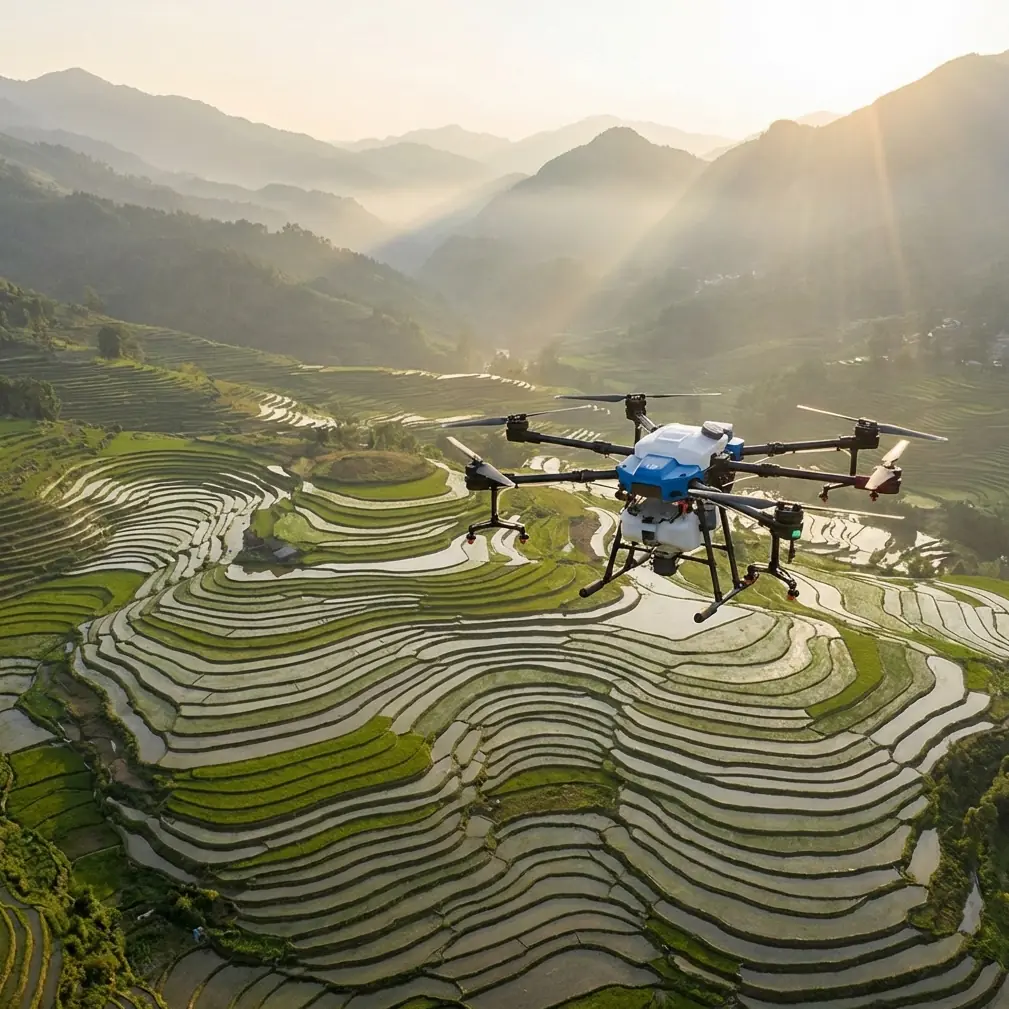
Agras T100 in Complex Terrain: Practical Spraying Tips That Actually Matter
META: Technical review of the Agras T100 for spraying in complex terrain, with practical guidance on spray drift, nozzle calibration, RTK stability, centimeter-level positioning, IPX6K durability, and antenna adjustment under electromagnetic interference.
By Dr. Sarah Chen
Complex terrain exposes every weak point in an agricultural drone operation. Steep orchard rows, terraced fields, irregular boundaries, roadside tree lines, steel-roofed farm buildings, and patchy GNSS visibility all tend to show up in the same workday. A platform can look impressive on paper and still become difficult to trust when the field forces low-altitude turns, uneven canopy height, and signal instability.
That is the context in which the Agras T100 deserves a serious technical review. Not as a brochure subject, but as a spraying tool for venues where terrain complexity is the rule rather than the exception.
The most useful way to evaluate the T100 is to look beyond payload discussions and focus on operational control. In difficult spraying environments, three things decide whether results are consistent: how accurately the aircraft holds its line, how well the spray system matches crop structure, and how effectively the pilot manages interference and environmental drift. The T100 matters because it sits at the intersection of those three variables.
Why complex terrain changes the entire spraying equation
Flat broadacre work allows some margin for error. A little path deviation or slight inconsistency in atomization may not translate into major losses if crop spacing is uniform and the target surface is forgiving.
That margin disappears in complex venues.
On terraces or sloped orchards, swath width becomes a live operational parameter rather than a fixed specification. The same nominal pass width can behave very differently when one side of the spray pattern is crossing downhill air and the opposite side is interacting with rising canopy and eddies near tree crowns. In those conditions, centimeter precision is not a luxury phrase. It has direct agronomic consequences. If the aircraft drifts off line by even a small amount at low altitude, you risk two linked problems: underdosing on one pass and overdosing on the overlap. Both hurt efficacy. Both can raise drift risk because correcting poor coverage often tempts operators to fly again in less-than-ideal weather.
That is why RTK fix rate deserves more attention than many pilots give it. A stable RTK solution is what allows the T100 to hold repeatable lines over broken ground, especially where visual references are poor and manual compensation becomes fatiguing. The practical significance is simple: reliable positioning reduces uneven overlaps, improves boundary discipline near roads or water channels, and makes route repetition more credible when a block requires staged treatment over multiple days.
The hidden problem in hilly sites: electromagnetic interference
Terrain is not the only source of instability. In many real agricultural sites, electromagnetic interference is the issue that operators misdiagnose first.
The classic scenario is a field bordered by utility structures, pump houses, greenhouses with metal framing, or temporary equipment parked near the takeoff point. The aircraft may still fly, but the pilot notices inconsistent heading behavior, delayed RTK convergence, or intermittent confidence in the navigation solution. In these situations, the wrong response is to assume the field is simply “difficult” and continue as normal. The better response is to examine the launch geometry and antenna orientation before the job develops into a coverage-quality problem.
Antenna adjustment can be the difference between a clean mission and a frustrating one. In practical terms, that means choosing a takeoff location with better sky visibility, increasing separation from large metal surfaces, and ensuring the antenna configuration is not being shadowed by nearby obstacles or vehicle bodies. If your RTK fix rate is slower than expected or fluctuates during setup, do not treat that as a minor inconvenience. It is an early warning that centimeter-level guidance may not remain stable once the aircraft is committed to a tight orchard corridor or terrace edge.
This matters operationally because the T100’s value in complex terrain depends on precision that remains usable under pressure. If signal quality collapses near a field edge where terrain already narrows the maneuver envelope, the aircraft’s path control may still be acceptable for transit, but spraying accuracy can degrade enough to show up later as uneven deposition. That is a field-performance issue, not just a navigation issue.
If your site routinely suffers from this kind of interference and you want a second opinion on setup logic, a quick field discussion via technical WhatsApp support can save a wasted spray window.
Spray drift is not just weather. It is also setup discipline.
Spray drift gets discussed as if it begins and ends with wind speed. That is too simplistic, especially for complex terrain.
In hilly and enclosed venues, local airflow patterns are rarely uniform. Air can descend along one bank, curl around tree lines, and accelerate through gaps in structures. The T100 operator has to treat drift management as a systems problem. Flight path, nozzle calibration, droplet characteristics, speed, height above canopy, and turn behavior all interact.
Nozzle calibration is the first place to start. If the output does not match the intended application plan, every downstream adjustment becomes guesswork. A well-calibrated setup ensures the T100 is delivering the right volume consistently across the full spray circuit. That consistency is critical when the venue forces varying ground clearance. In simple terms, calibration gives the operator a known baseline. Without it, it becomes impossible to tell whether weak coverage is caused by drift, poor atomization, incorrect speed, or inconsistent flow.
The second issue is swath width. On paper, operators often want to maximize it. In complex terrain, that instinct can create more problems than it solves. A wider pass may improve theoretical productivity, but if the canopy is irregular or slope angles change quickly, the usable swath can narrow in practice because the outer portions of the pattern become less reliable. A tighter, more conservative swath often produces better real deposition and fewer misses, particularly around orchard shoulders and terrace margins.
This is where the T100’s precision becomes meaningful in field terms. If the aircraft can hold a repeatable route with centimeter-scale accuracy, an operator can intentionally reduce swath width to improve coverage uniformity without losing confidence in overlap placement. The result is a cleaner spray strategy: fewer assumptions, less recovery flying, and lower cumulative drift exposure.
RTK stability and route confidence in difficult venues
Many discussions about agricultural drones stop at whether RTK is present. That misses the point. Presence is not performance.
For the Agras T100, the more relevant question is whether the RTK fix remains stable enough to support route confidence across complex terrain transitions. That includes entering a block from a constrained takeoff area, moving along slopes where the horizon line changes rapidly, and executing turns near obstacles that may affect signal quality. A strong RTK fix rate under these conditions contributes directly to route repeatability.
Route repeatability matters more than many first-time operators expect. If one section of a site must be completed later because of weather, refill logistics, or crop access constraints, the aircraft needs to return to a pattern that matches the original treatment geometry closely. That is how you avoid visible treatment seams. In orchard and specialty crop settings, those seams are not just cosmetic. They can correspond to actual differences in pest pressure or nutrient response if spray deposition varies enough from one pass set to the next.
Centimeter precision also reduces the mental workload of the pilot. In complex venues, pilot attention should be spent on environmental reading and hazard awareness, not constant micro-correction of the aircraft line. When the T100 holds the path reliably, the operator can spend more attention on canopy transitions, drift cues, and refill timing. That shift in cognitive load is one of the least advertised but most valuable productivity gains in advanced spraying systems.
IPX6K matters more on farms than in spec sheets
Durability ratings are often skimmed over, but IPX6K deserves a practical reading here.
In agricultural operations, the aircraft is not just exposed to rain. It works around chemical residues, rinse procedures, muddy staging zones, and frequent cleanup cycles. An IPX6K-rated design indicates serious resistance to high-pressure water ingress scenarios, which has obvious implications for maintenance after spray missions. On complex terrain sites, where access roads may be rough and cleaning may happen in improvised washdown areas, that extra confidence matters.
The operational significance is not simply that the drone survives a wash. It is that routine decontamination becomes more realistic. And routine decontamination protects long-term reliability. A spraying platform that is hard to clean properly often accumulates residue around vulnerable areas, leading to preventable maintenance issues and inconsistent field readiness. In high-tempo agricultural seasons, downtime is rarely caused by dramatic failure. It is more often caused by small avoidable reliability problems that stack up.
So while IPX6K might sound like a secondary specification, it directly supports the T100’s suitability for regular use in demanding spraying programs.
Where multispectral thinking fits, even in a spraying workflow
Multispectral is usually discussed in relation to crop analysis rather than application. Yet the two should not be separated too rigidly.
For operators using multispectral data to identify stress variation, canopy density differences, or uneven vigor, the spraying mission becomes more targeted and more defensible. In complex terrain, this can be especially valuable because slope, irrigation differences, and microclimate effects often create patchy crop behavior within the same block. If a T100 mission is planned with awareness of those differences, the operator can make better decisions about route priorities, application timing, and whether a uniform swath assumption is realistic across the entire site.
This does not mean every T100 user needs a full remote-sensing workflow. It means the best spraying outcomes often come from integrating spatial crop intelligence with precision application. The more variable the terrain, the more useful that mindset becomes.
Field tips that separate average results from reliable ones
The best T100 performance in complex terrain usually comes from small disciplined habits rather than dramatic tactics.
Start with antenna awareness. Before power-up, look around the launch zone for metal roofs, vehicles, poles, utility hardware, or dense structural clutter. If the site feels electrically noisy, relocate before you commit. Do not wait for unstable navigation cues to prove the point.
Next, verify nozzle calibration as a routine, not as a response to a problem. Calibration should confirm that the spray system is delivering the intended output before the aircraft enters a difficult block. In complex terrain, small flow inconsistencies become magnified because the environment is already reducing your tolerance for error.
Treat swath width conservatively until the site proves it can support wider spacing. On uneven ground, theoretical capacity can be a trap. A narrower pass with better placement usually outperforms an optimistic plan that has to be corrected later.
Watch drift in relation to terrain, not just the general weather report. Airflow near slopes and canopy edges can behave differently from the broader wind reading. The aircraft may be flying inside microcurrents that the standard site check barely captured.
Finally, monitor RTK fix quality as a live operational metric. If it degrades, do not dismiss it. In precision spraying, the difference between a strong fix and a marginal one often appears later in coverage maps, crop response, or operator confidence during the next mission.
The real case for the Agras T100
The strongest case for the Agras T100 is not that it makes spraying easy. Complex terrain never becomes easy. The better claim is that the platform gives skilled operators a more controllable system for difficult sites.
Its value shows up in the details that affect real field performance: centimeter-level guidance that supports cleaner overlaps, RTK stability that improves route repeatability, nozzle calibration discipline that keeps application rates honest, and an IPX6K build approach that better fits the washdown reality of agricultural work. Add careful antenna adjustment in electromagnetically messy environments, and the aircraft becomes far more dependable where many spraying jobs are at their most sensitive.
That is the distinction worth paying attention to. In rugged, obstructed, irregular agricultural venues, success is rarely about one headline specification. It comes from how the system behaves when precision, signal stability, spray quality, and cleanup all matter at once. The T100 is best understood through that operational lens.
Ready for your own Agras T100? Contact our team for expert consultation.