
Agras T100 Field Report: Spraying Urban Vineyards Without
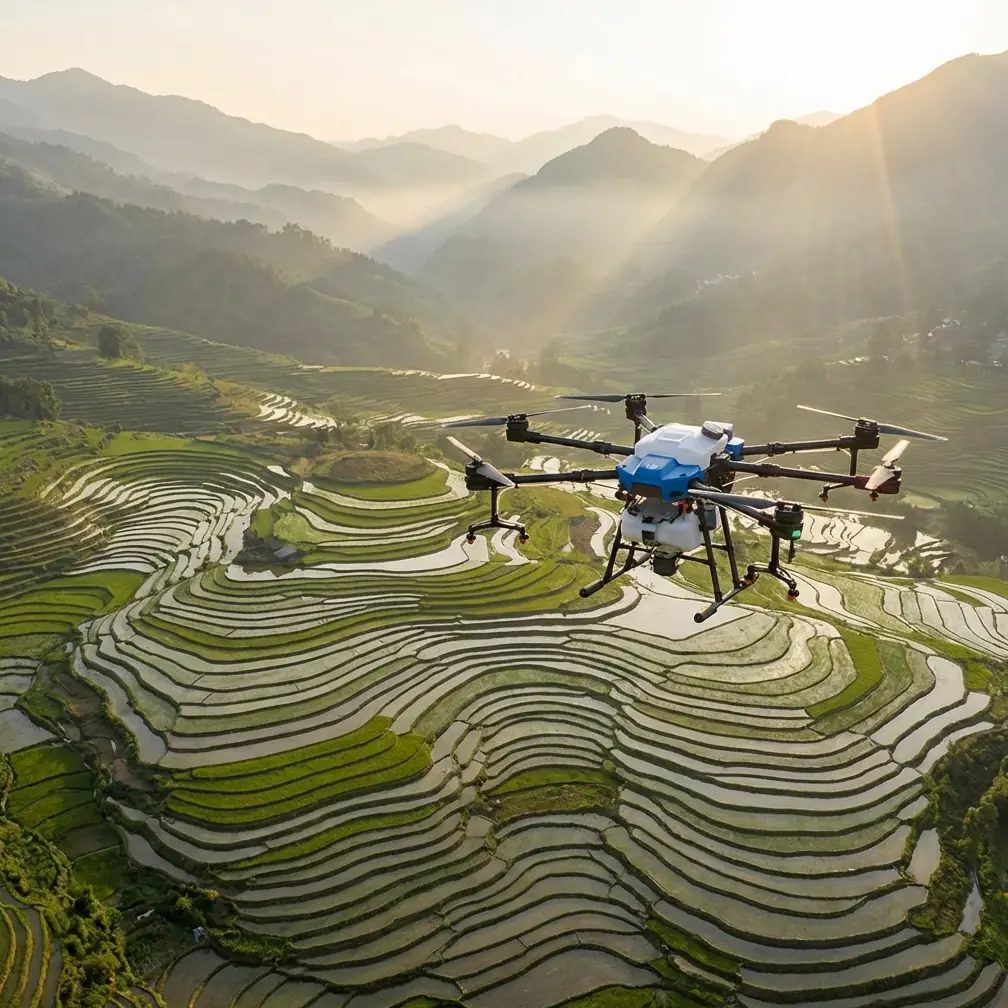
Agras T100 Field Report: Spraying Urban Vineyards Without Losing Control of Drift
META: Expert field report on using the Agras T100 in urban vineyards, covering drift control, nozzle calibration, RTK fix stability, sensor avoidance, swath width, and centimeter-precision spraying.
Urban vineyard work punishes sloppy setup. That is true with any spray drone, but it becomes especially obvious with a platform like the Agras T100, where the machine can only be as precise as the operator’s planning, calibration discipline, and understanding of the site.
I have spent enough time around tight vineyard blocks to know that “vineyard spraying” is not one job. A broad-acre row on open ground behaves one way. A narrow urban parcel bordered by walls, parked vehicles, homes, ornamental trees, and pedestrian paths behaves another way entirely. In that environment, the Agras T100 is not just carrying liquid. It is managing risk in real time.
This field report is written for the operator facing exactly that scenario: spraying vineyards in an urban setting, where spray drift margins are thin, GNSS reflections are common, and obstacle sensing matters because the airspace around vines is rarely clean.
The first operational truth is simple: drift control starts before the motors spin. Most urban vineyard problems are not created by poor flying. They begin with overconfident route design, excessive speed, or nozzle choices that are mismatched to canopy density and street-edge exposure. The T100 gives you the capacity to cover ground efficiently, but in an urban vineyard, efficiency has to be subordinated to containment. If your swath width looks good on a planning screen but pushes droplets beyond the vine wall toward neighboring structures, you have designed the wrong mission.
That is why I treat swath width as a compliance variable, not just a productivity variable. In an urban block, a slightly narrower effective swath is often the smarter choice. You give up some theoretical area coverage, but you gain tighter droplet placement on the target canopy. On vines, that matters twice over: first because you need the spray to penetrate where disease pressure actually lives, and second because every meter of unnecessary lateral spread increases the chance of off-target deposition.
Nozzle calibration is where many operators still leave performance on the table. A drone as capable as the T100 can create a false sense of security. People assume that onboard intelligence will mask poor fluid setup. It will not. If your flow rate, droplet spectrum, pressure behavior, and forward speed are not aligned, the aircraft will faithfully execute a bad plan with impressive precision. In vineyards near homes or public roads, that is the wrong kind of consistency.
My baseline recommendation is to calibrate nozzles to canopy architecture, not just tank mix volume per hectare. Dense mid-season growth, trellis variation, and end-row turbulence all change how spray behaves around the vines. In an urban parcel, wind eddies can form around masonry walls, sheds, and apartment corners, then roll back into the row. You may think you are flying in mild conditions, but the droplets tell a different story. A T100 operator who checks output uniformity and verifies real deposition after calibration will always outperform the one who relies only on app settings.
The T100’s value becomes more obvious once you start looking at navigation quality under urban constraints. Vineyard blocks near buildings often create multipath issues that degrade positioning confidence. This is exactly where RTK fix rate stops being a technical brag and becomes an operational necessity. Centimeter precision is not a luxury in this setting. It is what keeps repeated passes aligned to the row, limits overlap near property edges, and reduces the temptation to widen margins “just to be safe.”
If your RTK fix is unstable, the practical result is not only inconsistent path tracking. You also start seeing subtle compensation behaviors that can affect spray uniformity at row starts, turns, and pinch points near access roads or fence lines. In a broad farm environment, that may be tolerable. In an urban vineyard, it can be the difference between a clean job and a complaint from the neighbor whose courtyard furniture now has chemical residue.
I tell operators to watch fix behavior like they watch battery reserve. If the T100 is not holding a reliable RTK solution, the mission is no longer routine. It is now a conditional operation that requires more conservative parameters. Slow down. Reconfirm base station placement. Validate edge offsets again. Precision systems are only precise when the fix is real.
The machine’s robustness also matters more in vineyards than many people expect. The T100’s IPX6K-level protection is not just a line item for a brochure-minded buyer. In actual spray work, especially when moving between blocks and washing down after corrosive or sticky formulations, that level of ingress protection affects uptime and maintenance confidence. Vineyard operations are hard on equipment. Mist, splashback, residue, dust from access lanes, and repeated cleaning cycles all compound wear. A platform built to tolerate heavy washdown is better suited to a workday that does not end after one neat demonstration flight.
That durability becomes meaningful when the schedule is compressed by weather. Urban vineyards often have narrower spray windows because you are not only reading the agronomic conditions. You are reading the neighborhood. Early morning may be best for calmer air and lower pedestrian activity, but it also means dew load, tighter visibility at sunrise, and the need for a machine that can transition from transport to operation without fuss. A drone that shrugs off wet, dirty field conditions is not glamorous. It is useful.
Sensor performance is another category where urban vineyard work exposes the difference between theory and field reality. Vineyards are visually repetitive, physically cluttered spaces. Wires, posts, trunks, anti-bird systems, trellis hardware, perimeter vegetation, and irregular headlands all challenge obstacle awareness. Add an urban backdrop and the environment becomes less forgiving.
On one recent site walk, before the first treatment pass, a pair of magpies started harassing a feral cat along the edge of the block. That commotion pushed a ring-necked pheasant out from the cover crop and straight toward the turnaround zone. It is the kind of thing that sounds trivial until you are managing an autonomous or semi-autonomous aircraft in a confined spray corridor. Wildlife movement near vines is common. Wildlife movement near urban vineyards is chaotic. The T100’s sensing and route discipline matter because the real world does not clear the airspace for you.
This is also where operator judgment has to stay ahead of automation. Sensors can help the aircraft detect and respond. They do not replace a conservative turnaround design or a clean buffer strategy. If there is a patch of vegetation near the row end that regularly flushes birds, build the mission as if something will emerge from it. Do not wait for the machine to prove it can react. Good urban vineyard spraying is less about daring the technology and more about reducing the number of surprises it needs to solve.
A lot of growers ask whether multispectral tools should influence spray planning in vineyards. The answer is yes, but selectively. Multispectral data can be very useful for identifying vigor differences, water stress patterns, and canopy irregularities that change how spray should be distributed. The mistake is assuming a map automatically becomes an application strategy. It does not. What it does do is help the T100 operator avoid treating the entire block as if every row is equally receptive.
That matters in urban vineyards because excess application in high-reflection, low-density canopy areas can amplify off-target risk. If multispectral scouting shows weak zones or gaps in canopy continuity, you can adjust expectations around deposition and route efficiency rather than flying a one-size-fits-all profile. The combination of canopy intelligence and centimeter-precision pathing is where the drone becomes more than a simple replacement for ground equipment.
Another point that deserves more attention is downwash behavior near vertical vineyard canopies. Operators often focus on liquid output and forget that rotor wash changes the interaction between droplets and foliage. In urban conditions, that wash can either help drive coverage into the target or worsen drift if the aircraft is too high, too fast, or working in unstable air. The T100 gives you the control to fine-tune that relationship, but only if you resist the urge to generalize from open-field spraying habits.
Height above canopy should be treated as a live variable, not a set-and-forget number. A one-meter difference can change both coverage quality and drift behavior, especially at the edges of the block where airflow is disrupted by adjacent buildings. If the aircraft is carrying a stable RTK fix and the terrain model is reliable, use that precision. Urban vineyard work rewards disciplined altitude management more than bold throughput.
I also encourage crews to rethink end-row behavior. Most spray irregularities in vineyards happen at the transitions: entering rows, exiting rows, and turning for the next pass. These are the moments when overlap builds, drift spikes, and the temptation to save time leads to shortcuts. The T100 can execute highly repeatable patterns, but repeatability only helps if the pattern itself is well designed. Pull turnarounds farther from sensitive edges than your instincts suggest. Build in cleaner deceleration and acceleration zones. Audit your first few passes visually rather than assuming the digital plan has solved everything.
For operators working these sites regularly, documentation becomes part of the job. Record weather, route decisions, nozzle setup, RTK conditions, and observed obstacles. Urban vineyard clients often care as much about evidence of careful operation as they do about the treatment itself. That is not bureaucracy for its own sake. It is a sign that the operation is being run with enough professionalism to survive scrutiny.
If you are trying to refine your T100 setup for a difficult vineyard parcel, share the block layout and operating constraints through this field setup channel. A good route review can prevent the sort of drift and overlap problems that no post-flight explanation will ever fully fix.
The larger point is that the Agras T100 makes the most sense in urban vineyards when it is used as a precision risk-management tool, not merely as a faster sprayer. Its practical advantages show up in the details: holding a clean RTK fix when alignment matters, maintaining controllable swath width instead of chasing raw coverage, supporting careful nozzle calibration, tolerating washdown and harsh spray conditions with IPX6K-level protection, and using onboard sensing in an environment where both wildlife and infrastructure can complicate every pass.
That is the difference between operating a capable aircraft and running a credible aerial application program.
An urban vineyard is a proving ground. The rows are narrow, the margins are public, and mistakes travel. The T100 is well suited to that pressure, but only in the hands of crews who understand that precision is a chain. Break it at nozzle setup, route design, fix quality, or drift discipline, and the entire operation weakens. Keep the chain intact, and the result is exactly what vineyard managers want: targeted coverage, cleaner edges, fewer compromises, and a spray operation that fits the site instead of fighting it.
Ready for your own Agras T100? Contact our team for expert consultation.