
Agras T100 in Windy Wildlife Spraying: What Actually
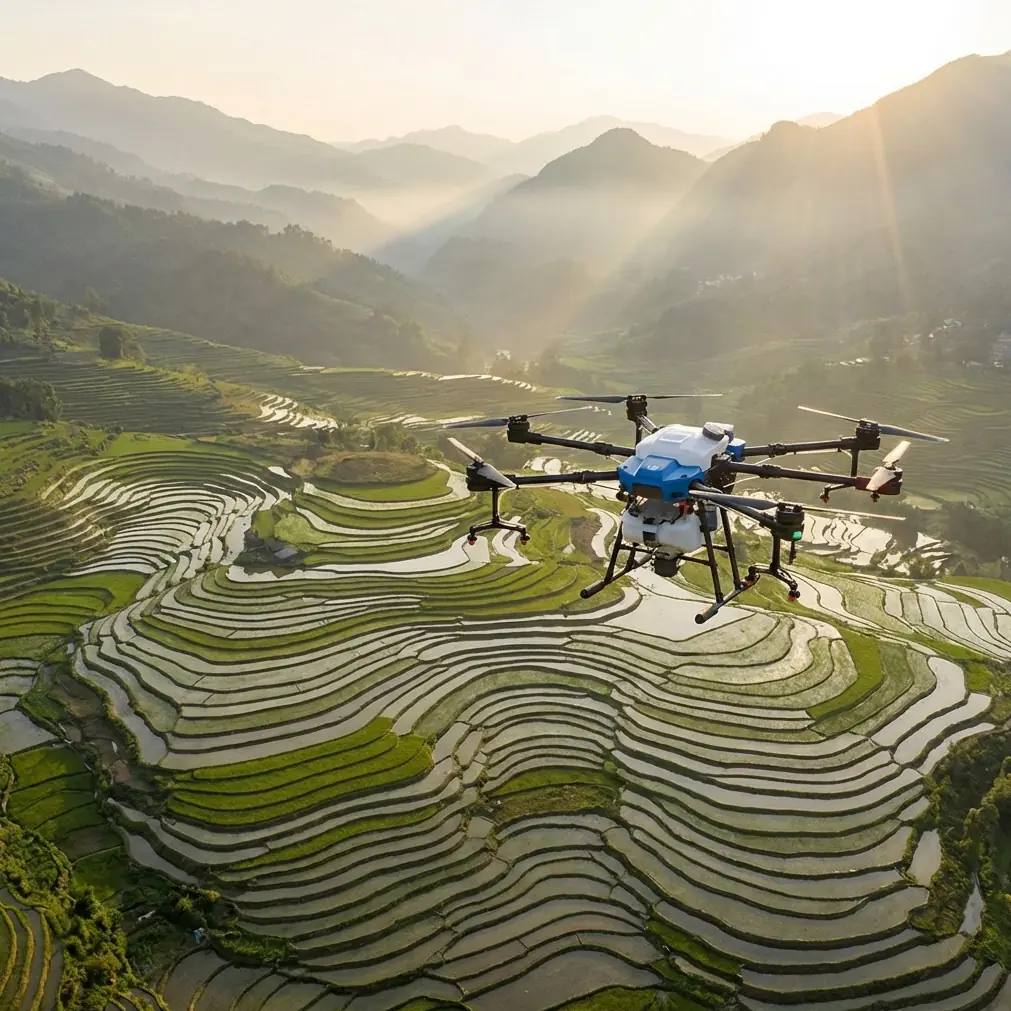
Agras T100 in Windy Wildlife Spraying: What Actually Matters When Accuracy Starts to Drift
META: A technical review of Agras T100 for windy wildlife spraying, connecting airflow behavior, drift control, positioning accuracy, and LiDAR-style terrain logic to real field performance.
When people talk about spraying in wind, they usually jump straight to tank size, flight time, or headline payload figures. That misses the real problem.
Wind does not just push droplets sideways. It changes how spray leaves the aircraft, how it bends around structures and vegetation, how evenly it lands, and whether your carefully planned route still matches what reaches the target zone. For wildlife-focused habitat work, that matters even more. You are often not treating a flat, open, forgiving agricultural block. You may be working around uneven ground, edge vegetation, water, brush corridors, or protected habitat buffers where overspray is not a small error but an operational failure.
That is the lens through which the Agras T100 should be judged.
This is not a generic drone review. It is a technical reading of what a serious operator should care about when using a platform like the T100 in windy wildlife spraying conditions: spray drift, nozzle calibration, route fidelity, terrain response, and the quality of the positioning stack behind every pass.
The hidden physics behind windy spraying
One of the most useful clues comes from an unlikely place: basic fluid behavior. In an educational drone text, a simple experiment shows water falling vertically will curve and cling to the outer wall of a cup when the cup is brought close enough. The explanation is the liquid’s adhesion to the surface plus surface tension, which “pulls” the stream toward the curved wall. The same material also points to an air-wall attachment effect in a candle-and-glass experiment.
Why mention a classroom fluid experiment in a T100 review? Because it captures something many UAV operators observe but do not always frame correctly: moving fluid does not travel in a perfectly obedient straight line once nearby surfaces and airflow gradients begin to shape it.
In practical spraying terms, droplets interact with rotor wash, ambient crosswind, canopy edges, slope transitions, and nearby obstacles. In wildlife management scenarios, especially around reeds, scrub margins, tree lines, or embankments, the air is rarely uniform. You can have a planned swath width on paper and a very different deposition pattern at the edge of the target. That is where the better platform usually separates itself from lesser competitors—not through marketing specs, but through how well it lets the operator manage these interactions.
The Agras T100’s value in wind, then, is not just whether it can carry liquid. It is whether it can hold a stable path, preserve nozzle intent, and adapt to terrain with enough precision that the spray system remains predictable when the air is not.
Why route precision matters more than raw throughput
The strongest reference in the source material is not about crop spraying at all. It is about airborne LiDAR.
A UAV LiDAR system is described as an integrated package combining a laser scanner, GPS, IMU, and high-resolution camera, then using pulse timing plus platform position and attitude to calculate 3D coordinates. That workflow matters because it reminds us what high-quality aerial work depends on: not one sensor, but a coordinated positioning and attitude solution. The source also highlights a concrete benchmark—UAV LiDAR being used for 1:1000 topographic mapping—which is a useful proxy for the level of spatial discipline modern UAV missions can achieve.
Now bring that idea back to the Agras T100.
Wildlife spraying in wind is never just a pump-and-nozzle job. It is a geospatial execution problem. If the aircraft cannot maintain a clean RTK fix rate, stable heading, and repeatable line spacing, the spray result will not match the mission plan, especially once crosswind starts widening uncertainty. This is where centimeter precision stops being a brochure phrase and becomes operationally significant.
Competitor platforms often look similar in calm air. In wind, weak positioning behavior shows up fast:
- inconsistent spacing between passes
- uneven overlap
- over-application on one edge of the swath
- untreated strips on the other
- route distortion on slopes or broken terrain
A T100 configured and calibrated properly should be evaluated on whether it can preserve track geometry under these conditions. If your target zone runs alongside a habitat boundary, a drainage line, or protected vegetation, a strong RTK fix rate is not just about efficiency. It is drift mitigation by another route: the aircraft goes where it is supposed to, at the speed and height it is supposed to, reducing the variables that amplify off-target deposition.
Terrain awareness is not optional in wildlife work
The LiDAR reference also describes why active sensing has become so useful in difficult ground: it can rapidly acquire precise 3D information, works well in challenging areas such as forests or mountainous terrain, and reduces dependence on large numbers of ground control points. It is also noted as an active remote sensing system, less constrained by some weather and timing limitations than traditional methods.
That logic applies directly to how operators should think about the T100 in non-uniform spray environments.
Wildlife spraying often happens where terrain changes quickly. Berms, gullies, floodplain edges, reclaimed land, marsh margins, and mixed canopy zones all alter relative height above target. Once that height changes, droplet behavior changes. Too high and drift risk climbs. Too low and rotor wash can distort coverage or disturb the target surface. Swath width is no longer stable if altitude above canopy is not stable.
This is why the best comparison point for the T100 is not simply another sprayer with similar output. It is whether the aircraft can behave more like a spatially aware survey platform when holding its line over difficult ground. The source material’s LiDAR processing chain—design, point cloud, classification, correction, DSM/DEM outputs—illustrates a broader truth: 3D understanding is what turns aviation from approximate to reliable.
For an Agras T100 operator, that means mission planning should be terrain-led. If you are spraying wildlife habitat in wind, you should think in layers:
- target biology
- terrain model
- wind pattern
- droplet/nozzle behavior
- aircraft route stability
The drone that best supports this layered thinking is the one that will outperform in the field.
Spray drift starts before takeoff: nozzle calibration and droplet discipline
A surprising number of operators treat nozzle calibration like a maintenance checkbox. In windy work, it is one of the main control levers.
If the T100 is being used for wildlife-related application work, calibration determines whether your chosen flow rate, droplet spectrum, and travel speed still produce acceptable deposition once crosswind begins to bias the pattern. You are not calibrating for a static test bench. You are calibrating for a moving aircraft inside a dynamic airflow envelope.
This is another area where the fluid-behavior reference is more useful than it first appears. The educational example showing a water stream bending toward a curved cup surface is a clear reminder that fluids respond strongly to local forces and nearby geometry. In a spray system, substitute rotor downwash, nozzle placement, and ambient crosswind for cup curvature and the lesson holds: the path of liquid is influenced earlier and more dramatically than many assume.
So when reviewing a T100 for windy wildlife spraying, ask practical questions:
- How consistent is output across nozzles after calibration?
- Does the aircraft maintain the intended boom or nozzle geometry during acceleration and turns?
- What happens to the spray pattern at the edge of a swath in crosswind?
- Can the operator reduce drift by adjusting speed, height, and droplet class without breaking route efficiency?
The stronger aircraft is not the one that merely sprays. It is the one that gives the operator a stable platform for controlled tradeoffs.
Why windy wildlife spraying is also a training problem
One source item describes the University of Missouri’s experimental drone journalism course, which ran in 2012–2013 but lasted only one year before being halted by an FAA ban. The point is not journalism itself. The point is that advanced drone use cases often outrun formal training structures.
That observation still resonates today. The article notes that multiple media schools in China explored drone practice or public classes, yet there was still no formal drone curriculum in many communication programs. The same pattern appears across specialized commercial UAV operations: equipment capability moves faster than operator education.
For T100 users, especially those entering wildlife or habitat spraying, this matters a lot. Wind work is not something you master by reading a spec sheet or watching a demonstration clip. It requires structured understanding of airflow, deposition, terrain effects, route planning, and environmental safeguards.
In fact, one of the clearest ways the T100 can outperform competing models is when it is paired with better operator method. A capable aircraft in untrained hands may produce worse outcomes than a slightly lesser aircraft flown by someone who understands drift physics and geospatial discipline. That is not a romantic idea; it is operational reality.
If you are evaluating the T100 seriously, your purchase decision should include a training decision:
- how to verify RTK stability before launch
- how to confirm nozzle calibration under field conditions
- how to adjust swath width conservatively in crosswind
- how to build terrain-following routes around habitat edges
- how to document spray logs for compliance and repeatability
If you need to discuss those setup details with someone who understands field deployment rather than just paperwork, this Agras T100 application channel is a sensible place to start.
Where the T100 can genuinely excel over competitors
The T100’s strongest case in windy wildlife spraying is not one flashy feature. It is system behavior.
A weaker platform often reveals itself in fragments: a less stable flight path, poorer consistency in altitude over uneven ground, slower recovery from gust-induced corrections, or less confidence when trying to maintain a narrow treatment corridor. Each weakness alone may look manageable. Together they widen the error band of the mission.
The T100 should be favored when the job demands:
- narrow placement tolerances
- repeatable corridor spraying
- treatment near sensitive boundaries
- consistent route tracking over broken terrain
- integration with centimeter-level planning logic rather than broad-area approximation
This is where terms like swath width and RTK fix rate stop being technical decoration. They become the machinery behind environmental responsibility. A wildlife spraying mission in wind is successful when the right amount lands in the right place and nowhere else.
A note on multispectral thinking—even when you are not carrying a multispectral sensor
The context mentions multispectral, and while that is not directly developed in the source material, the concept still belongs in the workflow. Not because the T100 must be framed as a mapping drone, but because wildlife and habitat treatment increasingly benefits from data-informed targeting.
The LiDAR reference emphasizes 3D spatial acquisition and downstream outputs such as DSM, DEM, contouring, and classification. That mindset is transferable. Multispectral layers can help define stress zones, invasive spread, moisture differences, or treatment boundaries before a spraying mission. The T100 then becomes the execution platform rather than the sole intelligence source.
That division of labor is smart. Survey to understand variability. Spray to act precisely. Operators who separate those tasks usually get better ecological outcomes than those who treat spraying as a blunt, single-pass operation.
The bottom line
Agras T100 should be assessed as a precision field system, not a flying tank.
The source material points us toward two deeper truths. First, fluid behavior is easily bent by surfaces and airflow, which is exactly why spray drift becomes so hard to control in wind. Second, reliable aerial work depends on integrated spatial awareness—the same principle that allows UAV LiDAR systems to support 1:1000 mapping and derive dependable 3D outputs.
Put together, those ideas give a better framework for wildlife spraying:
- keep deposition physics in view
- trust route geometry only when positioning is strong
- treat terrain as a live variable
- calibrate nozzles for the actual airflow environment
- train the operator as carefully as the machine
That is where the Agras T100 can distinguish itself from competitors. Not by promising perfection in wind, because no sprayer can do that, but by giving skilled operators a better chance of staying precise when the field refuses to behave.
Ready for your own Agras T100? Contact our team for expert consultation.