
Agras T100 in Dusty Survey Conditions: A Practical Flight
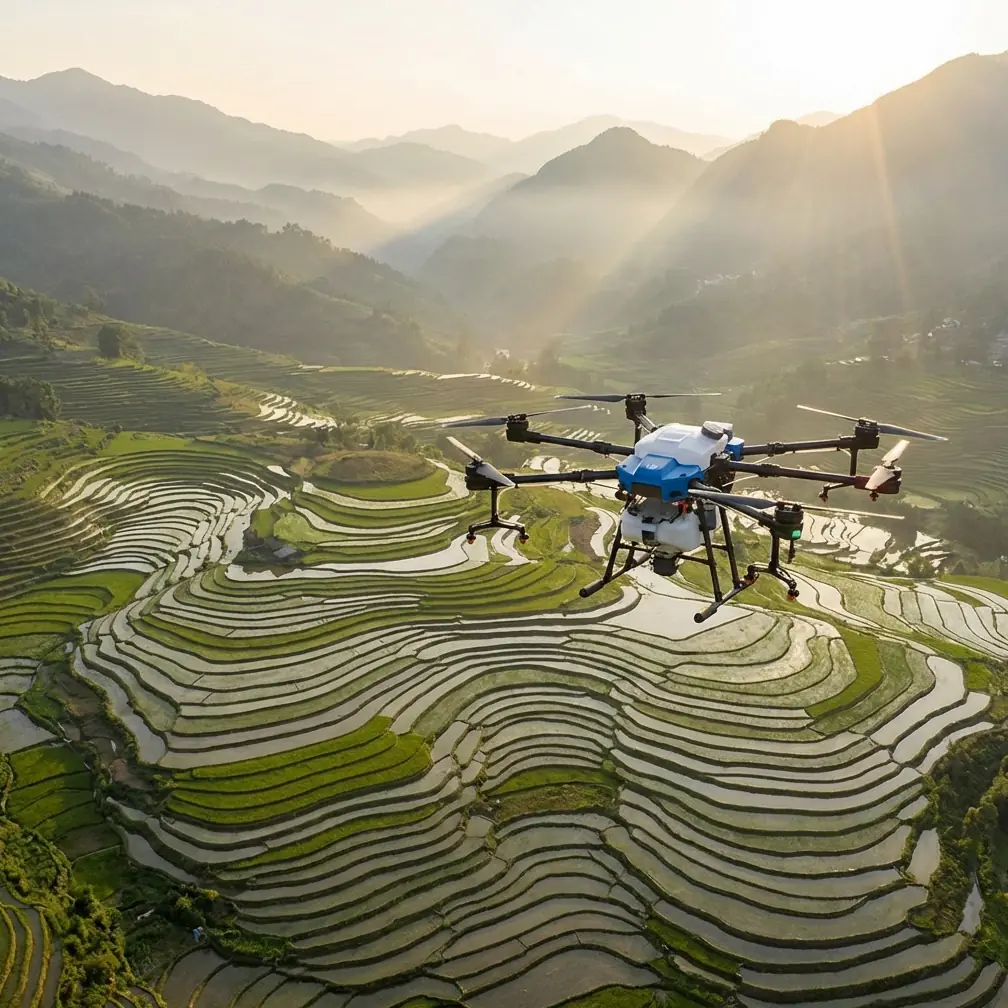
Agras T100 in Dusty Survey Conditions: A Practical Flight-Height Strategy for Cleaner Data
META: Learn how to approach dusty field surveying with the Agras T100, including flight altitude strategy, RTK precision, mapping workflow, and why image quality and geometry matter in real farm conditions.
Dust changes everything.
Not in the abstract. In the field. It lifts off dry rows, hangs over bare soil, softens edges in imagery, and turns an otherwise simple survey pass into a data-quality problem. If you are planning to use an Agras T100 for surveying in dusty agricultural conditions, the real question is not just whether the aircraft can cover the area. It is how to preserve usable visual and positional data when the environment is actively working against you.
That is where flight altitude stops being a routine setting and becomes an operational decision.
The Agras T100 sits in a category that attracts growers, service providers, and ag-tech teams because it is expected to do more than one job on a farm. Readers searching for this platform are rarely asking for generic specs alone. They want to know how to make it work under imperfect conditions: powder-dry access roads, recently worked ground, irrigation edges, crop transitions, and visibility that changes from one corner of the field to the next.
A good way to think about dusty surveying is this: the aircraft is not just collecting images. It is trying to separate the land surface from a moving atmospheric layer made of fine particulate matter. If you fly too low, the camera sees more of that contamination. If you fly too high, you may reduce the dust effect but lose the level of detail needed for agronomic interpretation or boundary work. The best altitude is the one that balances clarity, geometry, and precision.
Why the altitude question matters more than people think
A lot of drone users still treat aerial imaging as if the main job is simply to get photos from above. That mindset leaves performance on the table.
One of the most useful ideas from the reference material is that drone imaging should be judged by what it enables downstream, not just what it captures in the air. In civil UAV work, some of the most mature applications have been aerial survey workflows that produce DEM, DOM, and DLG outputs. Those three products matter because they represent different forms of usable information: elevation, orthorectified imagery, and vector linework. In other words, the flight is only the first step. The real value comes when image and position data are clean enough to support a map, a model, or a management decision.
That is highly relevant for the Agras T100 in dusty fields. If dust degrades image sharpness or obscures surface features, your orthomosaic quality suffers. If your geometry is inconsistent, your lines and boundaries become less trustworthy. And if your field team needs repeatable passes over time, weak data on day one becomes a comparison problem later.
The 2016 water-industry UAV reference is especially useful here because it highlights why drones became so widely adopted in practical surveying: they can obtain high-precision surface data quickly, with short implementation cycles, and they can fill the gaps left by manual field measurement, which is often inefficient, discontinuous, and not intuitive to interpret. That logic transfers directly to agriculture. Dusty farms are exactly the kind of places where walking every block or trying to verify every issue by eye burns time and still misses continuity.
The operational significance of RTK and geometry in dusty fields
Dust creates a visual problem, but the recovery path is positional discipline.
Another reference point worth bringing in is the forestry remote-sensing paper, which notes that improving geometric accuracy depends on real-time aircraft attitude data, GPS position recording during capture, and supporting terrain data. That sounds technical, but the operational takeaway is simple: when visibility gets messy, strong georeferencing becomes more valuable, not less.
This is where an Agras T100 workflow benefits from a strong RTK fix rate and stable flight behavior. Centimeter-level positioning does not magically remove dust from images, but it reduces the risk that poor visual conditions become compounded by poor spatial consistency. If your field edges, drainage lines, wheel tracks, and crop-zone transitions are all being mapped under dusty conditions, positional confidence helps keep the final dataset usable.
That matters for three reasons:
Repeat surveys become meaningful.
If you are comparing pre-irrigation and post-irrigation conditions, or checking emergence variability after planting, a stable coordinate framework gives you a trustworthy baseline.Boundary interpretation improves.
Dust can soften visual separation between road, ditch, berm, and crop edge. Better spatial control makes those features easier to digitize accurately later.Derived outputs hold up better.
If your aim is to produce a field surface model, drainage interpretation, or management-zone layer, geometry errors are not a small nuisance. They propagate.
The forestry study also reported an overall accuracy of 88.7% in UAV-based forest compartment investigation, with most category accuracies above 80%. That is not an agriculture paper, but it is still relevant because it shows a larger point: drone imagery can be highly effective for classification and delineation work, yet accuracy drops when the scene itself contains ambiguity. In the forestry example, mixed stands and similar visual classes caused errors. In dusty farm surveys, the equivalent problem is not mixed-species canopy; it is reduced contrast, obscured boundaries, and surface haze. The lesson is the same. Image quality limitations show up later as interpretation errors.
The best starting altitude for dusty field surveying
For dusty agricultural blocks, the safest practical starting point is to begin slightly higher than you would in clean air, then step down only if the data proves it can hold detail.
That is the strategic answer. The tactical version looks like this:
- If dust is concentrated close to the ground, a modest increase in flight altitude often helps the camera see across the field rather than through the densest particulate layer.
- If the field is actively shedding dust because of vehicle traffic, tillage, or dry rotor wash interaction near takeoff and turns, flying too low can magnify contamination in each frame.
- If your survey target is general field condition, drainage pattern, access routes, or broad variability, preserving clean geometry is usually more valuable than chasing the absolute lowest-altitude detail.
For many operators, that means resisting the instinct to immediately fly low for “maximum detail.” In dusty conditions, lower is not always better. A higher pass can deliver a more usable DOM if it avoids the worst haze layer and reduces visual clutter.
There is an interesting parallel here with the long-exposure photography reference. That piece argues that the beginner view of long exposure is too narrow, and that more advanced use involves blurring visual clutter, simplifying composition, and revealing effects the naked eye does not easily isolate. While that article is about photography rather than UAV mapping, the principle transfers well. In dusty surveying, your job is also to remove clutter from the visual result—except you do it with flight planning, altitude, overlap, and timing rather than shutter artistry. The goal is not a dramatic image. The goal is a cleaner dataset.
Dust is visual clutter in its most literal form.
A practical altitude-testing method for the Agras T100
If I were setting up an Agras T100 for a dusty farm survey, I would not lock in one altitude based on theory alone. I would run a fast comparison.
Step 1: Split the field into a test strip
Choose an area that includes:
- bare soil or dry headland
- crop edge
- wheel track or access lane
- at least one clear boundary feature such as a ditch, fence line, or berm
This gives you surfaces that reveal dust interference quickly.
Step 2: Fly two or three short passes at different heights
Do not overcomplicate it. Use a low, medium, and slightly higher altitude profile relative to your normal clean-air survey setting.
You are looking for:
- loss of edge definition
- haze between frames
- inconsistent texture on the soil surface
- reduced ability to distinguish subtle elevation or drainage cues
- mosaic stitching stress caused by weak feature matching
Step 3: Check the geometry, not just the look
Operators often judge test imagery by whether it looks “sharp enough” on a tablet. That is not enough. Review whether the overlap and alignment support a stable orthomosaic. Dust can create repetitive low-contrast frames that look acceptable individually but perform poorly in processing.
The water-industry reference emphasizes the value of professional data processing to turn flight captures and point-cloud-style information into sector-specific products. That is the right mindset here. A survey flight should be evaluated by the reliability of the output, not the beauty of single images.
Step 4: Lock the highest altitude that still preserves required detail
That is the sweet spot in dusty conditions.
Not the lowest possible. The highest one that still resolves what you actually need.
If your task is stand counts in early growth, you may need to come down. If your task is field boundary verification, drainage mapping, or identifying broad stress zones, staying a bit higher is often the smarter choice.
Dust, nozzle calibration, and spray workflow crossover
Even if your immediate goal is surveying, many Agras T100 users are running mixed missions over the same ground: mapping, treatment planning, and application. That makes dusty surveying more than an imaging problem. It affects the whole workflow chain.
For example, a poor survey can lead to weak interpretation of vegetation gaps or field edges, which then affects treatment planning. If you are also thinking ahead to spray drift, swath width, or nozzle calibration, the survey stage should help reduce uncertainty, not add to it. Dust near field margins can hide the exact transition between treated and untreated zones or between crop and non-crop surfaces. A cleaner survey pass supports better later decisions.
This is one reason I advise operators to separate “mapping altitude” from “application mindset.” Spray planning often focuses on coverage mechanics. Survey planning should focus on data integrity. They overlap operationally, but they are not the same task.
Timing can matter more than camera settings
Dust is not constant across the day.
A field that is difficult to survey during active traffic or immediately after dry ground disturbance may become much cleaner after the air settles. That sounds obvious, yet many teams still try to brute-force their schedule instead of adjusting it.
If your Agras T100 mission window is flexible, prioritize:
- lower on-site traffic
- reduced nearby vehicle movement
- periods after dust has had time to settle
- stable light that preserves surface contrast
The forestry source also underscores a broader challenge: image limitations are only one reason for classification error. Scene complexity matters too. In agricultural terms, dusty backscatter plus low-contrast lighting is a bad combination. A modest schedule adjustment can improve results more than a settings tweak.
Why ruggedness still matters in survey work
Readers looking at the Agras T100 often care about durability terms like IPX6K because farm survey conditions are not neat laboratory environments. Dust, residue, windblown particulates, splash from irrigation edges, and repeated transport all add up. While the reference materials here do not provide a T100 spec sheet, they do reinforce a key operational truth: field-ready UAV work depends not only on image capture but on the platform’s ability to maintain consistent performance across difficult environments.
That consistency matters because dusty surveys often require retesting altitude, re-flying sections, and processing multiple candidate datasets. A platform that stays stable and repeatable under farm conditions reduces workflow friction.
The bigger lesson for Agras T100 users
The strongest idea running through the reference materials is that UAV value comes from what the data can become.
In water management, drones became useful because they could quickly produce actionable products such as DEM, DOM, and DLG while reducing the limits of manual surveying. In forestry, drone imagery proved workable for thematic delineation with 88.7% overall accuracy, but geometric correction and positional data remained critical to improving results. Even the photography article carries a quiet lesson: advanced image-making is often about removing distraction and revealing structure that ordinary viewing misses.
Put those together, and the dusty-field strategy for an Agras T100 becomes clear.
Do not think only about getting airborne. Think about separating signal from interference.
In practice, that means:
- starting a little higher than your default clean-air survey altitude
- validating image clarity against processing quality
- protecting geometric integrity with strong RTK performance and stable capture
- timing flights to avoid active particulate disturbance
- choosing the highest altitude that still resolves the agronomic or boundary detail you actually need
That is the difference between collecting images and producing survey data.
If you are planning a real farm workflow and want a second opinion on flight profile, overlap, or altitude tradeoffs for dusty blocks, you can message the field workflow team here.
Ready for your own Agras T100? Contact our team for expert consultation.