
Agras T100 Surveying Tips for Solar Farms in Low Light
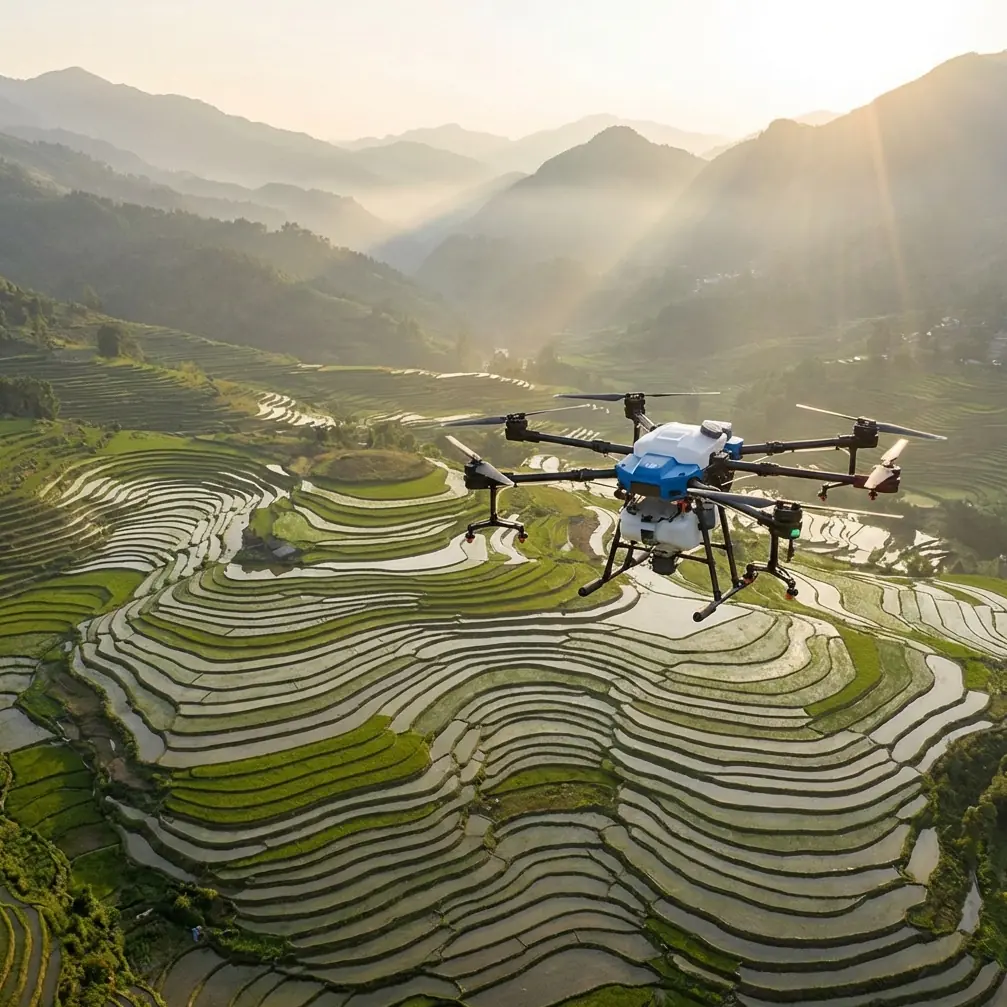
Agras T100 Surveying Tips for Solar Farms in Low Light
META: Practical field guidance for using the Agras T100 around solar farms in low light, with RTK setup advice, battery management tips, IPX6K considerations, and workflow details that matter on real sites.
Low-light work around solar farms sounds simple until you are actually standing between long rows of panels before sunrise, watching contrast disappear and orientation cues flatten out. This is where platform discipline matters more than marketing specs. If you are considering the Agras T100 for site work in solar environments, the discussion should not start with headline capacity. It should start with repeatability, environmental resilience, and how the aircraft behaves when visibility, moisture, and timing all begin to squeeze your operating window.
I approach this as an operations problem, not a brochure exercise.
The Agras T100 is better known in agricultural circles, so using it around utility-scale or commercial solar sites requires a shift in method. The hardware strengths that matter in field application work also carry over into solar-farm support tasks: stable route execution, high positioning confidence, weather-tolerant construction, and disciplined payload workflow. In low light, those strengths become more consequential because the site itself is visually deceptive. Rows look identical. Shadows collect in drainage channels. Dew builds on surfaces. The margin for sloppy setup shrinks fast.
Why low-light solar surveys are tricky
Solar farms create a unique optical environment. Before full daylight, panel surfaces can absorb and distort visual cues. Access roads and array gaps may remain visible, while the panel field itself reads as a dark mass. If your operation depends on precise track spacing, clean route alignment, or repeatable revisits, you need positioning confidence that does not rely on the eye alone.
That is where RTK performance becomes operationally significant.
People often throw around the phrase centimeter precision without explaining what it actually changes in field practice. On a solar site, centimeter-level positioning is not about abstract accuracy. It is about making sure successive passes track where they should, especially when your visual references are weak. A strong RTK fix rate reduces the chance of drift in route execution near arrays, service lanes, and perimeter edges. When the light is poor, a stable RTK solution does part of the work your eyes cannot do reliably.
For the Agras T100, that means your preflight is not complete when the props are spinning. It is complete when your correction source is stable, your route geometry has been reviewed against the site layout, and you have confidence that the aircraft will hold path discipline across repetitive infrastructure.
First priority: set up for RTK integrity, not speed
On solar farms, operators are often tempted to rush the first launch because low-light windows are short and site access may be scheduled tightly. That is precisely when poor habits creep in. If your RTK fix rate is inconsistent at takeoff, the rest of the mission inherits that uncertainty.
My rule is simple: do not treat RTK lock as a box-check. Treat it as the foundation of the mission.
Place your base or correction setup where sky visibility is clean and where nearby structures do not complicate signal quality. Solar sites can look open, but in practice you may have inverter stations, operations buildings, fencing, parked vehicles, and metallic clutter that degrade your setup more than expected. I have seen teams blame route inconsistency on wind when the real issue was weak correction stability at startup.
A solid RTK solution matters even more if your objective includes repeatable line-following along panel rows or revisiting a section to compare conditions over time. High fix reliability is what turns a flight from “generally in the right area” into a usable operational record.
Use swath width carefully near panel rows
Swath width sounds like an agricultural term, but it is just as relevant here. Around solar infrastructure, effective swath width determines how much ground you can cover while preserving route confidence and avoiding unnecessary overlap. In low light, too aggressive a width can create hidden gaps or route uncertainty that you may not notice until later review.
Narrower, more conservative planning often wins.
That might feel inefficient at first glance. It usually is not. A tighter swath can reduce corrective rework, especially when operating close to repetitive structures. On a solar site, repeating a block because your overlap assumptions were wrong costs more than the minutes you thought you saved.
This is where the Agras T100’s positioning discipline and route consistency become practical assets. If the aircraft is holding line well, you can make informed decisions about widening or tightening coverage based on observed performance, not guesswork.
Low light changes your battery strategy more than most operators admit
Now for the field point that tends to separate experienced operators from those who are still learning the hard way: battery behavior in low-light solar work is often shaped less by flight duration than by morning temperature and turnaround habits.
Here is the tip I give crews and graduate researchers alike: do not put a battery straight from a cool vehicle or damp staging area into an early mission and expect normal voltage behavior under load. Give it time to stabilize toward a healthy operating temperature before takeoff, and rotate packs with intention rather than convenience.
This sounds basic. It is not.
On pre-dawn or early-morning solar sites, the air can be cool even when the day later becomes hot. Add dew, concrete pads, metal cases, and rushed launch cycles, and you can end up flying packs that look acceptable on paper but sag earlier than expected once the aircraft starts working. The result is not always dramatic. Sometimes it is just a subtle shortening of your confidence margin, which is exactly the kind of problem that catches teams off guard during route completion near the end of a sortie.
My field practice is to track not just charge state, but pack temperature trend across the first wave of flights. If one pack consistently shows less stable behavior in the first segment of the morning, it moves later in the rotation or gets held until conditions improve. This one habit has saved more mission continuity than most people realize.
Weather resistance matters when dew is everywhere
The IPX6K-level protection associated with rugged drone platforms deserves more respect in solar applications. Many operators think of ingress protection mainly in terms of rainfall or washdown conditions. On solar farms, dew and residue can be just as relevant, especially in low light when moisture lingers on surfaces and in the air.
An IPX6K-style resilience profile does not mean you should become casual. It does mean the platform is better suited to harsh field realities: damp launch zones, mist, splash exposure during transport or cleaning, and dirty industrial environments that are routine on energy sites. That changes operational confidence. It lets you focus on route execution and data discipline instead of constantly worrying that ordinary site moisture will compromise the day.
The practical significance is straightforward. If your platform is built for punishing field conditions, you can maintain a more consistent schedule across marginal morning windows. That is valuable on solar farms, where the best time for certain inspections or observational passes may be early, before thermal conditions and glare evolve.
If you are carrying spray hardware, calibration still matters
The Agras T100 belongs to a family of aircraft strongly associated with application work. Even if your use case around solar assets is not conventional crop spraying, the discipline behind nozzle calibration remains instructive. Why? Because calibration culture creates predictable output, and predictable output is the foundation of safe, tidy operations around infrastructure.
If you are using a liquid system for vegetation management around array perimeters or access lanes, low light can hide subtle issues with nozzle performance. A partially obstructed nozzle, uneven pressure behavior, or poor calibration can alter droplet distribution before the operator notices. Around solar sites, that matters because spray drift is not merely an agronomy problem. Drift near panel surfaces, electrical housings, or maintenance corridors creates cleanup and compliance headaches.
This is one reason I encourage teams to perform calibration checks in controlled conditions and not assume yesterday’s settings are fine today. Dew, residue, and temperature can all affect what happens at the nozzle. The cost of laziness here is operational mess, not efficiency.
Spray drift deserves particular attention near panel fields. Even light movement of fine droplets can carry farther than expected in the calm-but-variable air that often exists near dawn. Lower light can trick you into thinking conditions are settled when microcurrents are still active around rows, fencing, and service structures. Calibration, droplet control, and conservative spacing are what keep the mission clean.
Multispectral thinking is useful, even when your platform configuration varies
The mention of multispectral capability often pushes people into a false binary: either they have a dedicated multispectral workflow or they do not. In reality, multispectral thinking is a method before it is a sensor choice. Around solar sites, the lesson is to think in layers. What changes are visible in low light? What becomes clearer after sunrise? What needs revisits from the same geometry to support comparison?
If your Agras T100 workflow intersects with broader site monitoring, consistency of flight path and timing becomes the bridge between visible observations and any future sensor-enhanced program. You may not start with a full multispectral stack, but you can still build a repeatable survey habit that supports higher-quality comparison later.
That starts with route repeatability, clean metadata, and environmental notes taken seriously.
A practical low-light workflow for the T100 on solar sites
Here is the workflow I recommend when the mission objective is disciplined site coverage in weak light:
1. Walk the launch and recovery zone first
Do not trust memory from a previous visit. Dew, maintenance vehicles, temporary barriers, or cable reels can change the launch area overnight.
2. Confirm RTK stability before arming into a mission mindset
Again, this is not a cosmetic step. High RTK fix confidence is what supports centimeter precision and repeatable routing when the site lacks strong visual references.
3. Start with a conservative swath width
Use the first pass to validate path discipline and environmental behavior. Expand only after you confirm real performance on-site.
4. Log battery temperature behavior, not just percentage
This is the field habit many skip. Early sorties often reveal which pack is not ready for front-line duty.
5. Watch moisture assumptions
IPX6K-style durability helps, but moisture still affects surfaces, visibility, connectors, and staging discipline. Rugged does not mean careless.
6. If using liquid application hardware, verify nozzle calibration every session
Do not let spray drift become an avoidable infrastructure problem.
7. Review route fidelity immediately after first pass
A quick check early saves wasted coverage later.
Where operators usually get into trouble
The most common failure mode is not dramatic. It is layered complacency. A team assumes the site is open, so they relax around precision. They assume the morning is calm, so they neglect spray drift risk. They assume all charged batteries are mission-ready, so they ignore temperature behavior. They assume rugged construction means weather is irrelevant, so moisture discipline slips.
None of those errors alone may end a mission. Together, they degrade it.
The Agras T100 is best used as a field system, not a flying appliance. On solar farms in low light, that means respecting the details that preserve repeatability: RTK quality, route geometry, swath choices, battery conditioning, and moisture-aware handling.
If you are building a site-specific workflow and want to compare setup notes or operational planning for a solar-farm deployment, you can message the field team directly here.
The real advantage is consistency under imperfect conditions
People tend to ask whether the Agras T100 is suitable for solar-farm work as though suitability were a static trait. It is not. Suitability emerges from the match between the aircraft’s field-oriented strengths and the operator’s discipline.
Two details tell the story. First, RTK fix reliability enables centimeter precision where repetitive panel geometry can otherwise confuse route control. Second, IPX6K-level resilience gives the aircraft a practical edge in damp, dirty, early-morning conditions that are ordinary on these sites. Add thoughtful battery management and careful calibration practice, and the platform becomes far more useful than a generic “inspection drone” label would suggest.
That is the difference between a mission that merely gets airborne and one that produces dependable work.
Ready for your own Agras T100? Contact our team for expert consultation.