
Tracking High-Altitude Fields With the Agras T100
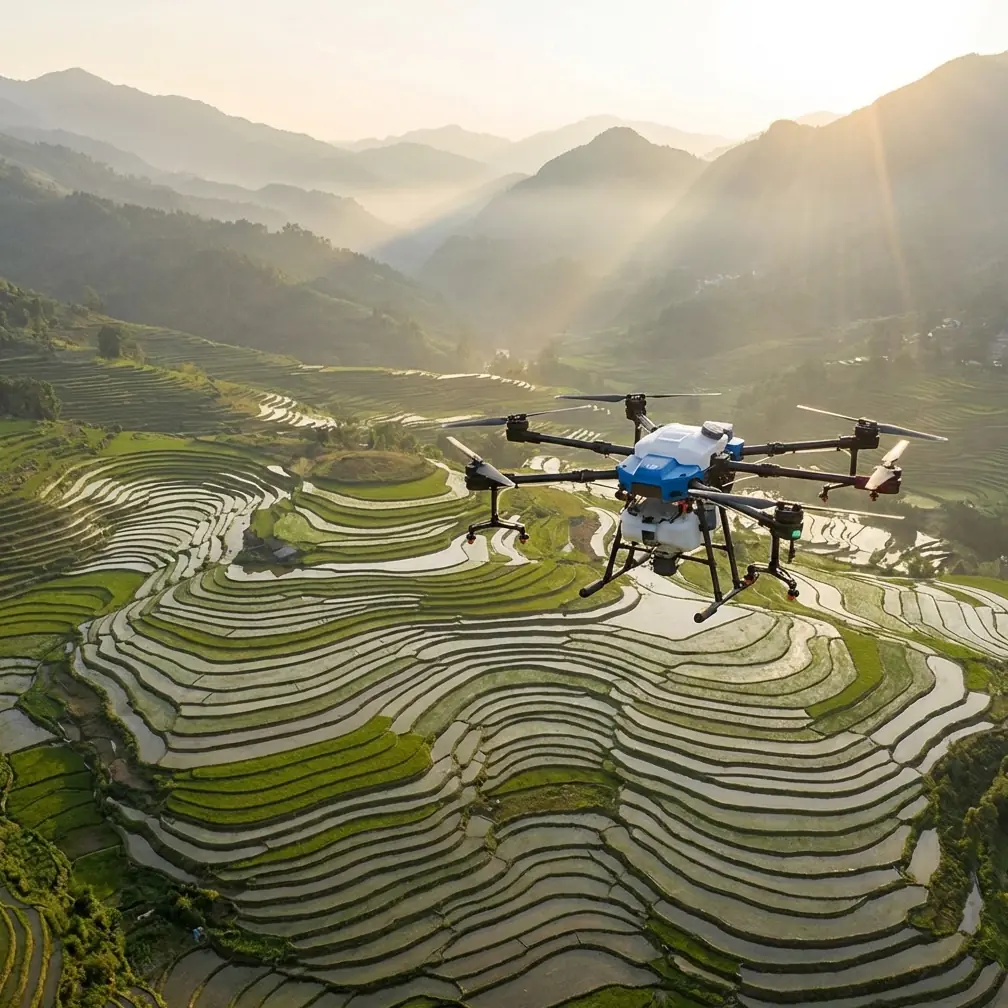
Tracking High-Altitude Fields With the Agras T100: What Actually Matters
META: Expert insights on using the Agras T100 for high-altitude field tracking, with practical guidance on precision, drift control, sensor awareness, and why the UAV market’s shift toward real applications matters.
High-altitude agriculture exposes every weak point in a drone operation. Wind arrives faster than the forecast suggests. Terrain breaks line of sight. Temperature swings alter spray behavior. Even routine scouting takes more discipline when fields sit on slopes, terraces, or mountain shoulders rather than flat valley ground.
That is why the most useful way to think about the Agras T100 is not as a flying machine first, but as an agricultural work system built for a specific job: getting repeatable coverage and dependable field intelligence where conditions punish sloppy setups.
That framing also lines up with a wider shift in the drone sector. Back on July 21, at the Rebuild2018 technology and business summit in Chengdu’s Chenghua District, drones were one of the most frequently discussed topics alongside artificial intelligence and real-world application design. The most telling idea from that event was not simply that drones were getting more attention. It was that the industry was moving into a later stage of development, where the emphasis was turning toward practical combinations of technology and domain use. In plain terms, the value was no longer “drone first, use case second.” It was application first.
For anyone tracking fields at altitude with an Agras T100, that distinction matters. The question is not whether the aircraft has advanced features. The question is whether those features solve the actual field problems you face on a mountain block, a hillside orchard, or a patchwork of narrow plots above the valley line.
The Real Problem in High-Altitude Fields
At elevation, the mission is rarely just about spraying or mapping. It is about maintaining decision quality when the environment keeps trying to degrade it.
Take spray drift. On lower ground, you may be able to compensate for a mild crosswind with conservative timing and a modest swath width. In higher fields, wind funnels through terrain and changes character over short distances. A pass that looks clean on one side of the slope can start feathering droplets downhill on the next. If nozzle calibration is even slightly off, small inconsistencies become expensive ones. Coverage gaps appear where crops need protection most. Over-application can pool on the leeward side. Neither problem is obvious until plant response or residue patterns expose it.
Then there is positioning. High-altitude readers usually care less about abstract specs and more about whether the drone returns to the same row edge, terrace boundary, or contour line with reliable repeatability. That is where centimeter precision and RTK fix rate become operational, not marketing, concerns. A strong fix rate is what keeps a route stable when terrain complexity, slope angle, and variable satellite visibility challenge the aircraft’s navigation logic. It reduces overlap waste, helps maintain cleaner edge work, and improves the accuracy of field tracking records over time.
And then there is the factor people often ignore until it appears right in front of the drone: wildlife.
During one hillside survey, a pair of hawks lifted from a rocky ridge just as the aircraft crossed into the next section. Minutes later, a small deer burst from brush at the edge of a terrace, moving unpredictably across the route corridor below. This is where onboard sensing and obstacle awareness stop being abstract safety features and start preserving the mission. In steep agricultural zones, birds, livestock, and wild animals move in the same narrow spaces your aircraft uses to transition between blocks. Sensors that interpret the environment quickly can give the operator time to adjust speed, altitude, or route before a routine pass turns into a recovery exercise.
Why the Agras T100 Fits This Shift
The Agras T100 makes the most sense when you treat it as part of the “+ drone” era described by that 2018 summit discussion. In other words, its relevance comes from how well it supports agronomy, terrain management, and repeatable operations rather than from the aircraft alone.
For field tracking in high-altitude areas, that means combining several disciplines:
- Precise route execution
- Stable data capture
- Controlled application behavior
- Rugged operation in messy weather and dusty field conditions
- Fast adaptation when terrain or biology changes mid-mission
This is why features like RTK-based positioning and centimeter-level repeatability are not luxury add-ons in mountain agriculture. They are the basis for comparing one mission to the next. If your route lines wander from day to day, your scouting data becomes harder to trust. You may think canopy stress has shifted, when the truth is that your flight geometry changed. If your application paths drift, your treatment map becomes less meaningful than it should be.
The same goes for swath width. Operators often chase wider coverage because it promises productivity, but in elevated fields the smarter move is to set swath width based on terrain stability, canopy structure, and wind pattern rather than maximum theoretical output. A narrower, controlled swath can outperform a broader one if it preserves droplet placement and route consistency. With the T100, the better strategy is usually disciplined tuning instead of brute-force coverage.
Where High-Altitude Tracking Usually Fails
Most failures come from trying to run mountain operations with flatland assumptions.
One common mistake is launching too early into unstable morning air. Cool air pockets and slope-driven movement can create uneven behavior at different heights above the canopy. The operator sees a manageable surface condition and assumes the whole route will behave similarly. It does not.
Another is ignoring nozzle calibration between chemical changes, altitude shifts, or maintenance intervals. At elevation, small output deviations can combine with wind to create visible inconsistencies across a block. If tracking reveals one side of the field is lagging in plant health response, poor calibration may be the hidden cause rather than seed, soil, or disease pressure alone.
A third problem is weak environmental hardening. Agricultural work is dirty. Mountain agriculture is dirtier. Dust, moisture, and sudden weather changes are normal, not exceptional. This is where an IPX6K-rated platform matters. That rating supports a more realistic operating rhythm in conditions where moisture exposure, washdown needs, and residue buildup are part of the weekly routine. It does not remove the need for careful maintenance, but it does support the kind of field durability serious operators need.
Using Multispectral Thinking Without Overcomplicating the Job
A lot of discussion around high-altitude field tracking gets lost in sensor jargon. What matters is practical interpretation.
If you are pairing Agras T100 operations with multispectral workflows, the objective is not collecting more layers for the sake of it. It is separating true crop stress from terrain-driven visual noise. High-altitude fields are deceptive. Sun angle, slope orientation, and patchy canopy density can make standard visual scouting unreliable. Multispectral data can help isolate where vigor is dropping, where moisture stress is developing, or where treatment response differs across elevation bands.
But the real value appears when those observations feed back into route planning and application logic. If one upper terrace consistently shows weaker vigor and stronger drift exposure, then your next mission should reflect that. You may adjust pass direction, reduce swath width, tighten altitude control, or revise timing to limit off-target movement. Data without operational response is just organized curiosity.
This is another reason the old “drone first” mindset has aged poorly. The drone industry’s later-stage maturity, signaled in those 2018 discussions around drones, AI, and application, points toward systems that connect observation to action. For high-altitude agriculture, that is exactly the right lens for the T100.
A Practical Problem-Solution Workflow for the T100
If the problem is unreliable field tracking at altitude, the solution is rarely one setting. It is a repeatable workflow.
Start with positioning discipline. Before any meaningful mission, confirm RTK fix rate stability and avoid treating precision as optional. In mountain terrain, degraded positioning compounds quickly. A route that looks acceptable on the flight screen can still produce enough lateral inconsistency to weaken downstream analysis or application accuracy.
Next, tune nozzle calibration to actual field conditions, not yesterday’s assumptions. Changes in fluid behavior, maintenance state, and environmental conditions can all influence output. A calibration routine that feels repetitive is still cheaper than correcting a treatment pattern after crop response reveals the problem.
Then evaluate swath width with humility. Operators often want speed. Crops want consistency. In windy, sloped, or uneven canopy conditions, a reduced swath can be the more productive choice if it limits drift and stabilizes deposition. Field tracking should tell you where a broader swath works and where it does not.
After that, use sensor awareness proactively, not passively. If your route crosses habitat edges, hedgerows, or rocky transitions, expect animal movement. On one mission in a highland block, the drone’s sensing system picked up abrupt movement near a field boundary just after a large pheasant erupted from low vegetation. That early detection gave the pilot time to pause forward progression and re-enter the line with a safer angle. Wildlife encounters are not rare anomalies in mountain agriculture. They are part of the environment.
Finally, close the loop with comparison. The real advantage of a capable platform is not a single clean mission. It is the ability to compare one block, one treatment, and one week against the next with confidence that route precision and data quality remain aligned.
What Experienced Operators Watch More Closely
Professionals tracking fields in high-altitude conditions tend to care about three things more than casual observers realize.
First, they watch drift behavior at the edge of the usable envelope. Not because drift is a theoretical compliance issue, but because it directly affects treatment efficiency and crop uniformity. A drift-prone mission wastes more than liquid. It weakens the value of every map and follow-up decision tied to that pass.
Second, they watch fix integrity, not just positioning availability. There is a big difference between having a signal and maintaining a trustworthy RTK solution in terrain that interrupts or complicates reception. Centimeter precision only matters when it holds under real route conditions.
Third, they watch machine survivability as part of uptime. An IPX6K-rated aircraft used properly is easier to keep field-ready in wet, dusty, residue-heavy farm environments. That matters when your season windows are short and your weather opportunities are shorter.
The Bigger Industry Lesson Behind the T100
The old phase of the drone business rewarded novelty. The next phase rewards fit.
That is why the Rebuild2018 discussion still feels relevant. Drones were repeatedly brought into conversation with artificial intelligence and applied use, not as isolated gadgets. That shift is exactly how serious agricultural operators already think. They do not ask whether a drone is interesting. They ask whether it reduces uncertainty in a real operational context.
For the Agras T100, high-altitude field tracking is one of those contexts. If your farm blocks sit where wind, slope, fragmented geometry, and variable access complicate every decision, the value of the platform comes from its ability to support precision, consistency, and adaptation at the same time.
Not flashy. Useful.
If you are trying to decide how to set up a high-altitude T100 workflow around drift control, route repeatability, or field monitoring logic, it helps to talk to someone who understands the agronomic side as well as the aircraft side. You can reach out directly here: message Marcus and the team on WhatsApp.
The operators who get the best results from a platform like this are usually the ones who stop thinking of the drone as the center of the story. The field is the center. The crop is the center. The terrain is the center. The drone earns its place by making all three easier to read and manage.
That is the real meaning of “+ drone” in agriculture. Not a slogan. A filter for better decisions.
Ready for your own Agras T100? Contact our team for expert consultation.