
Agras T100 Tracking Tips for Highways: What Actually
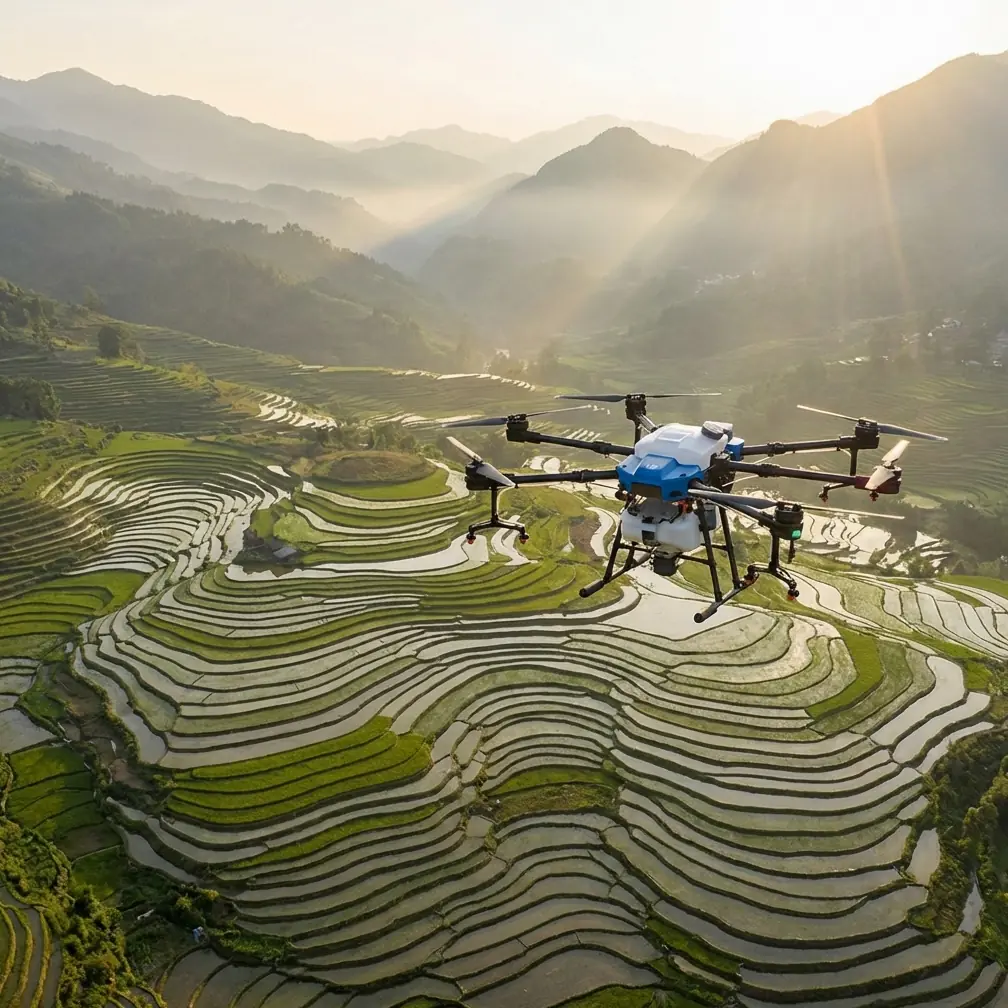
Agras T100 Tracking Tips for Highways: What Actually Matters in Urban Operations
META: Practical Agras T100 guidance for urban highway tracking, with expert insight on positioning, signal reliability, spray-system limits, route precision, and antenna placement for safer, more consistent operations.
Urban highway work exposes every weak point in a drone operation.
Signals bounce off barriers and overpasses. Wind behaves badly between structures. GNSS quality can swing from clean to compromised within a few hundred meters. If you are trying to run an Agras T100 near highway corridors, whether for vegetation management along rights-of-way, corridor assessment, or tightly controlled roadside treatment tasks, the machine is only part of the story. The rest comes down to setup discipline.
That is why older plant-protection research still deserves attention. A 2015 Chinese study on rotor crop-protection drones identified several problems that remain surprisingly relevant today: navigation precision needed improvement through DGPS or software-based coordinate correction, spray technology still required refinement, and operational quality depended heavily on variables like flight height, speed, weather, route planning, and navigation automation. Those are not museum-era problems. In dense urban corridor work, they are daily realities.
The Agras T100 sits in a much more advanced generation of UAVs, but advanced hardware does not cancel field physics. It just gives you more tools to manage them. For highway tracking missions in urban environments, the winning approach is simple: treat positioning, communication, and spray behavior as one connected system.
The real problem with highway tracking in cities
When operators say a drone is “tracking the highway,” they often mean one of several jobs: following a long corridor for repetitive application, maintaining a stable route near roadside vegetation, logging repeatable passes over service strips, or working a linear mission where the aircraft has to hold accuracy despite interference and changing geometry.
Linear jobs look easy on a map. They are not easy in practice.
A highway corridor forces the aircraft into a narrow operational envelope. You are often threading between guardrails, sign structures, embankments, utility lines, sound walls, and patches of variable airflow created by traffic and built surfaces. Any weakness in route control gets amplified because the corridor itself is unforgiving. Drift a little off-line in a wide open field and the result may be minor. Drift a little off-line near a highway edge and the consequences are operationally significant.
That is where the old research becomes useful. The paper specifically points to DGPS as a way to improve navigation accuracy, and also mentions correcting coordinates through software analysis. Operationally, this matters because urban highway missions are exactly where centimeter-level consistency becomes more than a luxury. If your RTK fix rate drops or your corrections become unstable, your swath consistency, edge control, and repeatability can all degrade at once.
For the T100 operator, that means corridor work should begin with a positioning mindset, not a flight mindset.
Why centimeter precision is not just a mapping concern
A lot of people treat precision positioning as something mainly relevant to surveying or mapping payloads. That is too narrow.
In roadside vegetation work or corridor spraying, precision dictates where your treatment begins, where it ends, and how well adjacent passes line up. The 2015 study flagged route planning and automatic navigation control as major quality factors. That remains true today, especially when the job involves long, narrow strips rather than block-shaped fields.
Centimeter precision affects at least four things in a T100 highway scenario:
Swath alignment If each pass shifts even slightly because of poor fixes, overlap becomes inconsistent. That can create under-application in one strip and over-application in another.
Boundary confidence Urban corridors rarely offer generous margins. Precise positioning helps the pilot keep work inside the intended treatment or inspection zone.
Repeat missions Highway maintenance is often recurring. Better positional consistency means you can compare one mission against the next without guessing where drift or offset came from.
Pilot workload Stable guidance reduces correction inputs and frees the operator to monitor environment, system status, and risk points instead of constantly “chasing the line.”
The lesson is straightforward: if you are seeing route wobble, uneven corridor spacing, or inconsistent pass-to-pass results, do not start by blaming the aircraft. Start with fix quality, base station logic, and the antenna environment.
Antenna positioning advice for maximum range
This is the field habit that gets overlooked most often.
If you want maximum usable range and cleaner communication in an urban highway setting, the antenna setup should be treated like part of the airframe, not an afterthought on the ground station.
Here is the practical rule: keep the control and correction link antennas elevated, unobstructed, and oriented with the corridor rather than across dense reflective clutter.
Why that matters:
- Highway environments create partial blockages from overpasses, trucks, metal barriers, signs, and roadside structures.
- Reflections can corrupt link quality long before you see a total disconnect.
- A low antenna position beside a vehicle or behind a concrete barrier shortens your effective reliability even if the raw distance looks modest.
My preferred setup logic for urban corridor missions is:
- Place the operator station where the antenna has line-of-sight down the longest practical segment of the route.
- Avoid parking directly beside tall metal objects that can shadow or reflect the signal path.
- Raise the antenna above head height if local setup allows it safely and legally.
- Do not let the support vehicle become the main obstruction between controller and aircraft.
- Reposition sooner rather than later as the aircraft progresses down the corridor.
The point is not chasing headline range. The point is preserving stable command and correction quality where the route is hardest to recover manually.
If your team needs a second opinion on corridor antenna placement or communication setup, this direct field support channel is a practical starting point.
Spray drift is not only a nozzle issue
The source paper spends meaningful attention on spray technology, and that is one of its most valuable reminders. It notes that many plant-protection drones of that period relied on centrifugal atomization, while systems in the US and Japan often used electrostatic nozzles to improve liquid adhesion. It also describes how droplet behavior is affected by airflow, collision, aggregation, and highly complex turbulence around the aircraft and crop canopy.
That matters for the Agras T100 because highway-adjacent work is a drift problem before it becomes a productivity problem.
Urban roadside airflow is messy. You may have:
- crosswinds spilling from open lanes,
- turbulence from passing traffic,
- air recirculation near sound barriers,
- thermal lift from pavement,
- and friction-driven swirl near vegetation edges.
The old paper also calls out flight height, flight speed, and weather as major determinants of application quality. That should immediately shape how you configure a T100 for corridor work. A stable route with poor droplet control is still a poor operation.
What this means in practice
Nozzle calibration cannot be treated as a one-time setup.
If the task involves application, the calibration process should be tied to actual mission conditions, not just workshop assumptions. Urban corridor work changes the airflow picture enough that a setup proven in open farmland may not behave the same along a highway edge.
Swath width should be verified, not assumed.
The temptation is to use theoretical swath numbers from ideal conditions. But corridor missions punish that laziness. If drift or turbulence narrows the effective deposition band, your route spacing has to reflect the true result, not the brochure result.
Altitude discipline matters.
The 2015 research explicitly highlights flight height as a quality variable. Fly too high in a roadside environment and droplet exposure to crossflow increases. Fly too low without a clear operational reason and you may create a different turbulence pattern or obstacle risk. The right answer is site-specific, but the principle is universal: altitude is a spray parameter, not just a clearance parameter.
The hidden connection between navigation and deposition
One of the most useful insights from the reference material is that spraying quality does not sit in its own silo. Navigation quality, meteorology, and route control are all tied together.
Think about what happens when a T100 loses positioning confidence for short intervals in an urban corridor:
- The aircraft may correct laterally.
- Ground speed may vary slightly during correction.
- Heading may hunt more than expected.
- The effective overlap pattern changes.
- Droplet placement shifts even if the pump and atomization system are working normally.
That chain reaction is exactly why the old paper’s discussion of route planning and navigation automation still deserves respect. The aircraft can have robust hardware, but once the line quality deteriorates, application quality can degrade through movement, not through fluid mechanics alone.
For highway tracking jobs, that means you should watch more than the visible route trace. Pay attention to the relationship between:
- RTK fix rate,
- speed stability,
- heading behavior,
- and actual treatment uniformity.
If those four indicators start drifting apart, you are no longer running a controlled corridor operation. You are improvising.
Why “more automation” is not the whole answer
The 2015 study argued that plant-protection drones needed simpler operation, more automatic route planning, and self-protection measures when conditions changed. That prediction was right. Modern platforms are much better in all three areas.
Still, the urban highway environment puts a ceiling on blind trust.
Automation is strongest when the environment is predictable. Highway corridors in cities are the opposite. Shadows, structures, traffic-generated airflow, and intermittent signal masking can push the aircraft into situations where human planning still decides whether the mission is clean or sloppy.
So for the T100, the better question is not “How much can it automate?” It is “How much can I simplify the mission so the automation stays inside its strongest operating zone?”
That usually means:
- breaking long routes into shorter controlled segments,
- selecting takeoff and relay positions that preserve line-of-sight,
- validating actual swath width before full execution,
- and adjusting plans when GNSS quality degrades rather than forcing the route.
Materials and durability still matter in corridor work
The source text mentions alloy framing, carbon-fiber components, and even notes that some wiring on earlier machines was exposed. That is a useful historical benchmark because it shows how far the category has come. For current operators considering the T100, the durability conversation should not stop at frame material. In urban corridor work, resistance to water ingress, contamination, and repeated setup cycles matters just as much.
This is where practical specs such as IPX6K earn their place in the discussion. Not because a protection rating is glamorous, but because roadside operations are dirty. Moisture, residue, dust, and washdown realities all affect uptime. If the aircraft is expected to move between urban roadside sites and maintain consistency, durability against those conditions becomes part of mission planning, not just maintenance.
Multispectral talk can distract from the basics
Some buyers jump straight to advanced sensing conversations, including multispectral workflows for vegetation analysis along road networks. Those tools have value in the right program. But if the goal is dependable T100 corridor execution, the first operational gains still come from the basics the 2015 paper emphasized years ago: precise navigation, route planning, droplet control, and parameter optimization.
You can add more sensing later. You cannot compensate for poor line discipline and weak setup with fancy data products.
A field-tested operating mindset for Agras T100 highway jobs
If I had to reduce this to one working doctrine, it would be this:
Run the corridor like a precision system, not a general-purpose drone task.
That means every mission should answer these questions before lift-off:
- Is the positioning environment good enough for repeatable corridor tracking?
- Is the antenna placed for reliable down-route communication rather than convenience?
- Has swath width been verified under the day’s actual wind and surface conditions?
- Are nozzle calibration and droplet expectations aligned with the roadside airflow reality?
- Is the route segmented in a way that keeps automation inside stable operating conditions?
The reference research may be from 2015, but its warning is still current: aerial application quality is shaped by a web of interacting variables, and some of the hardest ones involve turbulence, droplet randomness, and navigation consistency. The Agras T100 gives operators a far more capable platform than the rotor plant-protection drones discussed in that paper. But capability only pays off when setup choices respect the environment.
Urban highways are not forgiving. They reward disciplined operators who understand that centimeter precision, spray drift control, and antenna positioning are not separate topics. They are the same mission seen from three angles.
Ready for your own Agras T100? Contact our team for expert consultation.