
Agras T100 in Windy Solar Fields: A Field Report
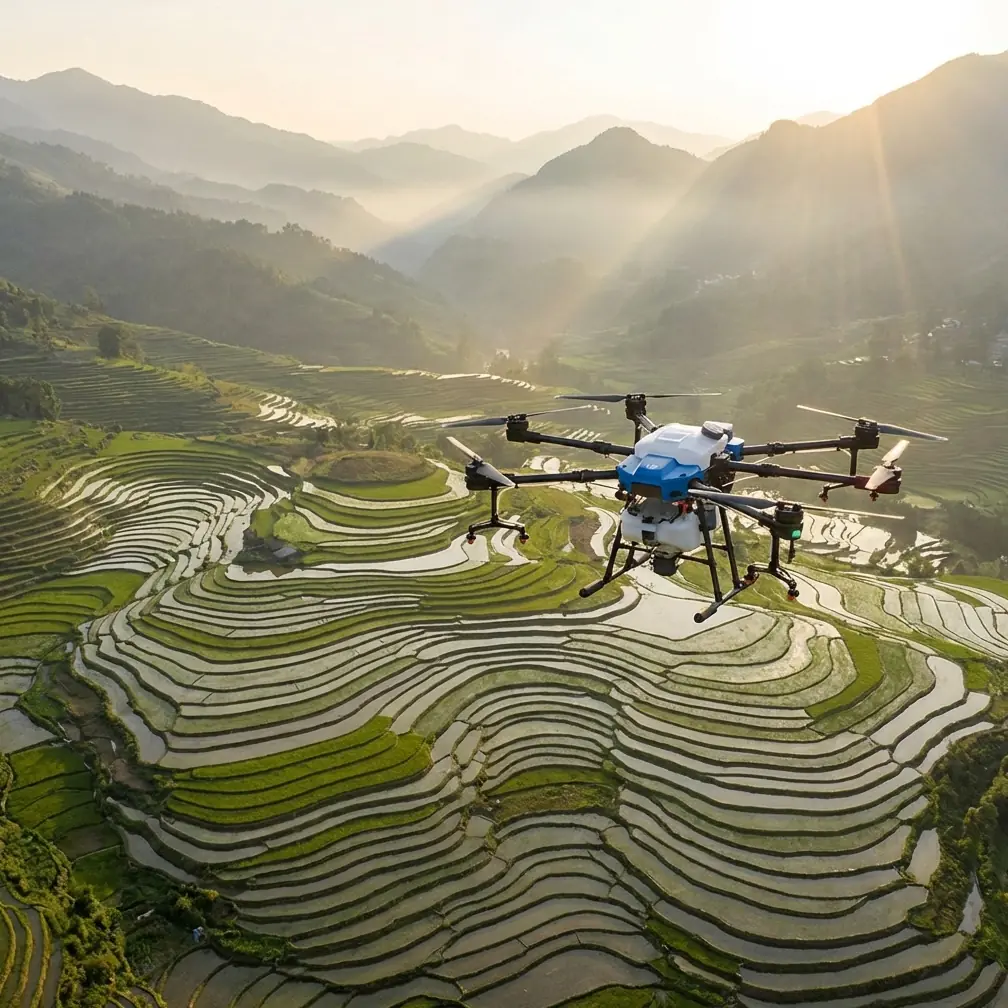
Agras T100 in Windy Solar Fields: A Field Report on Tracking, Drift Control, and Reliable Positioning
META: Expert field report on using the Agras T100 around windy solar farms, with practical guidance on antenna placement, RTK stability, spray drift control, nozzle calibration, and mission accuracy.
Wind changes everything on a solar site.
Not in theory. In practice. The open geometry of utility-scale arrays creates long corridors, turbulent edges, and uneven gust patterns that can make a drone feel stable one second and oddly busy the next. If you are operating an Agras T100 around solar infrastructure and trying to maintain accurate tracking in windy conditions, the difference between a clean mission and a frustrating one usually comes down to three things: how well the aircraft holds its position, how intelligently you manage spray drift, and whether your communications setup is working with the site instead of fighting it.
I have spent enough time on industrial properties to know that solar farms behave differently from broad-acre crop fields. The visual line of sight may look easy at first glance because the terrain is often open. Then the layout starts to interfere. Rows of panels can block low-angle signals, service roads create tempting but misleading straight-line routes, and the heat profile across the site changes through the day. That matters when the mission depends on consistent tracking and repeatable path accuracy.
For pilots focused on the Agras T100, the headline issue in wind is not simply “can the drone fly.” It is whether the aircraft can keep doing precise work while the environment keeps trying to push it off the ideal line.
Why windy solar farms are their own operating environment
A solar site is full of micro-effects. Air rolls over panel edges. Gusts can channel through row spacing. Reflected heat can disturb the layer close to the ground, especially by late morning. Those conditions affect more than comfort. They affect swath consistency, overlap, droplet behavior, and the pilot’s confidence in what the aircraft is actually doing relative to the intended route.
That is where the Agras T100 conversation gets more specific than a generic “ag drone in wind” discussion.
On a solar farm, the job often depends on tracking narrow, repeatable corridors with very little tolerance for drift toward sensitive hardware, maintenance paths, or adjacent treated areas. If your line holds but your spray pattern spreads, the mission is off-spec. If your application pattern is fine but your RTK fix rate falls apart near obstructed sections, the aircraft may still complete the route while quietly losing the precision that justified the route design in the first place.
Those are two different problems. Many crews treat them as one.
They are not.
Centimeter precision only matters if you protect it
The Agras T100 operator community talks a lot about centimeter precision, and rightly so. Fine positional accuracy is not a marketing detail on technical sites. It is what lets a pilot run repeatable lines near fixed infrastructure with confidence.
But precision is never just a GNSS or RTK spec on paper. It is an operating condition you preserve.
On windy solar sites, I watch RTK fix rate more closely than almost any other metric during setup and the first passes. A stable fix rate is your early warning system for whether the aircraft is truly locked into a high-confidence navigation state or simply coping its way through a mission. If the fix degrades at specific points in the array, that is useful intelligence. It tells you the site geometry, local obstructions, or controller placement may be creating blind spots in the mission envelope.
A pilot who ignores that pattern usually ends up misdiagnosing the problem as wind alone. In reality, what looks like wind-induced wandering can sometimes be the combination of gusting plus degraded positioning quality.
Operationally, that matters because a narrow corridor flight profile on a solar farm leaves little margin. A few centimeters of positional uncertainty repeated over pass after pass can become visible in your coverage consistency. That is especially true if the job also depends on strict swath width discipline.
Swath width gets theoretical fast when wind starts bending the pattern
Swath width is one of the first numbers pilots rely on when planning throughput. It is also one of the first assumptions that collapses in crosswind.
In calm conditions, your planned width can stay close to your observed width. On a windy site, the effective width is often smaller than what you planned on paper because the edges of the spray pattern become unreliable first. Once that happens, you are not really flying the width you think you are flying. You are flying the width that still deposits consistently.
That distinction matters around solar installations because overestimating effective swath width increases the chance of undercoverage in the center of a corridor or off-target deposition near the panel edges. Neither is acceptable if the mission has compliance or asset-protection implications.
My rule in these environments is simple: trust the conservative width, not the optimistic one. If the site is gusting and the air is moving unpredictably along the rows, shorten the operational swath width until the pattern remains coherent. Throughput may dip, but the mission quality improves. And on an industrial site, quality beats nominal productivity every time.
Spray drift is not abstract around panel infrastructure
Spray drift in an open field is already a serious planning factor. Around solar assets, it becomes even more sensitive because the target zone often sits close to surfaces and equipment you do not want exposed.
The problem with drift is that pilots often think of it only as downwind travel. On solar sites, that is incomplete. Turbulence from panel rows can lift and redirect droplets in awkward ways, especially where air accelerates between structures or eddies at row ends. A pilot may compensate for the prevailing wind direction and still miss the localized movement pattern caused by the site layout.
That is why nozzle calibration deserves much more respect than it usually gets in routine operations.
Calibration is not just a startup checklist item. It is how you adapt the aircraft’s output to a site where deposition quality is vulnerable to both wind speed and structural turbulence. If the nozzles are not producing the pattern and droplet profile you expect, every other planning decision sits on shaky ground.
The practical takeaway is this: on a windy solar farm, do not assume yesterday’s nozzle settings are still right because the aircraft passed a basic systems check. Recheck them against the day’s conditions and the actual treatment objective. A small calibration mismatch in a controlled environment is annoying. In a turbulent array, it becomes expensive in time and rework.
Antenna positioning advice for maximum range
This is the part operators often underrate until they have one bad day on a large site.
If you want maximum range and more stable control on a solar farm, your antenna positioning has to be deliberate. Not casual. The layout of panel rows can make a strong signal feel inconsistent because the geometry creates partial masking at low angles and distracting reflections in certain positions.
The most effective field habit is to keep the controller antennas elevated, clear of your body, and oriented to maintain the broadside of the antenna pattern toward the aircraft’s working sector rather than pointing the tips directly at it. In plain terms, do not hold the controller low against your torso while facing down a long row and assume the link will sort itself out. Raise it. Keep your stance open. Avoid parking yourself beside vehicles, metal fencing, or inverter housings that can complicate the immediate RF environment.
Position on slightly higher ground whenever the site allows it. Even a modest elevation change can improve line quality across long corridors. If the mission area is extensive, relocate with the aircraft instead of insisting on one static control point for the entire job. Range is not just about transmission strength. It is about preserving a cleaner path.
One more point that matters on real jobs: avoid standing at the end of a row where the panels form a long visual tunnel but the signal path still skims across structural clutter. A more offset position often produces a healthier link, even if it feels less intuitive at first.
If your team is building a site-specific communications routine for the Agras T100, this quick range planning chat is the kind of step that saves time before you ever lift off.
The RTK side of wind management
Wind management is usually framed as an attitude-control issue. That is only part of the story. On technical sites, wind management is also a navigation-quality issue.
A strong RTK fix rate gives the flight controller better positional confidence while the aircraft is correcting against gusts. That does not mean RTK eliminates wind effects. It means the aircraft is less likely to compound them with avoidable positional uncertainty. Around solar arrays, where repeated passes may run very close to fixed structures, that confidence matters.
I recommend treating RTK health as a live operational input rather than a green light you check once at startup. If the fix rate weakens in a particular zone, note it. If it improves after you reposition the base, relay station, or pilot location, note that too. Over a few missions, that information becomes a site map of where your precision is strongest and where the environment starts to interfere.
This is one of the most useful habits for crews working the same solar assets repeatedly. They stop “flying the property” and start “understanding the property.”
IPX6K matters more than people admit
When operators discuss the Agras T100 in harsh field conditions, waterproofing often gets mentioned as a durability footnote. I think that undersells it.
An IPX6K rating matters operationally because windy solar sites are rarely clean environments. Dust, residue, splash exposure during mixing or rinsing, and quick weather shifts all pile onto the normal workload. Equipment that can tolerate aggressive water exposure is easier to maintain between sorties and less stressful to operate in dirty, high-turnaround conditions.
That does not make the aircraft invincible. It does make the workflow more realistic.
On sites where turnaround time matters, cleaning and inspection discipline can slip when crews are trying to keep moving. A platform built for harsher washdown conditions supports better maintenance habits simply because the process is less fragile. Over time, that shows up as more dependable field performance.
What about multispectral?
I would not force multispectral into every Agras T100 conversation, but it has a place here if your solar-site work includes more than application tasks. In windy industrial environments, multispectral data can complement field decisions by helping teams distinguish actual vegetation stress patterns from visual noise caused by dust, panel shading, or uneven ground conditions.
Its value is not that it replaces operator judgment. Its value is that it helps narrow the question. If vegetation pressure varies across drainage lines, fence margins, or panel blocks, multispectral review can improve how you define treatment zones before you send the aircraft back out. That becomes especially useful when wind windows are short and every sortie needs to count.
A practical operating pattern for windy days
When I brief crews for a site like this, I keep the process tight.
Start early, before thermal activity builds. Confirm the RTK environment and watch the fix rate during the first route segment, not just during initialization. Reassess nozzle calibration for the actual wind and target conditions. Reduce expected swath width if the pattern edges are not staying honest. Choose your pilot position based on signal quality, not convenience. Move if the site tells you to move.
Then stay humble about the weather.
The temptation on industrial sites is to press ahead because the property looks organized and accessible. But clean roadways and neat panel rows do not mean the air is cooperative. Some of the trickiest low-altitude turbulence I see in field operations happens in places that look easy from the gate.
That is why the Agras T100 performs best in these scenarios when the pilot thinks like an operator, not just a drone user. Read the site. Read the signal. Read the pattern. The aircraft can do serious work, but only if the setup respects the environment.
The real takeaway for Agras T100 operators
If you are tracking solar farms in windy conditions, the Agras T100 is not a one-variable machine. Success depends on how its navigation precision, spray system setup, and communications link hold together under site-specific stress.
Two details deserve special attention because they directly shape field results. First, RTK fix rate is not a background metric; it is the backbone of repeatable centimeter precision around fixed infrastructure. Second, nozzle calibration is not routine maintenance; it is the frontline defense against spray drift when panel geometry and gusts distort deposition.
Add disciplined antenna positioning to that mix and the aircraft becomes noticeably easier to trust across long, awkward corridors. Ignore it, and even a capable platform starts working harder than it should.
That is the difference I see on real sites. Not hype. Not theory. Just cleaner missions, better repeatability, and fewer surprises when the wind comes sideways through the rows.
Ready for your own Agras T100? Contact our team for expert consultation.