
Agras T100 in Steep Vineyards: A Field Report on Precision
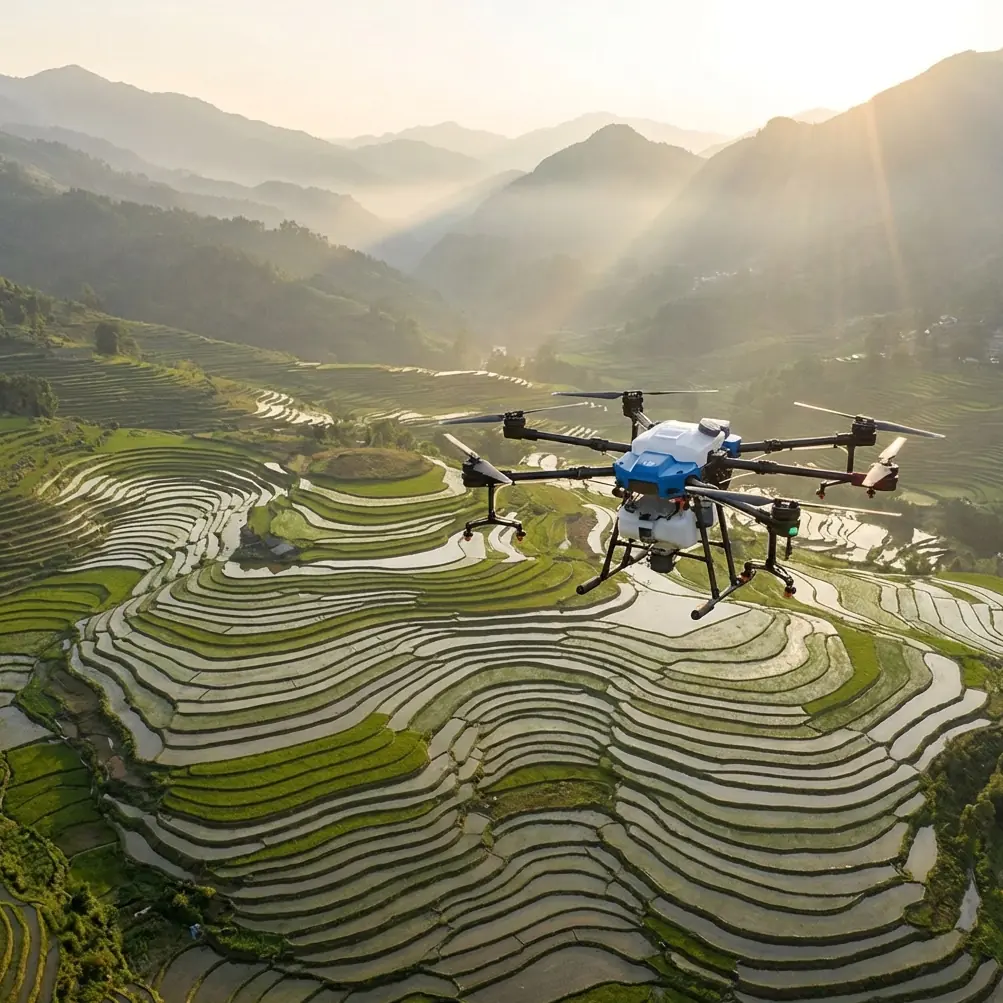
Agras T100 in Steep Vineyards: A Field Report on Precision, Cleaning Discipline, and Why Airspace Trends Matter
META: A field report for mountain vineyard operators exploring how the Agras T100 fits steep terrain work, with practical notes on pre-flight cleaning, RTK precision, spray drift control, nozzle calibration, and broader aerial platform trends.
Mountain vineyards punish sloppy workflow.
Rows bend around slopes. Wind shifts between terraces. Moisture hangs low in the morning and vanishes by midday. A drone that looks excellent on a spec sheet can become frustrating fast if the operator treats it like flat-field equipment. That is why any serious conversation about the Agras T100 for vineyard tracking has to start in the field, not in a showroom.
I’ve spent enough time around hillside blocks to know that success comes from discipline more than hype. The T100 enters that conversation as a platform expected to carry real operational weight: repeatable flight paths, predictable spray behavior, strong positional confidence, and enough environmental resilience to survive long days around dust, mud, chemical residue, and washdowns. For growers managing vines on mountain terrain, those details matter more than glossy claims.
There is also a bigger context developing above the vineyard. One recent industry signal came from Finland, where Kelluu raised €15 million in Series A funding to expand its autonomous airship platform and international operations. That round was led by the NATO Innovation Fund, marking its first investment in Finland. I’m not bringing that up to wander off-topic. I’m bringing it up because it shows where aerial robotics is heading: endurance, autonomy, and platforms designed to fill operational gaps that satellites and conventional drones don’t fully cover. For a vineyard operator evaluating the T100, the significance is practical. The market is moving toward layered aerial systems, not one-size-fits-all machines. A spray drone like the Agras T100 has to justify itself as a precise, task-specific tool within a broader data and operations stack.
And in mountain viticulture, it can.
Why steep vineyards expose weak drone operations
Vineyards on slopes create three problems at once.
First, they distort line-of-sight and terrain-following assumptions. An aircraft can look stable from the launch point while actually working through uneven canopy heights and irregular row spacing. Second, they amplify spray drift risk. Air doesn’t move cleanly on a mountainside. It curls, accelerates through gaps, and changes direction along contour edges. Third, they magnify inconsistency. A minor nozzle imbalance that might go unnoticed in an open field can leave visible treatment variation across terraced vines.
That is where the Agras T100 discussion gets serious. Not “Can it fly?” but “Can it hold a reliable swath width, sustain a high RTK fix rate, and deliver controlled output in a place where every mistake is expensive?”
Mountain vineyards are rarely forgiving. If your route planning lacks centimeter precision, your overlap suffers. If your nozzle calibration is even slightly off, your lower rows can receive a different deposition profile than upper rows under the same mission plan. If your aircraft is dirty before takeoff, safety systems and sensors may be working from compromised inputs before the first pass even begins.
That last point gets ignored too often.
The pre-flight cleaning step that actually protects safety features
Before any vineyard mission, especially after prior spray work, I insist on a cleaning check before batteries, before route confirmation, before payload loading.
Not a cosmetic wipe-down. A deliberate inspection.
Chemical residue, sticky dust, and dried droplets can interfere with what the aircraft “thinks” is happening around it. On a machine used for agricultural work, that matters because protective systems only perform as well as the condition they’re kept in. If the T100 is being used in a mountain environment, where terrain and obstacles are already less predictable, operators should treat cleaning as part of the safety stack.
My preferred sequence is simple:
- Rinse and clear external contamination after each work session.
- Before the next sortie, inspect the spray system around nozzles and lines for residue buildup.
- Check arm joints, landing gear contact points, and sensor windows for film, splatter, or dust.
- Confirm no partially dried chemical deposits are affecting moving parts or visual surfaces.
- Only then proceed to nozzle calibration and mission setup.
The reference hint around IPX6K is relevant here. A platform built with washdown resilience is not just easier to own; it is easier to keep reliable in real farm conditions. For mountain vineyard crews, that means less hesitation around proper cleaning and less temptation to leave residue in place because the machine “still looks usable.” That laziness is expensive. A dirty aircraft can degrade the confidence you place in obstacle awareness, positioning consistency, and spray uniformity.
Operators who skip cleaning often blame terrain for what is actually maintenance error.
RTK fix rate and centimeter precision are not luxury features on slopes
On a flat cereal field, weak positional discipline may hide inside broad tolerances. In vineyards, especially mountain vineyards, it shows up fast.
A strong RTK fix rate matters because row spacing is fixed, vine value is high, and treatment margins are tighter. If the T100 maintains centimeter precision, it gives the operator two immediate advantages. First, route repeatability improves across multiple interventions during the season. That means the same rows can be revisited with confidence rather than with creeping lateral error from one mission to the next. Second, edge control becomes cleaner. Terrace boundaries, end turns, and irregular block shapes are where inefficiency accumulates.
That operational significance is easy to underestimate. A grower may think about precision in abstract terms, but in practice it affects labor planning, refill timing, overlap percentage, and the amount of manual correction needed after automated passes. In vineyards, precision is not a bragging point. It is what separates a usable system from a tiring one.
If I were auditing a T100 deployment in a mountain vineyard, I would want to see more than route screenshots. I’d want logs showing consistent RTK lock behavior in the actual terrain, not in a flat-yard demo. A drone can be technically capable and still underperform if canopy walls, slope geometry, and surrounding topography degrade positioning confidence.
Spray drift management is where real expertise shows
Most operators talk about spray drift as if it begins and ends with wind speed. That is too simplistic for vines on slopes.
Drift in mountain vineyards is influenced by terrain-induced airflow, canopy density, droplet size, flight altitude, direction of travel relative to contour, and the pressure setup behind the nozzles. The T100 becomes valuable only when the operator treats it as a controlled application system rather than a flying tank.
Nozzle calibration is the first line of defense. If output rates are uneven, drift analysis becomes meaningless because you are no longer comparing equal conditions. One side of the pattern may be underdelivering while the other side appears to drift more simply because atomization is inconsistent. Calibration should be done with the exact working liquid characteristics in mind, not as a box-ticking exercise.
Swath width comes next. On steep vineyard blocks, a theoretical swath width can be misleading. The practical swath is what remains uniform after terrain effects, downwash interaction, and canopy interception are accounted for. Experienced crews usually tighten expectations in difficult blocks rather than chase maximum width numbers. That may reduce area-per-hour on paper, but it often improves treatment quality and cuts rework.
Then comes flight direction. In mountain vineyards, alternating route logic may not always be the best answer. Sometimes it is smarter to bias passes based on prevailing slope winds and the way the canopy catches droplets at different times of day. The T100’s role is to execute that plan consistently. The operator’s role is to understand when conditions have changed enough to adjust.
This is where field records matter more than opinions. Log weather, time, block orientation, and outcome. The result is not just better compliance documentation. It is a better spray program.
Tracking vineyards is not only about spraying
Although the Agras T100 sits naturally in the application discussion, vineyard operators tracking crop conditions in mountain terrain should think in layers. The LSI hint around multispectral points to a broader workflow that many advanced growers are adopting: use imaging and spatial data to decide where intervention is warranted, then use a precision application drone to act on it.
That doesn’t mean the T100 needs to be everything. In fact, the Kelluu funding story is a useful reminder of the opposite. Aerial systems are becoming specialized. Kelluu is building autonomous airships that sit between drones and satellites, targeting long-duration coverage and broader operational reach. The company’s €15 million funding round to scale its platform internationally signals that the industry sees value in aircraft designed for persistence and mission-specific roles.
For agriculture, the lesson is straightforward. Don’t ask one platform to solve every aerial problem. Use the right tool for each layer of the job.
A mountain vineyard may rely on one system for multispectral scouting, another for detailed mapping, and the Agras T100 for treatment execution. That division of labor improves decisions. It also prevents overpromising from a single airframe. When growers understand that, procurement gets smarter and deployment becomes more realistic.
The hidden bottleneck: operator habits
I’ve seen excellent aircraft produce mediocre results because the operator brought bad habits from easier environments.
The usual mistakes are predictable:
- Launching too early while valley air is still unstable.
- Trusting default swath assumptions without testing deposition.
- Ignoring slight nozzle wear because the pump “sounds normal.”
- Skipping cleaning after a long day and calling it maintenance tomorrow.
- Assuming RTK precision in one block will transfer to another with different terrain shielding.
The Agras T100 can only reward disciplined operation. It won’t rescue a careless workflow.
For vineyard managers training staff, that means building standard operating procedures around the realities of slope farming. Include pre-flight cleaning. Include a calibration routine. Include terrain-specific route validation. Include weather thresholds that reflect drift risk on your blocks, not generic charts from flat farmland.
If you are building that SOP and want a second set of eyes from someone used to mountain-vineyard workflows, this is a practical line to use: message a vineyard drone specialist.
Where the T100 fits in the next phase of vineyard aviation
The aerial sector is getting more segmented, more autonomous, and more data-driven. Kelluu’s expansion push makes that clear. When investors commit €15 million to an autonomous airship company expanding internationally, they are betting that persistent aerial infrastructure will become part of normal industrial operations. Even though that funding story sits outside vineyard spraying, it still matters to T100 buyers because it reflects an industry-wide shift toward platform specialization and system integration.
For mountain vineyards, that means the Agras T100 should be judged on the jobs it is uniquely positioned to do well:
- repeatable treatment along difficult rows,
- controlled application in terrain that punishes drift,
- reliable operation under washdown-heavy farm conditions,
- and integration into a broader precision agriculture workflow.
That is the real standard. Not novelty. Utility.
If I were summarizing the T100’s value for a steep vineyard manager in one sentence, it would be this: the aircraft earns its place when it turns complex terrain into repeatable, documented, high-confidence fieldwork.
That outcome depends on the machine, yes. But it also depends on the habits around it. Clean before flight, not just after. Verify nozzle calibration instead of assuming it. Watch RTK behavior in the actual block. Treat swath width as a field-tested number, not a brochure number. Pair application with scouting data where possible. Build around the terrain you actually farm.
Mountain vineyards make every weakness visible. They also make good systems look very good.
Ready for your own Agras T100? Contact our team for expert consultation.